Roleplaying Games

I'm sitting at home, having just returned from the regular gaming meetup in Bielefeld. While I did pack but not play Dusk City Outlaws, I did get to play two other games: The Skeletons by Jason Morningstar and Thorny Games' Dialect.

Both games are very much focused on story and emotions, less about high adventures, so this meetup has again been very much thematic for me. (There was a DSA 4.1 game that I was invited to, but, let's say, even though I like the GM a lot, this isn't my cup of tea.)

So, what are these things about?

The Skeletons has the players all gather as undead guardians of a hidden tomb. The game asks them to map out the tomb together, to come up with the little details that give it a history.

And then watches on, as there are repeated incursions into the sacred stillness. Grave robbers, adventurers, monsters and others seek out the tomb, and the skeletons have to deal with them, rediscovering their own identities and memories while doing so.

A very fun game, but we sadly did not unlock it's full potential. One reason was that the game got constantly interrupted, so we couldn't really establish a flow. None of the interruptions were malicious (we got cake, new arrivals at the meetup wanted to say hi, and of course everything got paused when the infant kid of one of the players got carried in with a very nasty bruise on the forehead.), but a game that tries very much to evoke a feeling of loneliness and time passing suffers greatly from that.

The other was a result of this being our first time to play this game: The tomb we made was small. Basically one big room with just one corridor entering it. That way the skeletal guardians confronted each and every incursion in basically just one short encounter, not allowing for a lot of roleplay in those moments.

On top of that, I realized the actual point one probably should drive at only after the game ended, so the players felt a lack of agency. Discovering and making use of ones own personality should be much more important.

Still, I recommend this game a lot.

Dialect is a meta-game, similar to Microscope, but instead of a deep history, this game has you develop a language. It comes in a rather thick hardcover, gorgeously illustrated and also hands you a bunch of cards with prompts. All of this enables you to form a tightly knitted group that has somehow isolated themselves from the rest of society – and thus forms their own language.

We had a merry band of gentleman thieves in early 19th century Hamburg that surely but slowly moved towards their downfall. In that time we invented slang that defines our marks, our celebrations and our hierarchy and actions. We saw how words slowly took on different, meaner definitions, as we moved from high stake cons to simply robbing and murdering people.

The phrase “before the cellar”, which we used to have as a code to reference our lofty gentlemanly standards became a curseword and then evolved into “to cellar someone”, a euphemism for plain murder. In the end, the cellar was all we had, and when our fearless leader walked up to the hangmans noose, her last words were “no one sings in the cellar”, refusing to give up her partners in crime.

A great game, one that I cannot wait to play again.


Für deutschsprachigen Rollo-Content gehe zu https://write.orkpiraten.de/rollenspiele/
Harald runs his bi-weekly game in a slightly unusual fashion. It is an open table where he runs for whoever shows up. That in itself isn't that unusual and the West Marshes style of running a campaign is based on a similar foundation.

The difference is that he treats the constant exchange of players and characters as a single continuous group. That means that if last week Clara, River and Amy break into the Holy Temple of Om, and this week Clara, Rose and Jack turn up at the game, the game starts with all three having just broken into the temple and are now facing the Dire Weresheep Guards.

“But what about River and Amy?” you ask. “And where did Rose and Jack suddenly turn up from?”

And to this, Haralds game group will answer: “What? uh.. we don't care!”

The solution is that we treat this as just a cutting mistake in a B-Movie. As long as the plot continues and is overall kept intact, we're fine. So, we ended last week entering the temple and this week starts with the first confrontation inside the temple. Everything is fine. As long as no one draws attention to the fact that there are suddenly swapped-out characters, no one really notices.

The other main reason this works is what kind of game we play at this table: There is no prepared epic campaign where we follow a carefully crafted set of settings and obstacles. Instead, Harald throws us into any one of the dozens of adventure modules he has collected over time and watches our characters try to cope with them, even if they are widely out of our level.

Then he takes whatever exit we take and uses it to throw us right into the next adventure. Example: When we decided to open a portal to escape the Servants of the Cinder Queen, that portal opened to the Broodmother Skyfortress. After having explored the fortress and finally managed to make it sort-of-land, we had to blindly jump from the anchor chain found ourselves on top of a structure on the Misty Isles of the Elk.

At the game table, none of this felt out of place. Harald cleverly chose the Cthonic Codex and a very rules-light interpretation of the Adventure Fantasy Game as the base setting, and it works surprisingly well as scaffolding to hold up and connect all the different and slightly weird set-pieces we visit. Things do not get boring, but stay mostly consistent, as Harald does keep track of when we change things in places or set something in motion that might have a world-changing effect later on.

No, this isn't something to play if you want to watch your character with their three friends evolve over 20 levels and find out how they save the kingdom. But if you want to have regular fun that still connects to a story worth re-telling, this approach is worth a try.


Für deutschsprachigen Rollo-Content gehe zu https://write.orkpiraten.de/rollenspiele/
I spent the last weekend at a semi-regular gaming meetup. The beauty of this thing is that while it does host more than a few dozen people, but all of them are invited known persons. Friends and family one could say.

Blechpirat and me usually use this gathering to playtest the more different games we find. This time, the candidates were Ten Candles and Bluebeard's Bride. (And then there was a Dresden Files game that was full of vengeful pirate ghosts, so the horror theme was thoroughly observed :) )

Both, Ten Candles and Bluebeard's Bride are games where the characters can't really win. Even more so than a Cthulhu game, where the PCs usually are at least able to avert the apocalypse for now. Both of these games will end badly, period.

Ten Candles says so very clear on the tin: When the last of the ten candles on the table is extinguished, all characters will die, no way out of it. This is a game that tries to tell a story of hope and light in the face of utter darkness and hopelessness. And it does so quite well, at least most of the time. The player characters are stranded in a sea of darkness, clinging to the light that promises survival.

The titular ten candles are actually lit on the game table. One by one they will get extinguished whenever the players fail on a dice roll. If that happens, the current scene is ended and the narrator cuts to the next one, made bleaker and less hopeful by that failed roll. But the players get to narrate facts for the next scene, one for each candle still burning. These facts can be positive, but they don't have to...

Apart from the gimmick with the actual candles on the table, the game offers a really interesting mechanic: During character creation, you create a small stack of traits and moments. Each of these is written on a small piece of paper, and these are then actually stacked on top of each other.

Literally burning one of these will give you a small bonus, but you can only burn the one that is right on top of the stack. So the order you stack these becomes important during gameplay.

Pro-tip: If you prep for the game, hand out papers that include the prompts and the mechanic that kicks in when burning. It's something that is easily forgotten or confused during gameplay and having it right there will surely help.

The other thing to realise, especially for the person running the game, is that at some point, most tests the players roll will fail. And failing a test will not only progress the game by ending the scene, but also make the next one even harder. So choose the moments for these tests wisely, otherwise your game will speed up towards the end on autopilot during the last four candles or so.

But those are miner nitpicks: If you like to buy in to the “everyone will die” premise, Ten Candles is a very fine and quite atmospheric game. And even scenes that got cut short within the first 20 seconds managed to convey a good sense of bleak dread and despair, precisely by being cut off before any real hope can surface. One example of our session was when the drifting yacht briefly bumped onto the pylon of an oil rig, only to drift away into the darkness right away...

Bluebeard's Bride is quite another kind of horror. It is more personal, even intimate. Instead of several people, the players each pick one aspect of the Brides personality. During character creation they establish how the Bride thinks and feels and the narrator (called Groundskeeper by the game) is encouraged to mine these things, to use them against the Bride.

It is described as “feminine horror”, and it does indeed focus heavily on themes that are stereotypically feminine: How to cope with societies body standards, views on sexuality or body autonomy. Yes, these are sexist themes, but the point is to come to grips with that sexism, to see unfairness of it escalate into horror.

As Ten Candles, this is also a game where most of the story and challenges have to be created ad hoc during gameplay. And as the aim is to tailor these parts to the players, to address the things that make them shiver, I find it even more challenging with Bluebeard's Bride to do so. It helps if one has a collection of set pieces at hand and the rulebook gives you plenty of examples and prompts.

Personally, I found it surprisingly hard to populate Bluebeard's mansion with NPCs. The rooms were easy, but adding people into that creepy room, people that add to it instead of taking attention away was.. difficult. In the end, there was about a handful of them scattered through the house. As a result, the players didn't get to make some of the moves, simply because there were less people to interact with.

Still, the game gives excellent prompts to add horror to basically any aspect of the setting and I got to see the players shiver a lot.


Für deutschsprachigen Rollo-Content gehe zu https://write.orkpiraten.de/rollenspiele/
This weekend, I invited a few friends to playtest Tales from the Loop with me. I already had a first exposure to the game during the annual new years gaming bash at Spielefeld, but that was with the Alpha version, and as a player. This time I was the referee, which always is wholly different experience.

Despite having set the date two weeks in advance, I actually did only minimal preparation: One skim-read of the whole rulebook, one reading of the Mystery and..

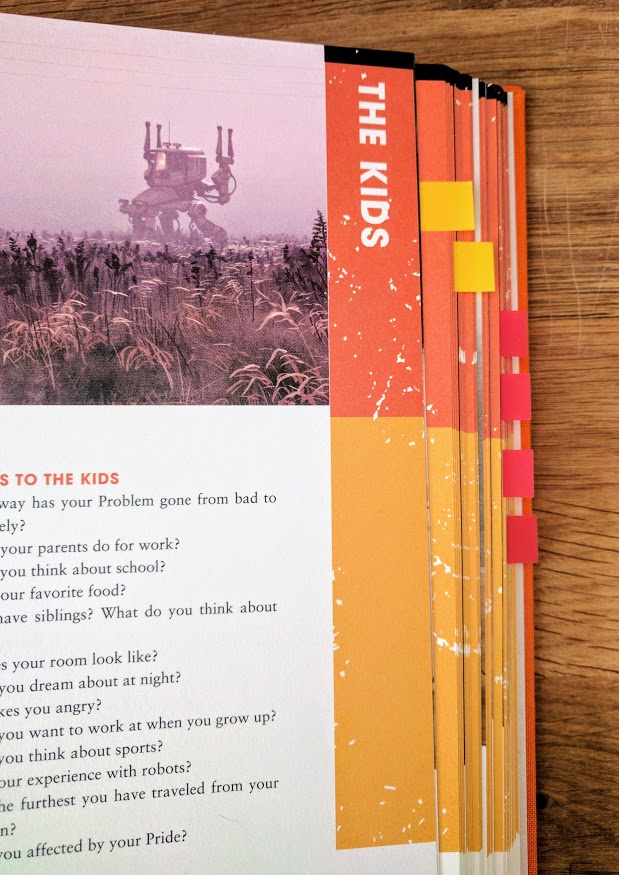
..yes, that was it in the end. The only extra mile I went was adding small post-it bookmarks to the rulebook, so I could quickly find relevant sections during play.

(Really, I cannot recommend these things enough. Colour-coding is quite enough, no need to name them. In this case, yellow is rules and red is the Mystery. And that is really one of my main gripes with the Rulebook: The really awesome pictures are too scattered, and not easy to find when you want to show something to the players. Guess I'll need another set of bookmarks for that.)

What really hooked me as a Gamemaster were the tenets of the game. First there are three that set the tone of the setting:

  • Your home town is full of strange and fantastic things
  • Everyday life is dull and unforgiving
  • Adults are out of reach and out of touch

Keeping to these tenets ensures that the Mystery will feel exciting, will give the Kids a reason to investigate and get into danger. After all, adults are no help, and everything is better than this boring everyday life.

And then, this is how you should play the game:

  • The land of the Loop is dangerous, but kids will not die
  • The game is played scene by scene
  • The world is described collaboratively

This lets the players know what is expected of them, how things will flow, and what kind of risks they can take.

Most of the players immediately got into the rules of the kids, enjoying the hot summer in sweden. They swam in the sea, agonized over the harsh decisions made by their parents (“take your little brother with you!”) and generally had fun.

(By the way: It does help if your players are old enough to remember the 80ies. One of mine isn't, and occasionally had to be reminded on what already existed and what didn't.)

The Mystery itself was taken directly from the Rulebook, “Summer Break and Killer Birds”, and it went, as far as I am concerned really well. It seems quite linear at first glance, but it actually is akin to a sandbox: There are a few locations and NPCs, as well as a countdown of events that will happen if the kids don't intervene. The NPCs and locations contain pointers to one or more others. If the kids follow these pointers they will invariably end up at the showdown, but it doesn't feel scripted, and there are many different possible paths and support for a lot of freewheeling in between.

My other gripe with the rules is the Showdown / Extended Trouble concept. It is very similar to the Wrap-Up in Leverage, but Tales from the Loop isn't as meta as Leverage, so it the Extended Trouble sticks out a bit mechanically. The general idea is that the Gamemaster sets a threat level and then all the kids have to roll a skill check – if the total number of sixes is equal to or higher than that threat level, they win. What exactly they roll for is determined by the narration, and then the die rolls tell you how exactly they won (or lost).

It works, but you move a bit out of the viewpoint of the kids doing it, which is a shame. Still, it does work, and the resulting showdown felt rewarding enough. As rewarding as the other half of the ending was frustrating to them: In the end believed the kids anything, and instead of being lauded as heroes, they had to evade a severe scolding by several policemen!

I'm looking forward to the next session (“Grown-up Attraction”) and already have made some notes on what to improve:

  • Tales from the Loop benefits from aggresive scene framing by the gamemaster. You really want to make sure that the players don't overthink things, and also have them experience the dull everyday life as a contrast occasionally.
  • Having sample pictures bookmarked. Often enough you want to show off some scenery or vehicles, and having to browse through the book for that disrupts the flow
  • more background 80ies music!
  • I should also encourage the kids to take care of their conditions. That'll slow them down a bit, instead of rushing from location to location. It also gives them a reason to play through their relationships and interact with adults.

Für deutschsprachigen Rollo-Content gehe zu https://write.orkpiraten.de/rollenspiele/

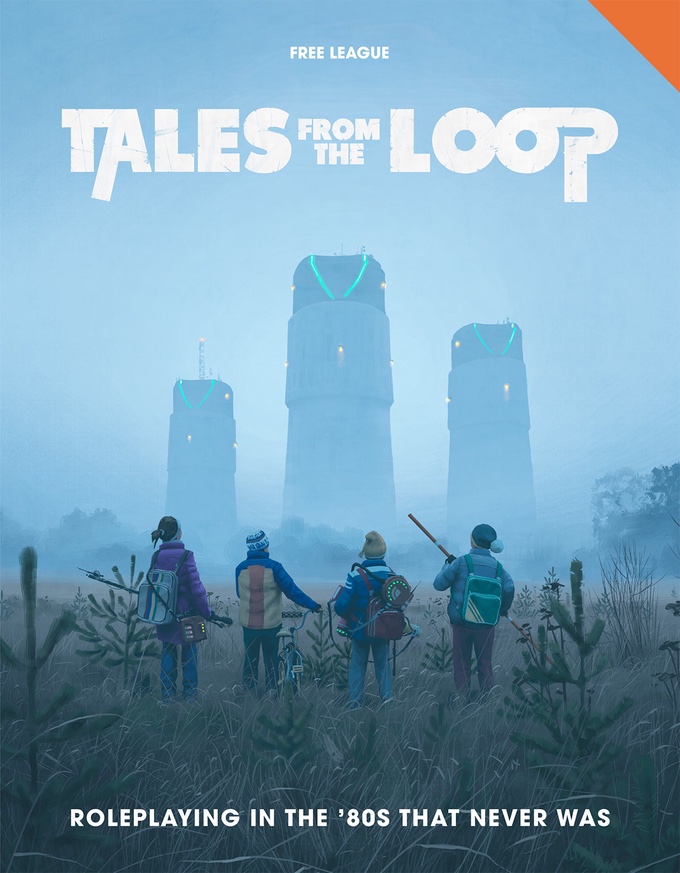
For all of you who live under rocks: Tales from the Loop is a roleplaying game based on the retro-scifi artwork by swedish painter Simon Stålenhag.

The world portrayed are the 80ies we saw when we watched E.T. or, more recently, Stranger Things. As a result, you will be playing teenagers, or rather: Kids, somewhere between 10 and 15 years old.

We got our picks from easily relateable archetypes: The Computer Geek, the Rocker, the Popular Kid, the Hick and of course the Jock. They don't get any custom skills like you might expect from games that are Powered by the Apocalypse but instead have slightly different sets of background notes and relationships.

The fun part is that the rules really drive home the idea that you're playing kids. For starters, there are no combat rules at all, a fact that I actually only realized when the game was over and someone else mentioned it. Rather consequently, the kids can't die either. Damage is caused by pushing ones limit and handled with an abstract set of conditions that are mechanically shed whenever you take a moment of timeout in a safe space.

As a result, you really get thrown into the kids mindset, even though some of the skills seem to be too broad or too narrow in name and definition, with a confusing overlap at some points. But that is not too bad – unlike the pool system: Nothing is more frustrating than throwing buckets of D6 and not getting a single success (which only sixes count as those).

Anyway: We opted for slightly older kids in the 13 to 14 year old range and had a blast. The kids spied on a scientist, camped on an island, played spin-the-bottle, nearly got torpedoed by a submarine and finally had to tell the truth to adults (which was a believably scary thing!)

If you know the teenager books like The Famous Five, TKKG and similar fare, you'll feel right at home.


Für deutschsprachigen Rollo-Content gehe zu https://write.orkpiraten.de/rollenspiele/

One of the nicest and also to me most intriguing RPG publishers I know these days is Paolo Greco with his Lost Pages. His stuff is whimsy, well made and often bafflingly strange. Where Lamentations of the Flame Princess stuff is heavy-metal gore weird, the Cthonic Codex for example is... odd. Paranoia meets Academentia is a nice explanation for it.

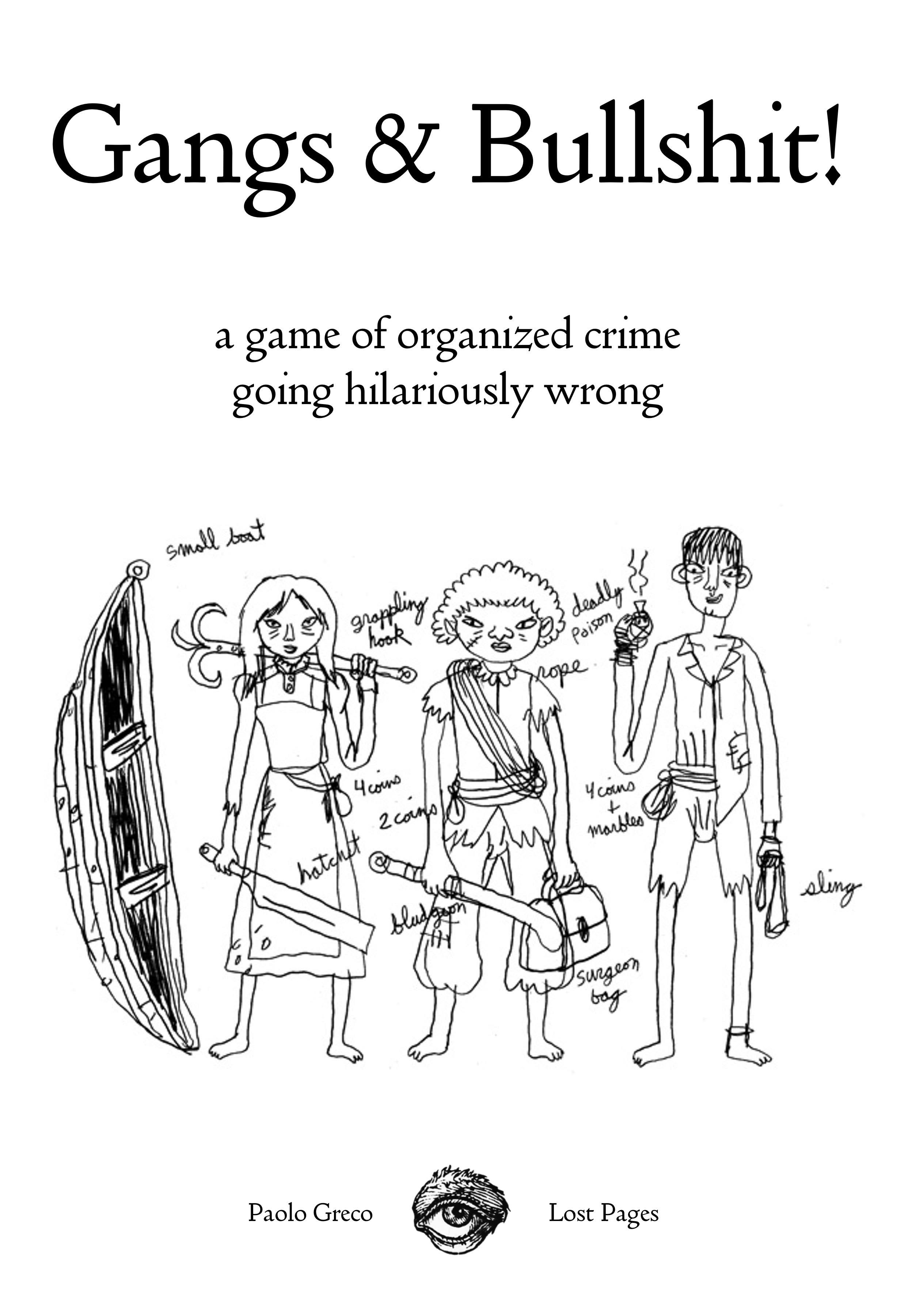
Gangs & Bullshit is the baby he's carrying now for a while. It is not really a roleplaying game, nor is it a boardgame, and it isn't “ready” yet by far. The closest explanation is campaign sandbox with boardgame elements. You do have characters, and you can create them with your favourite (fantasy) game system. But there will also be turns and lengthy meta-discussions where the players plan which single (big) action their characters do each week.

But what is it about, you ask me. Well, the closest literary example would be “The Lies of Locke Lamarra” – the players have a gang that tries to make money in a city where other gangs do the same. To quote:

Bullshit is screams in the night. Bullshit is a botched job. Bullshit is a corpse found by the city guard. Bullshit is something embarrassing coming known to your enemies. Bullshit happens.

The mechanics are mostly improvisation, some random rumour and encounter roles and helping hints on how to determine what other gangs and opponents are doing.

Personally, I think this game is a blast: The Broken Benches sat in their hideout (a leaky loft) and heard that this other gang wants you to buy several boxes of their cookies. Of course, this couldn't stand, and shortly afterwards, a bunch of girl scouts got what they had coming...

Surprisingly, this is a game that is equally suitable for the planners as well as for those who just barge into a situation to find out what'll happen next. A good deal of time can be spent studying the city map and planning where to break in, where to set up diversions and how to handle the minotaur-dung cart. But as you do have the backup of the RPG system of your choice, you can jump into the action at any time and see how things actually turn out.

Keep your eyes peeled, and get it as soon as it is available!


Für deutschsprachigen Rollo-Content gehe zu https://write.orkpiraten.de/rollenspiele/

A few days back, this thing made the rounds: Games sure are classy. In case you missed it, here's the summary: Someone was selling a game module on DriveThruRPG that was named “Tournament of Rapists”. Someone else got upset about this and complained to DriveThruRPG, who... showed a remarkable inability when it comes to a) understanding the issue and b) how to handle this sort of complaint.

They got a lot of flak for this, so, after the weekend, they went into full defence mode:

Their new policy states: ”If a reported title looks questionable, then we will suspend it from sale while we review its content internally, and we will speak with its publisher to determine the fate of the title on our marketplace. Our default will be to suspend titles rather than our prior default of letting titles stay public.”

They also state “We are no longer a wide-open marketplace.”

Which then made James Raggi from Lamentations of the Flame Princess fear for his income. Understandably so, as his products are quite controversial in some circles. I mean, they include walking penis demons and violence and sexual imagery. So he decided to go on a forward defence and used DriveThruRPGs messaging system (the only way to reach his customers there IIRC), to tell those who bought his stuff there how to not get screwed in the case of a pulled product.

Which in turn got someone elses panties in a bunch.

My take on this

First off: Bards and Sages Publishing is right on one thing: Pulling the Tournament of Rapists was, at that point in time, a sane thing to do for DriveThruRPG, and the wording of their policy indeed is more liberal than, say, Amazons. But the difference is that Amazon has a team that is comparatively well-schooled and professional when it comes to reacting to internet shitstorms.

DriveThruRPG has just shown that it completely fails in that regard. They completely missed the point of the initial complaint, they then tried to sorta-defend the thing, they didn't go out and explained their points in a way that the wider audience will get that message, and then hastily set up a new policy without soothing the legitimate fears of the merchants.

And that is why James Raggi is probably right with his decision to set up precautions.


Für deutschsprachigen Rollo-Content gehe zu https://write.orkpiraten.de/rollenspiele/

As there weren't enough players for Haralds planned bi-weekly Labyrinth Lord game, he decided to run ViewScream instead. ViewScream, which is just now running the Kickstarter for the 2nd Edition, is a game that is explicitly designed to be played via videochat.

Rafael Chandler is surely no “Indie Author” anymore, although his RPG products probably get lumped into that category. But he is a brilliant horror game designer if you ask me – and ViewScream, which plays on the isolation and despair of people sitting alone somewhere, reaching out to their colleagues for help, is an even more brilliant idea. The general mechanic is this: Everyone is alone, connected to the others via videochat. And everyone has at least one, maybe even more dire Emergency at hand, that is threatening their lives, and that they cannot solve by themselves. Your only hope for rescue? Someone else has to use up one of their Solutions (basically one or two sentences of technobabble that the game providesto you) and apply that to your problem.

In our game, each of us had three Solutions and two Emergencies – the kicker being, that not all of those solutions would actually work! None of your fellow players know how many Solutions you actually have, nor which of those will be successful: There are small indicators next to every Solution, telling you if they would work or not. So you pick a solution, narrate how you'd apply them, and then, more often than not, let the other players know that, alas, they weren't working for some reason or the other... or that they were saved, because the solution did work. But the game is actually rigged in a way, that there usually are more Emergencies than workable Solutions. Enter the haggling, backstabbing, pleading and outright begging!

Yesterday, Harald threw us into some cyberpunk world, where we were just returning from what was supposed to be an easy-in, easy-out hack into some virtual world. Except it went horribly wrong, we probably had a traitor in our midst, the enforcers were on our asses, our equipment sprouted the most disturbing bugs and the clock was ticking...

About halfway through the game (which took about an hour), I realized that my character wouldn't make it. So I let the virtual ghost that was riding my system take over and scare the bejeebus out of my fellow players, who were so eager to sacrifice me for their own sakes...

(The girlfriend was reading in the room next to me and later stated that she was on the verge of calling an excorcist to get those demons out of me.)

In the end, this was the most fun I ever had in a Hangout RPG session. The game provides custom overlays that enhance the mood, and the game mechanics are as close to freeform as you can get – while still providing enough structure and crunch to make things interesting on that angle.

The different characters are described in a gender-neutral and just vague enough way that basically everyone can fill those roles. But they are also provided with hooks and connections to each other to keep the game running and interesting. ViewScream encourages you to never leave character during gameplay, and as you never need to grab some dice or do anything that isn't covered by the narrative, things feel very natural.

The first edition (with slightly clunkier rules) is free on DriveThruRPG, and the 2nd Edition is 10 bucks well spent on Kickstarter. If you are even remotely interested in playing a Horror game or in playing over videochat, you want to try this out!


Für deutschsprachigen Rollo-Content gehe zu https://write.orkpiraten.de/rollenspiele/