Orkpiraten

Thinking and Playing and Testing

I've been on a small bender on this, and this is what I learned, in short. Reading my summaries could spare you the time of reading the actual books, but I don't recommend it – they are chock-full of useful language and terms to describe situations, which will help you apply the lessons better.

The Art of Action: How Leaders Close the Gaps between Plans, Actions and Results

This is the book about how you best communicate goals and plans to a team, so they can start working on them without being micromanaged. The trick: Explain the Why, then When, and the What (problem), not the How nor the What (solution), then have them repeat these things back to you in their own words to check for understanding and completeness (you might have forgotten something).

Getting Naked: A Business Fable About Shedding The Three Fears That Sabotage Client Loyalty

You want your clients trust. In order for that to happen, you need to be honest with them, especially when it comes to your own shortcomings. Let your successful work stand on its own. Don't grandstand, don't pretend your better than them, but don't be shy to be firm on the things you know to be right.

Radical Candour

Feedback is important, especially negative feedback. It needs to be on time, absolutely honest, and to come from a position of kind caring. If you give feedback in order to belittle, demean or because you're on a power trip, you're an asshole. But you're also an asshole if you don't give any negative feedback when you see flaws, because then no one can get better.

Reinventing Organizations: A Guide to Creating Organizations Inspired by the Next Stage in Human Consciousness

This is a slightly esoteric book. Read on despite the woo, it gets rewarding. Organisations work better when you let them live like an organism, with purpose and innate reactions instead of programmed machine-like behaviors. When you truly empower people to take ownership of their work, they'll do better. That means everyone basically manages themselves.

Strong Product People: A Complete Guide to Developing Great Product Managers

I don't agree with a lot of the actual people managing advice. It is well-meaning, but putting it into action would throw diverse people of all kinds under the bus, as a lot of the advice subconsciously encourages group-think and only hiring people that are like everyone else in the team.

But the idea of defining your good, meaning “figure out what a good person for $Position really needs to be able to do”, and then coming up with a metric on how to measure this ominous “good” is brilliant management advice, as it allows you to give useful and meaningful and above all, actionable feedback.

The Mom Test: How to talk to customers & learn if your business is a good idea when everyone is lying

Don't ask leading questions. Don't ask questions where any desire to please you could colour the answer. Ask open questions that give you useful insights regardless of the answer given.

The Lean Startup: How Today's Entrepreneurs Use Continuous Innovation to Create Radically Successful Businesses

hah, gotcha: I haven't actually read this yet. Come back later! :)


I also write about roleplaying games in english und auf Deutsch!

If you work in product management, you should make yourself familiar with the Kano model.

Noriaki Kano, a Japanese researcher and consultant, published a paper in 1984 with a set of ideas and techniques that help us determine our customers’ (and prospects’) satisfaction with product features.

The resulting categories have been translated into English using various names (delighters/exciters, satisfiers, dissatisfiers, etc.), but all refer to the original articles written by Kano. You can read up more at https://foldingburritos.com/kano-model/

Using the understanding from this model, product persons classify features of a product as follows:

  • Basic/Threshold
    These are features that are indispensible. If they were not present, anyone using this feature would be immediately dissatisfied. Think of a hotel room that is lacking a bed. These are the “must-have” features.

  • Performance
    Sometimes a feature or capability exceeds expectations. Some basic functionality turns out to be very fast or intuitive, or looks very pleasant. These are Basic/Threshold features that come with improvements. A real-world example would be an extra-comfy bed in the hotel room, or that one discovers more power outlets than expected.

  • Excitements
    Features that are completely unexpected, things that one wouldn't normally associate with a given product or service are Excitements. Users would not think of asking for them when a product is described, but when they find them, they are delighted about it. Usually, this is a novelty factor (“I would not have expected a cold brew coffeemaker in this hotel room, but I like it!”), and they will not always be the deciding argument for a purchase. But they are noteworthy and will ensure that the product or service is remembered well.

I've found this model quite useful when it comes to prioritizing tasks, or to figure out whether a product is “ready to ship”.

What makes teams tick?

For the past few months, I've been on a bender reading various books on how to best run a team or a company, how to be best manage people, or how to generally think about work. The current item in that stack of books is “Reinventing Organizations”, by Frédéric Laloux. I'll not go into the details and my criticism of the book right now, but one thing that tickled me was the story of how a brass foundry stated that part of their purpose was to be be loved by their customers.

As a result, workers take delight in hand crafting little presents to put into the crates when shipping an order of gearbox parts.

And that brings me back to the Kano model, and that I think we should add one quality: Is it satisfying or exciting to make this Feature?

We see a lot of work in the FLOSS sector embodying this quality. Something gets made because the people working on it found it exciting. Either because they wanted to have the resulting functionality, or because building it is an interesting challenge, or because they could already envision the reaction of the users when they'll find the hidden easter egg.

Trying to find out what features have this “exciting to make” quality can be a tremendous boon for product people, and I will surely add this to my toolbox! Partly because you can now select for maximum team satisfaction, but also because you can recognise rabbit holes and nerdsniping before it happens and let the team know that a certain functionality might be cool to build, but isn't helping in any of the other Kano qualities.


I also write about roleplaying games in english und auf Deutsch!

I'm working with computers and humans for long time. That has shaped a lot of my opinions and habits. In order to get the best experience of working with me, here's a handy manual:

Working hours

I'm neither a classical night owl, nor an early bird. That means that I keep pretty normal hours. I also do believe in a healthy work-life balance, so I do my very best to stick to the normal weekly working hours. As a result, you can depend on me being around at 9:00 AM and should not schedule any substantial meeting later than starting 5:00 PM in the evening, as I'll be aiming to clock out at 6:00 PM.

You will probably still occasionally find me going through email or chat notifications in the middle of the night or the weekend, but please do not count on this (unless there are pre-agreed circumstances and emergency protocols).

Knowledge and skills

Most people have one area of expertise where they have incredibly deep knowledge. My depth is width.

That means that I know more than the average layperson about nearly any given topic I come across professionally, but I am also aware that there are most likely a lot of people out there who know much more about it than me. If you have a problem outside of your area of expertise, chances are that I know at the very least the most useful search term or person that helps you with the next step.

My depth is width. Make use of that.

Managing and Delegating

Knowing that there are more senior experts on most topics in the organisation leads me to be pretty hands-off when it comes to the How and What (Solution) you are doing when I am managing you.

I tend to mostly think and communicate about the Why, When, and What (Problem), because it is my belief that these are the things you will need most to do your best. Answering the Why, When & What (Problem) questions give you all the ressources and constraints you need to define your problem space and find the best approach. Me, as a Product Person telling you as a Designer How to draw a picture would be pretty silly. And I won't tell an engineer which kind of motor best serves the stated purpose.

If you manage me, I expect you to do me the same courtesy.

When I delegate a task, I will always strive to include a proper definition of done, a timeline, and a useful set of constraints. (See my writing about Nerdsniping)

Communication

I try to put an emphasis on asynchronous communication. That means that you will receive a lot more chat messages, tickets and comments, emails, and text messages than live phone calls or desk visits from me.

Asynchronous etiquette

With those, I stick to the “No Hello” rule, getting to the point as quickly as possible in a fire-and-forget way. My expectation there is that even though you haven't acknowledged receiving the communication immediately, you will still get it and give me a useful feedback as soon as possible and convenient.

As I'll do the same in return when you send me such messages, here are some examples of what you can expect as answer:

  • a simple emoji indicating yes, no, on it, love the idea or similar. It should be pretty readable in context and also indicates that I'm probably in some situation where I cannot write anything more.

  • a direct answer to your query

  • a follow-up question

  • a request to send me the inquiry over a certain more documented channel (for example as a ticket or an email)

  • a deadline as to when I will actually get you the answer or complete the task.

Reaction times

If there is no deadline mentioned in the initial request, I will assume it is not urgent. If I didn't mention one in a request by me, it is certainly not urgent.

Notification etiquette

I manage my notification settings in a way that reflects my availability and mental state. If I need to concentrate, most things that could go beep at me will be switched off. That means that your chat message might sit unnoticed for quite a while.

Or it might got noticed, but paused with a “remind me in 20 minutes” marker, or similar. I have set up numerous filters that surface things that could be urgent, or silence things that have no impact on my current work.

It is my expectation, that everyone does something similar, which sets my own expectations of reaction time. For more on that, read my text on Spam everyone and use your filters!

Emails

We will probably exchange a lot of emails. My aim will always be to

  • meaningfully populate the “to” and “cc” fields. If you find yourself in the “cc” field, I only want you to know about the content of the email, but have no expection that you act in any way on the email.

  • set meaningful subject lines. I will change the subject line, if the email conversation drifts to a different topic. I will split up a single email into different new subjects replies, if there are several conversations at the same time.

  • answer within 24 hours of receiving the email, at the very least in order to acknowledge receipt and tell you when I'll get around to actually answering any questions inside.

Synchronous etiquette

I will do my very best to never call you out of the blue. At the very least, you will get an asynchronous message asking if you have a specified amount of time to talk about topic X. That ensures two things:

  • you actually have the time and do not have to sacrifice context switching effort at the wrong moment

  • you have a topic at hand to ease any potential anxiety and to judge whether the time you have and the time needed for the topic match.

There are of course exceptions and emergency situations where we simply have to talk to each other right now, but those should be the exceptions.

Also, this does obviously not apply to watercooler talk in the company kitchen :).

Meetings

Meetings where a group of people discuss a problem or topic should always be scheduled at least 24 hours in advance. They have an agenda that states the purpose and shape of expected outcome. (“we need to decide on a roadmap. After this meeting, we should have one”)

My instinct is always to keep the number of participants as low as possible. This is to keep the meetings productive, and to not waste anyones time. Please do not feel slighted for not being included. If you feel I erred, let me know why you want to join. If in any way possible, I will add you regardless of the reason you give me. The reason is just there to ensure you're properly included and have a voice. At the end, everyone in the meeting should have had an equal amount of time to speak.

Meetings facilitated by me won't overrun their booked timeslots and will usually have time for a biobreak after at most 45 minutes.

Tools

I love tools and will always be curious to try out new ones. That can became a source of procrastination, but overall, the gains outweigh the costs so far.

Mainly, I stick to text-based things. Markdown editors, email, chats. Tools that help me manage notifications and set filters are always the first things I check out and set up. Things that automate tasks are high on my list too.

I love talking about my findings and help you set things on your end, if my time allows.

Darmokra and memes

I'm a huge nerd. My hobbies include 3D printing, pen and paper roleplaying games (reading, playing & writing them), shooting foam darts at people who pretend they're zombies, and other stuff.

That also means that I will very often insert memes and pop culture references into conversations. You can rely on me adjusting the amount to the audience (it might even reach 0), but the preferred mode is OVER 9000!

Doge with pixellated sunglasses. Caption reads "DEAL WITH IT"


I also write about roleplaying games in english und auf Deutsch!

A part of my job is asking people things along the lines of “can you look up if XYZ is feasible” or “what would you need to do XYZ” or “can you make me a proposal about this?”.

And there are always two things I give them along with the task:

  • how much time I expect them to spend on it at most

  • the level of detail I want for the answer

This is not to set pressure on them, but to take it away: With this information, they will have a better understanding on when the task is done, how much effort they can put into it. Asking things this way is a part of the SMART set of goal criteria. In case this term is new to you, here's the breakdown of this acronym:

  • Specific

  • Measurable

  • Achievable

  • Relevant

  • Time-bound

SMART is a mindset that helps specify goals and tasks in a way that ensures they have a decent chance of being met with success. And it allows the persons you give this task or goal to measure themselves against that yardstick, so they don't start second guessing themselves. This lowers anxiety, is compatible with Auftragstaktik-style of management (which I highly recommend) and also ensures that your engineers aren't nerdsniped.

That last thing is a real danger if your engineers are any of the following: Competent, inquisitive, enthusiastic, intelligent, willing-to-learn, new to the field, experienced...

This approach is especially important if you work remotely: You want to trust your team to work without close supervision (which is a bad idea anyway if you have any kind of knowledge workers). And if you're working remotely, you're missing a lot of small cues that you could pick up in an office: Are they nervous? Are they burying themselves in research, as evident by the books and open browser tabs? Is that topic you've given out as a backburner research task eating up all their mental cycles, because it is all they talk about when fetching coffee?

The micromanaging approach would be to check in with them often, ask about progress, and so on. Which not only increases anxiety, but also keeps them distracted from the actual work. (And probably pisses them off too – I've threatened to quit over micromanaging more than once, with the full intent of following through if it didn't stop. Thankfully, I had enough standing for that to be effective.)

Instead you need to preempt the nerdsniping and anxiety and communicate clearly what is expected, what is out of bounds, and the time you expect them to spend on the task – as opposed to the deadline where you need the result.

So when I ask someone to research a topic, I say things like this:

I need this in a week, but you really shouldn't spend more than 4 hours on it, spending more effort on this would not be helpful. If you cannot provide a thorough answer after that time, that is an answer in itself for me!

If you add this task as part of the normal duties, and not on top of them, you take out most, if not all anxiety, you make the result a reliable measure, ensure that the other tasks won't take a hit, and give the engineer an understanding of what they are looking into.


I also write about roleplaying games in english und auf Deutsch!

For over two years now, polypoly is working as a remote-only company. Most of the time, this works well, but there are of course wrinkles and roadblocks. The major one is in how and where we communicate.

We have all the tools: Email, Chat, a wiki, a ticket system, a CRM-system, a design system, and so on.

And still, during our first in-person company offsite, a common concern was “I don't know what X does, nor how they work.”. This was voiced across all levels, from trainee to C-Level.

An investigation ensues

That is because we don't get a chance to observe others communicating or working. I peeked at the statistics of the messaging service we use to talk to each other, and it showed that 84% of all communication happens behind the virtual equivalent of closed doors! That may be not all of it, but it surely feels that way. Most of our chats are ad-hoc groups of three to four people, and these chats are closed and invisible to everyone else.

This is the equivalent of everyone having a private closed office and private corridors to visit the other offices. Yes, quite like in the dystopian TV show Severance.

We do have watercooler talk, but it is limited to the already-established small groups, not random encounters when fetching coffee.

I spent a whole day of our offsite workshopping this, talking to colleagues all across the company about this issue. The people who complained the most about the missing information are also those who fear of being inundated with information, and of course do not want to spam others. In the end, I realised that a key reason for this is that our social tools aren't very social, and that fact forms the wrong expectations:

  • There is the expectation that there is the perfectly fitting tool for every context, and that if everyone would only use them in the right way, everything would be fine.
  • The other expectation is that the onus is on the creators and senders of information to figure out who needs what and then to make sure that these people see it.

My take

I whole-heartedly disagree with both of these expectations. People use the tools they are comfortable with, and in the way that fulfils their needs the quickest. So they will always make mistakes, put things into the wrong wiki page, or use a superfluous label. One can minimize this, but never get it perfect.

And once your company passes a certain size threshold, probably at around five people already, no one can have perfect knowledge of who needs to know what.

(That does not meant that you wouldn't need working conventions within a certain team or domain. Of course it is important that the documentation of your backup for example is set in a way that it is structured, and at a known location. I am talking about cross-domain conversations here.)

What is needed for these tools is to make information discoverable to people outside your immediate team, and to facilitate serendipitous connections.

So what do I propose? Three steps, ideally all taken together:

  1. Communicate a guideline of what kind of information should generally live in which system. Tasks go to the ticket system, documentation and asynchronous discussions in long form to the wiki, and everything that involves short-form and/or live communication goes to the messaging platform. A corollary is to establish an etiquette on what tagging someone in a message means. For example, if I add someone to the “To” field of an email, this contains information they need to know and to act on. If they are in the ““CC” field, I just want them to be aware of the conversation.
  2. Encourage everyone to communicate as much in the open as possible. Make people not be afraid to use a channel, contact a person, or edit or comment on a wikipage. Allow questions everywhere. People should feel comfortable to ask if someone can use feedback on something. Everyone should feel free to make noise and be observeable.
  3. Teach everyone rigorously about filters. They need to understand how to effectively condense the noise into the background, but have the important signals stand out.

That last bit is crucial. It shifts the responsibility of managing the information flow away from the sender, to the receiver. This is because as a sender, I cannot ever reliably know the potential receivers state of mind, their load, their interests, and so on. Heck, often enough, people do not even reliably know who the potential receivers should be in the first place.

So the only chance we have is to communicate in the open, using keywords and making sure that bystanders have a chance of discovering whatever I send.

Managing the information firehose

The result is that any given person will have a potential firehose of information coming towards them. Lots of chat channels with an unread messages icon, full email-folders, a Wiki timeline that is chock-full of entries.

And that is fine. It means that one can get a sense of where the action is. You can see in which area of the virtual office everyone is congregating, where a lot of discussion is happening.

But it also means that one needs to learn to let go. Not every message needs to be read. Not everything needs to be commented. And even when people CC you, they probably just want you to be aware of something that is happening, nothing more.

So, figuring out how to make the important signals float to the top is important:

  • set up email filters that for example move all of the system messages that you don’t need to read all the time go away into a subfolder. Those ticket-system updates that someone logged work on something? If that isn’t something actionable for you, make them disappear.
  • On the other hand, ensure that things with words like “task assigned to you” or keywords relevant to your job get a highlight and stay in the queue you actively monitor and work on.

Setting up those filters and tweaking the notification settings is time very well spent, and everyone should be familiar with those settings. When choosing a new tool for your team, choose the one that has a better way to adjust these settings. And when you onboard a new team member, spend some extra time on showing them how to set up their own filters.

As an aside: In over 20 years of working in IT, I have never missed a message or notification because it got drowned out in useless noise. And I was nearly always one of the persons who had to be at least low-key aware of everything that is going on. The first thing I do for every new communication tool I get, is to figure out how to tweak the notifications.

In a former job, there were a few magic words that would summon me to any conversation happening on the company slack. I didn’t advertise those words, but when someone would use the word “tracking link” in any of the Slack channels I had access to, I’d be notified – because I knew that in 9 times out of 10, this was a problem I needed to know about.

Thankfully, I also knew that I could otherwise safely ignore these channels, as they would be talking about things entirely irrelevant to my job. But knowing that a conversation happened there, and how much, would help me gauge how much business is flowing through that part of the company. Kind of like the restaurant owner who can see the stack of order slips grow during the evening, knowing how well his business is doing at a glance.

Not everyone in a company needs to keep track of everything. Generally, the further down the ladder one finds oneself, the less sources of information one needs to watch. But in the other way around, the broader your responsibilities, the more interconnected you are in the work, the more you need to be able to gather a good view of what is happening.

This is not a call for having very precise summaries and statistics on all fields all the time (although there is use for that). This is about the feel of communication, and feelings are, by their nature as messy as us humans involved in it. One cannot expect a whole company to always communicate precisely and only to the exactly right persons. So it is important to factor in these imperfections.

Make asynchronous communication and work easier

The other reason to foster such a culture is because it makes asynchronous communication and work a lot easier: If I do not need to worry about whether my information comes at a convenient time and in a convenient channel, then I can do this a lot more efficiently from my end. But I can only do so, when I can rely on the receivers to actually not be inconvenienced by my actions. And that risk is significantly lowered when everyone has good filters.

So, go ahead: Spam everyone, but use your filters!


I also write about roleplaying games in english und auf Deutsch!

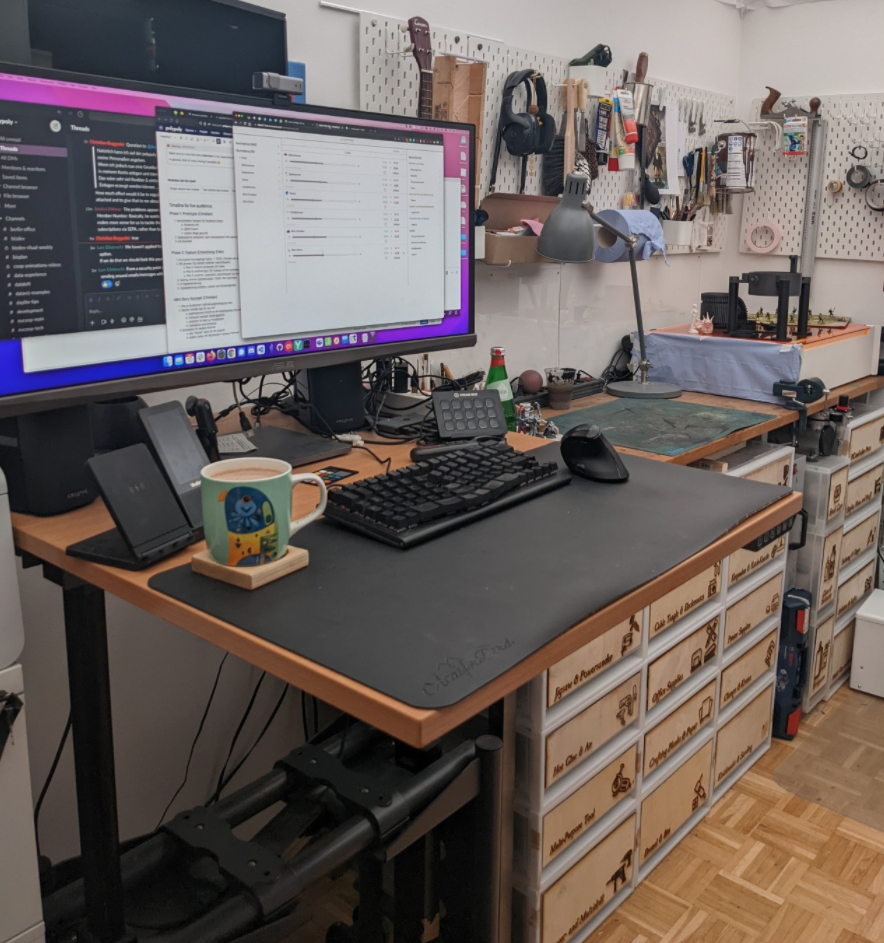
About a year ago, I shared how my home office setup looked. It is now not only a year later, but I also moved back to Hamburg and moved everything into a combined office&hobby room. And with that, I also upgraded a few key features of the space.

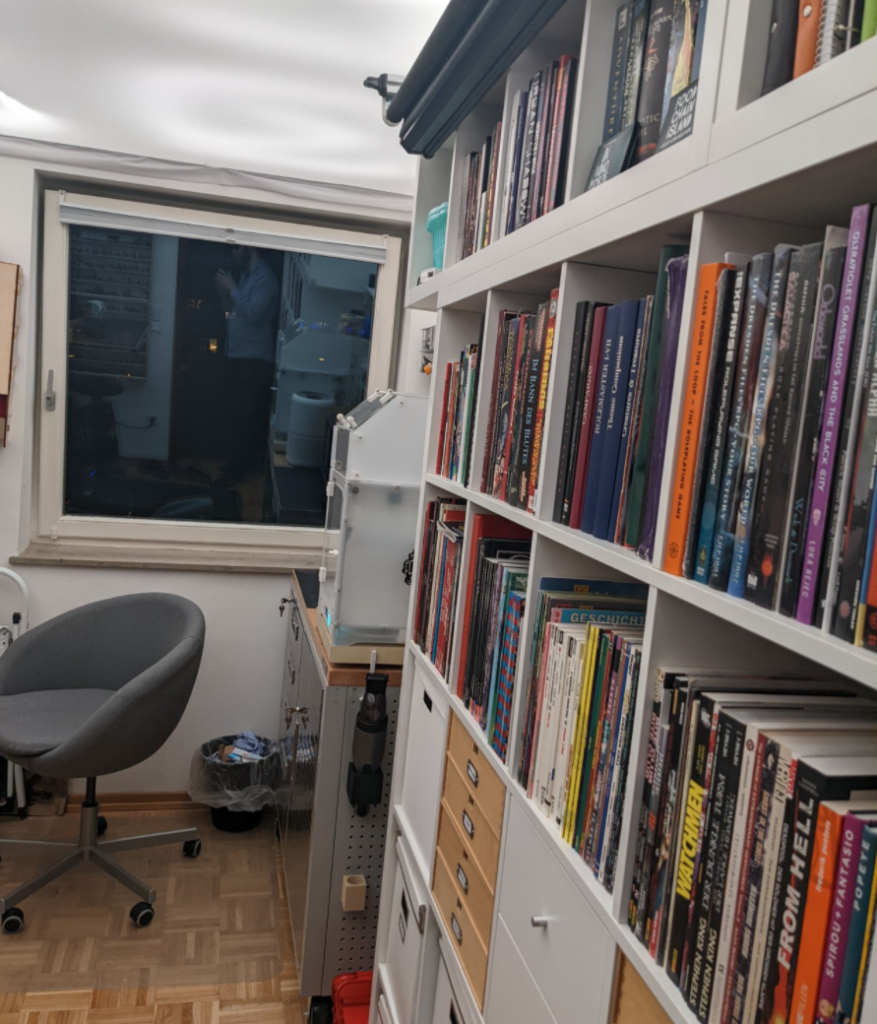
Let's start with the room itself: It is a rather small one, so I had to think of space economics. In the end, I settled for the traditional center aisle with desk, workbenches and storage along the sides, keeping the window free so I could move about the room at ease.

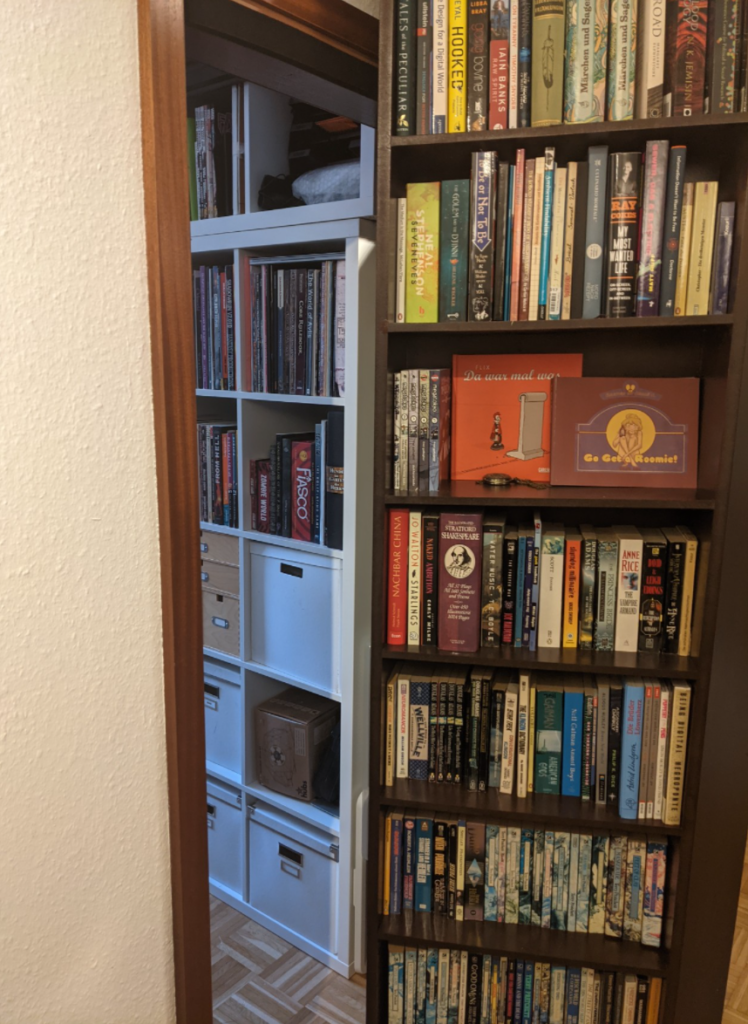
That meant that I had to get rid of the door, as it opened to the inside of the room and would have been blocked by the storage shelf. As a replacement, I fulfilled that inner nerds dream and built a secret door!

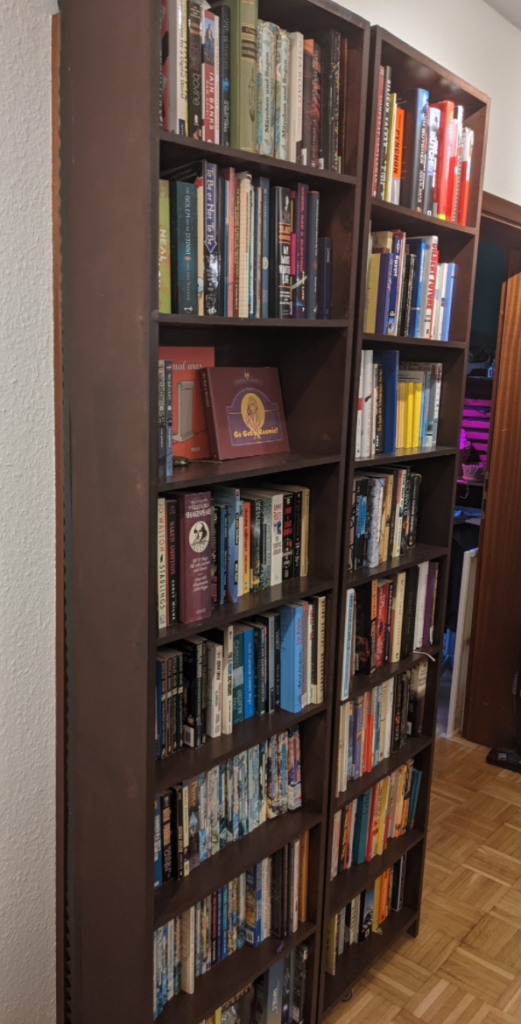
The room now houses not only my desk, but the printer, the filing storage, a workbench, all my tools and hobby supplies, two 3D printers, a borrowed laser cutter and all my roleplaying games and comics. Pegboards on the walls keep the more frequently used items in easy reach. Otherwise, I took full advantage of the laser cutter to have nice labels on all the drawers, so I don't have to remember where the different tools are.

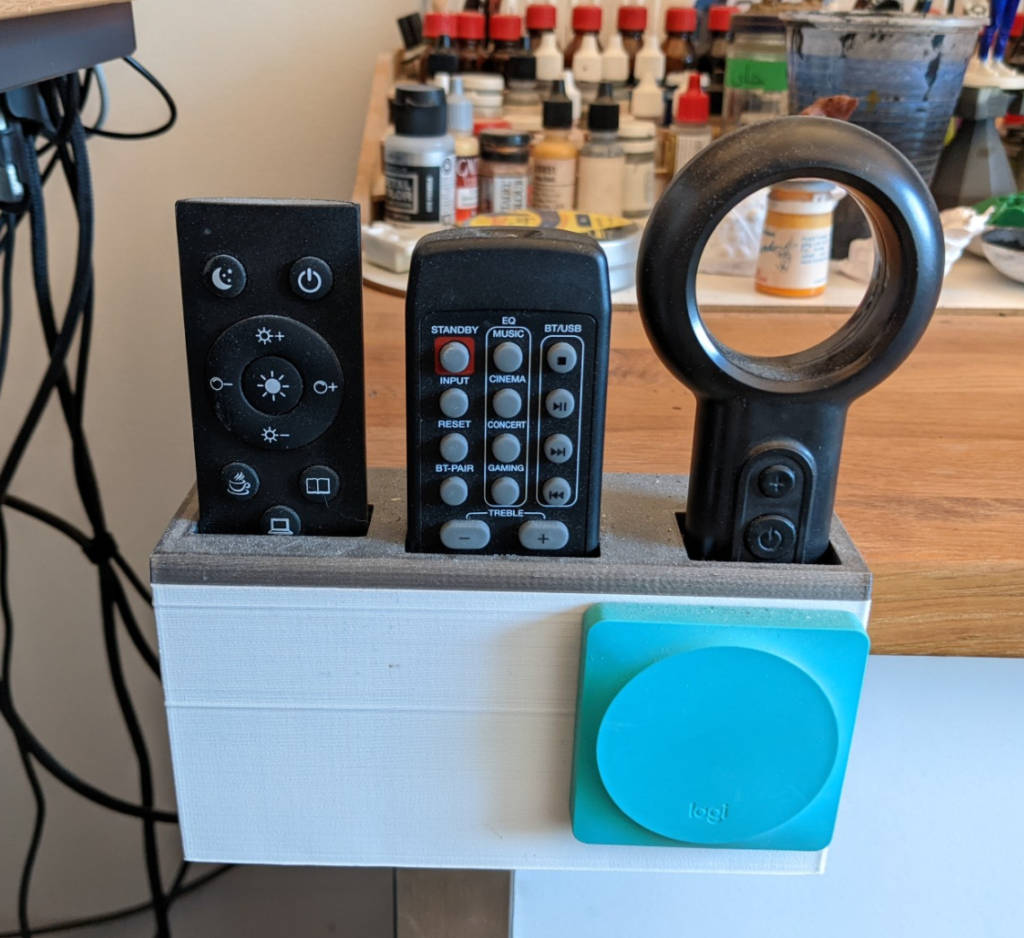
And yes, the motordesk and treadmill are still there, and I also managed to put the remote control holder into a fitting place on the workbench. That green button is a Logitech POP button that I use to switch the treadmill and 3D printer on or off.

But to the actual desk setup: Since last we met, I added and swapped a few things.

Audio

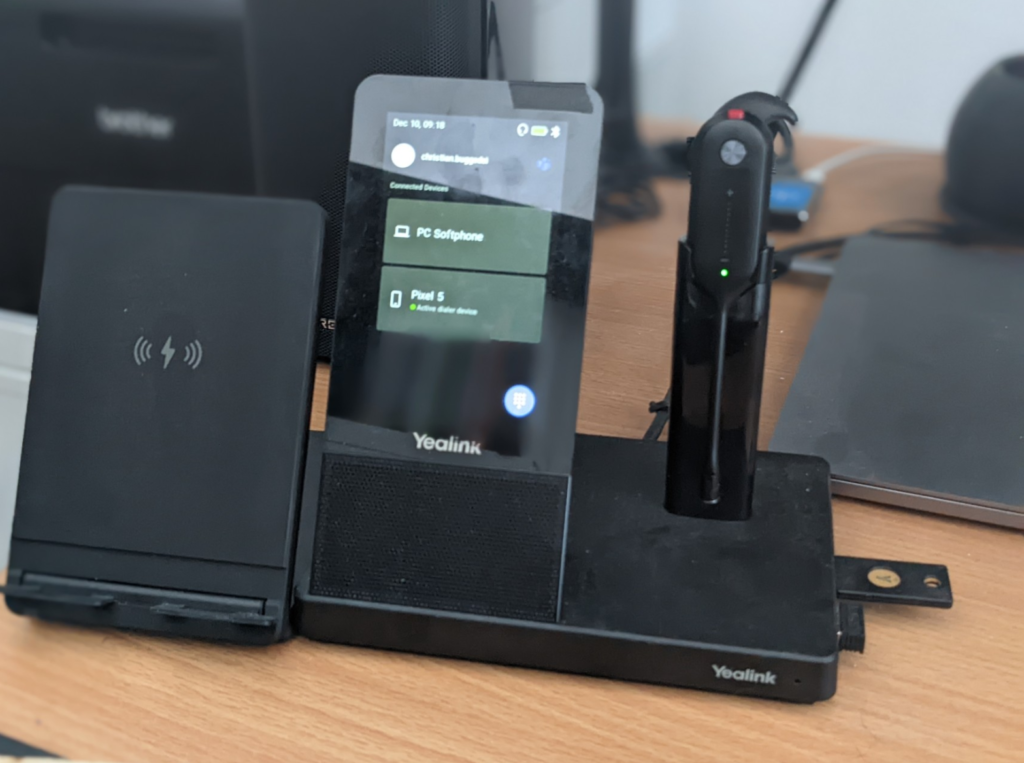
I ditched the Bluetooth headset for a DECT one. That has a lot better range and audio quality, while also sitting quite easy on the ear. It is a Yealink WH67 with built in speakerphone. As soon as I put the headset into the cradle, it switches from headset to hands-free operation. This happens entirely on the device, any computer or phone connected to the WH67 not seeing that change. I love this, as I never have to twiddle any software settings. And yes, the WH67 also has Bluetooth, so it connects to the computer and the phone at the same time.

Also, I've splurged for the QI-charging module, so the phone gets juice without any hassle too.

Video

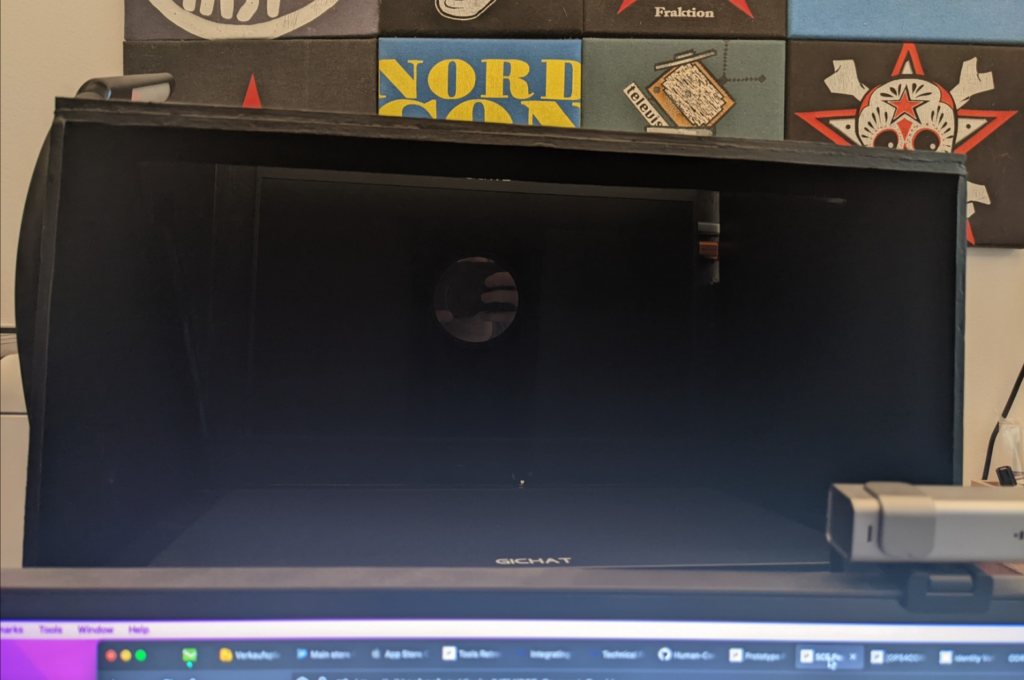
The SLR camera is now hidden behind a black box that acts as a teleprompter. I rarely use that for the usual purpose of reading a script, but to be able to make eye contact during conference calls. It is entirely self-built from foamcore, wood glue and black paint, with the only bought addition being the 12” USB-C screen and proper teleprompter glass, that reflects from the front surface of the glass instead of the back, providing crisper contrasts to me. It does eat some of the dynamic range, but not too much to be a bother. (Eventually I might update to a brighter screen to compensate, but that'd need some more serious budget).

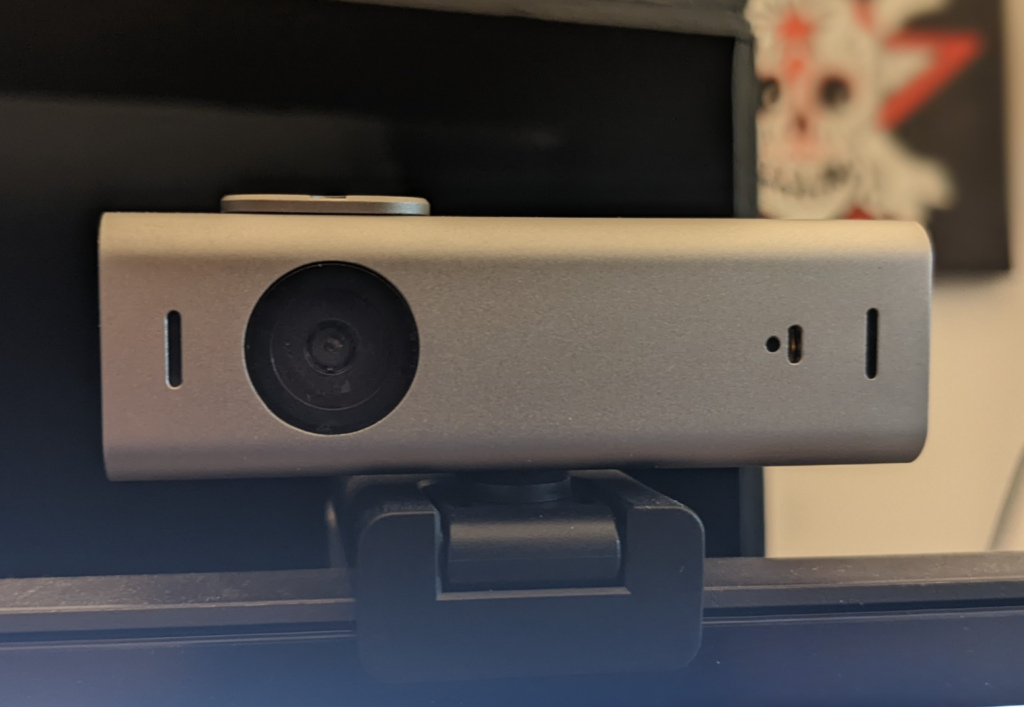
Also, the standard webcam is right now a Lumina, some crowdfunded, allegedly more intelligent camera with better colour calibration and more processing. Might go back to the Logitech BRIO eventually, but for now, I am giving the makers a chance and see what the software updates bring...

Lights and Buttons

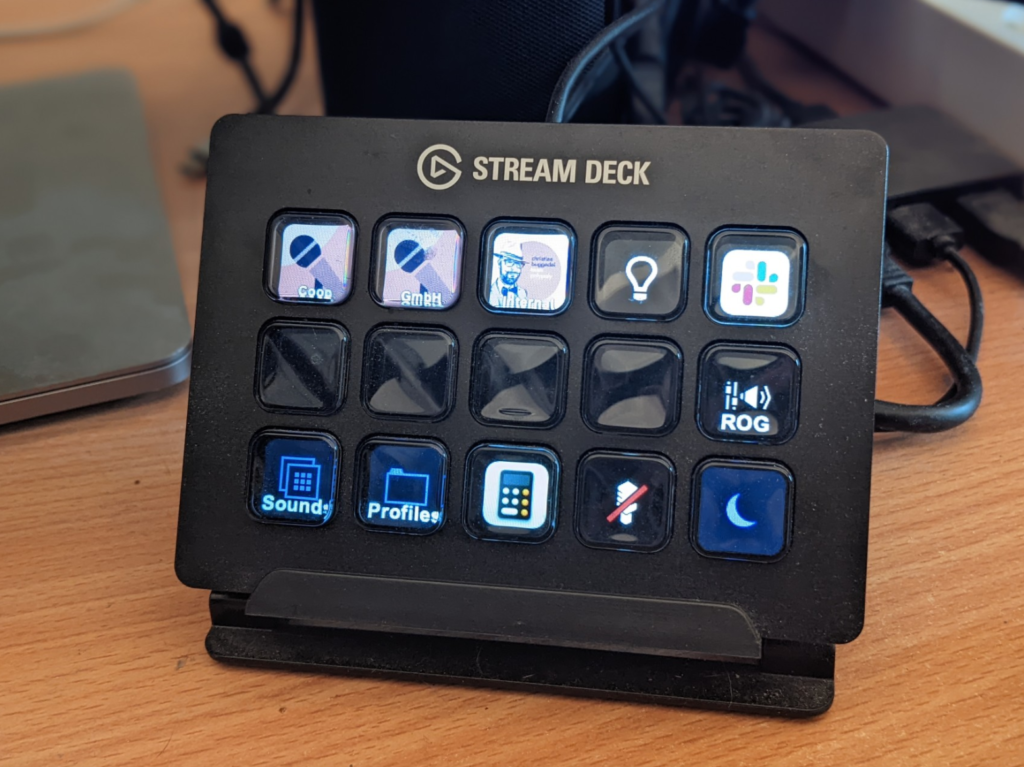
On the other side there is an Elgato Stream Deck. This is mostly a toy / luxury purchase, but it does come quite useful when hosting online events. Routing my camera through OBS I can easily blank my video feed, swap backgrounds, pipe in waiting music, etc. Just having a hardware button to mute myself or blank my video is already a godsend. Also, it controls the room light!

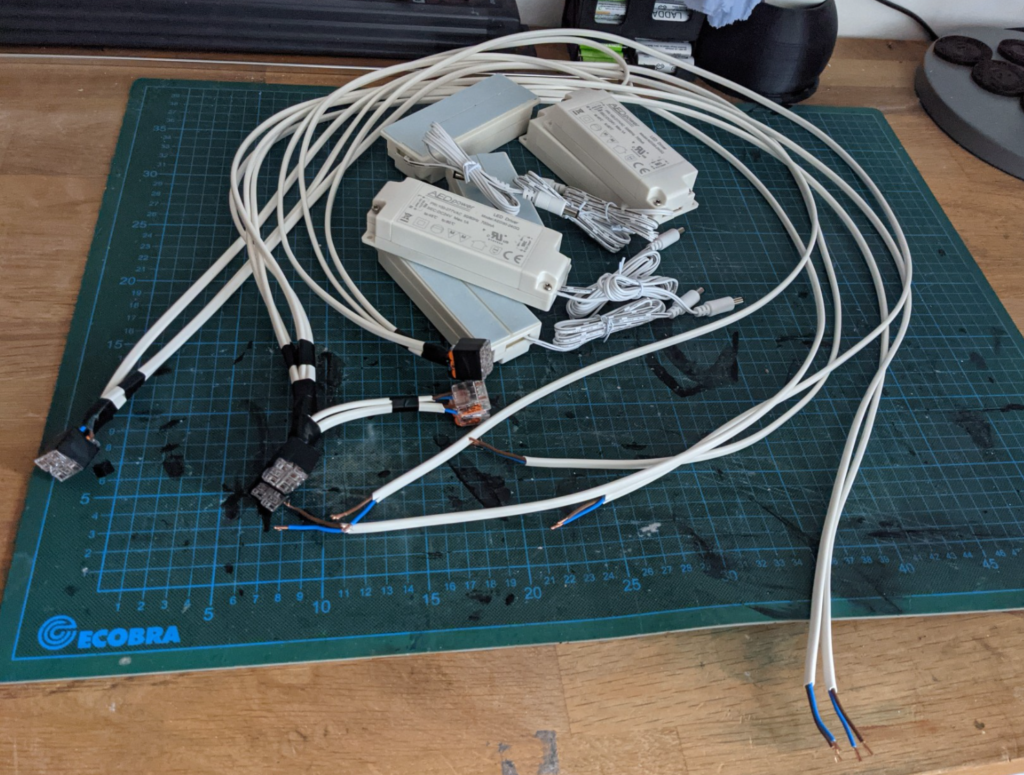
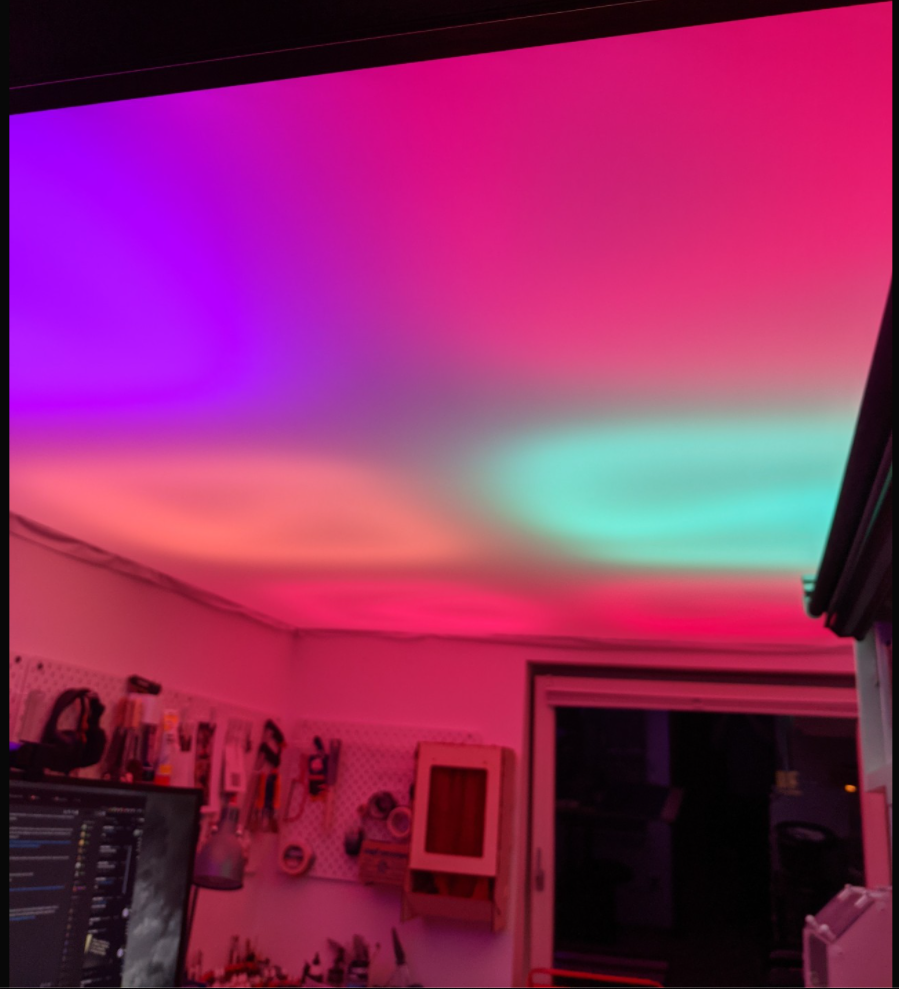
Speaking of room light: I splurged and installed a light-up ceiling. Six 4m RGB zigbee powered lightstrips that are hidden behind a semitransparent white cloth. They could be a tad bit brighter, but for now, this is pretty good to keep the winter depression at bay. And I have a button for “Red Alert” :D

SO many cables needed to be attached and sorted for the ceiling

admit it, it's pretty.


I also write about roleplaying games in english und auf Deutsch!
Immer wieder sehe ich Journalisty und Medien, die versuchen “neutral” über Blockchain oder NFts zu berichten. Im besten Falle geschieht dies, da man diese ja nicht einfach direkt kritisieren könne, ohne dem Publikum das ganze vorher einmal zu erklären.

Ich (und sehr viele andere) sehen NFT und Blockchain aber eben nicht als neue Technologie , die man neutral betrachten und erklären kann, sondern als das Äquivalent zu radioaktiven Klärschlamm.

Sprich, jedes Projekt, dass damit in Berührung kommt, ist sofort kaputt und verseucht. Aus unserer Sicht sind Berichte über das Thema, die das erst einmal hilfreich erklären wollen, so sinnvoll wie ein Bericht mit dem Titel: “Radioaktiver Klärschlamm – alles was Du wissen musst, und wie Leute damit Geld verdienen.”

Artikel, die radioaktiven Klärschlamm unbedarften Leuten verantwortungsvoll erklären wollen, müssen also tatsächlich zunächst ernsthaft über Gefahr für Gesundheit und Umwelt aufklären, und warum Kontakt damit schlimm sei, bevor man überhaupt zu irgendwelchen Vorteilen kommen kann.

Ich verstehe jetzt natürlich, dass diese Ansicht Blockchain == “radioaktiver Klärschlamm” für manche streitbar ist. Aber aus meiner Perspektive als IT Mensch mit über 20 Jahren Erfahrung, und in meiner Peer-Group aus Entwicklern, IT-Sicherheits und Datenschutzexperty, Aktivisty, CTOs, CISOs, etc. ist diese Sicht absolut unstrittig. Es fallen Sätze wie

Crypto/NFT sind die heutige Variante der CDO und der kommende Auslöser der nächsten Finanzkrise.

oder

Web3 ist damit ein politisches Programm, welches sich gegen ein offenes Web mit zumindest dem Potenzial zur Partizipation richtet und dieses ersetzen will durch eine Token-Infrastruktur, bei der für jede Aktion irgendjemandes Smart Contract die Hand aufhält.

Tante auf https://www.golem.de/news/web3-die-komplette-finanzialisierung-des-internets-2202-162689.html

Meine Lebensgefährtin hat in einem Blockchain Startup gearbeitet, und sich die Szene von innen angesehen, und kam ebenso zu diesem Schluss. Ich habe mich auf Parties und Konferenzen mit Blockchain-Enthusiasten unterhalten, und musste denen noch einmal erklären, warum ein öffentlich einsehbares und unabänderliches Archiv aller Stimmen garantiert kein sinnvolles Vehikel für eine Bundestagswahl sein kann.

Aus unserer Perspektive sind Blockchain-Befürworter das Äquivalent zu wissenschaftsskeptischen Impfverweigerern, und Berichte, die da versuchen “sachlich” erst einmal die Technik zu erklären, ohne die Kritik in den Vordergrund zu stellen, sind für uns das Äquivalent zur Bild-Zeitung, die fragt, ob man wirklich “diesen Virologen” trauen darf.

Es kann in dieser Sache keine neutrale Berichterstattung geben!


I also write about roleplaying games in english und auf Deutsch!
Vor 10 Jahren meinte die damalige Freundin, dass Split-Screen Spiele auf einem 23” Bildschirm doch irgendwie meh seien. Ich kratzte ein wenig Geld zusammen, ging zum örtlichen Tech-Discounter und kaufte einen knapp doppelt so großen Fernseher. Bewusst das Auslaufmodell, das kostete nochmal weniger.

Jetzt in der neuen Wohnung schaute das ein wenig... verloren aus:

Im Grunde alles gut, aber aktuelle Filme und Serien zeigen wichtige Plot-Informationen auf den Bildschirmen der Smartphones der Protagonisten. Und ganz ehrlich, die können wir vom Sofa aus nicht mehr lesen :)

Etwas neues sollte also her, und es war ja auch grad Weihnachten...

Das ist ein Samsung The Frame 65” QLED. Insgesamt ein schönes Bild, der Art Mode ist hübsch, und generell fügt sich Gerät gut in die Lücke hier ein.

Aber wie immer mit “smarten” Geräten muss man einiges tun:

  • Hauptzuspieler ist die Chromecast. Das sorgt dafür, dass wir uns so gut wie nie durch die Samsung UI bewegen müssen.
  • Sicherheitshalber, und um unnütze Werbung (WTF?!) zu blocken, hat der TV per Firewall nur eingeschränkten Internetzugriff.
  • Die Box mit allen Anschlüssen ist im Schrank. Das hat den Vorteil, dass man keinen Kabelsalat sieht.
  • Nachteil: Ich kann die Sonos Soundbar nicht einfach so mit der Samsung-Fernbedienung steuern. Denn die Fernbedienung nutzt Funk, und die IR-Signale für die Soundbar kommen aus der Anschlussbox. Ich habe also einen billigen IR Extender gekauft, damit geht das gut, und ich konnte der Soundbar beibringen, auf die Samsung IR Signale zu hören.
  • Wir haben alle Bildverbesserungen abseits der Helligkeitsanpassung abgeschaltet, das sieht für uns irgendwie besser aus.
  • Ebenso haben wir Multiview ausgeschaltet, damit man bei Nutzung der Chromecast-Funktion vom Handy nicht erst jedes mal so einen blöden Bild-im-Bild Modus hat.
  • Ich muss noch einen einfacheren Weg finden um eigene Bilder in den Art Mode zu transferieren – der Standardweg über die Mobile App ist.. umständlich.

Alles in allem, kein schlechtes Gerät, wir sind zufrieden.


I also write about roleplaying games in english und auf Deutsch!
So, jetzt alle:

https://www.youtube.com/watch?v=PIkm5wqwk5A

Ich wohne ja seit Februar 2015 in Berlin. Ist schon schön hier, aber wann immer wir meine Eltern besuchen, oder zum Nordcon fahren, fragt die Freundin mich “Warum wohnen wir eigentlich nicht in Hamburg?”

Gute Frage. Wahrscheinlich wegen dem Job (der ja lange Zeit erforderte, dass ich wochentags in ein Büro in Berlin ging). Und weil die Miete in Tempelhof halt supergünstig ist. Und weil ich hier mit grünen Haaren gar nicht mal so sehr auffiel.

Aber das einzig Stete ist der Wandel, und so ziehen wir im Sommer zurück nach Hamburg! Nach Schnelsen, knapp vor der Grenze zu Bönningstedt, eine Gegend die ich eigentlich meiden wollte, aber die Wohnung ist bezahlbar, hat eine begrünte Dachterrasse und einen Balkon für die Kater, und vor allem: Zwei Büroräume, so dass ich nicht mehr das Wohnzimmer als Büro missbrauchen muss.

Denn das ist mein persönliches Fazit aus der Pandemie: Es ist egal von wo ich arbeite, solange ich vernünftiges Internet für Email, Webanwendungen und Videokonferenzen habe. Denn polypoly hat den Sprung zu einer 100% verteilten Firma geschafft, im Endeffekt haben wir alle Neueinstellungen seit Februar letzten Jahres komplett virtuell durchgeführt.

Insofern freue ich mich jetzt wie Bolle, wieder nach Hamburg zurück zu kommen, näher an meinen Rollenspielspezis zu sein, und auch Freunde zum gepflegten Brettspielabend auf unserer Terrasse einladen zu können...

Bis dahin:

https://www.youtube.com/watch?v=NJgv5dYfhbE


I also write about roleplaying games in english und auf Deutsch!
A key element of modern games is often the heist, caper, or in the case of cyberpunk-esque games, the “run”. The common part here is that the target is usually a complicated and large system, full of people, computers, security systems and other components.

In movies and books, we follow the crew through their preparations and then see them pull off the perfect caper, where each element more or less seamlessly enables the next part, until it all comes together in a showdown and ends with the heroes walking (or running?) off with their ill-gotten gains.

There are quite a lot of attempts to map this into game mechanics, and here is my own one:

It introduces two concepts:

  • the network map of the entity that is to be robbed
  • failure cascades

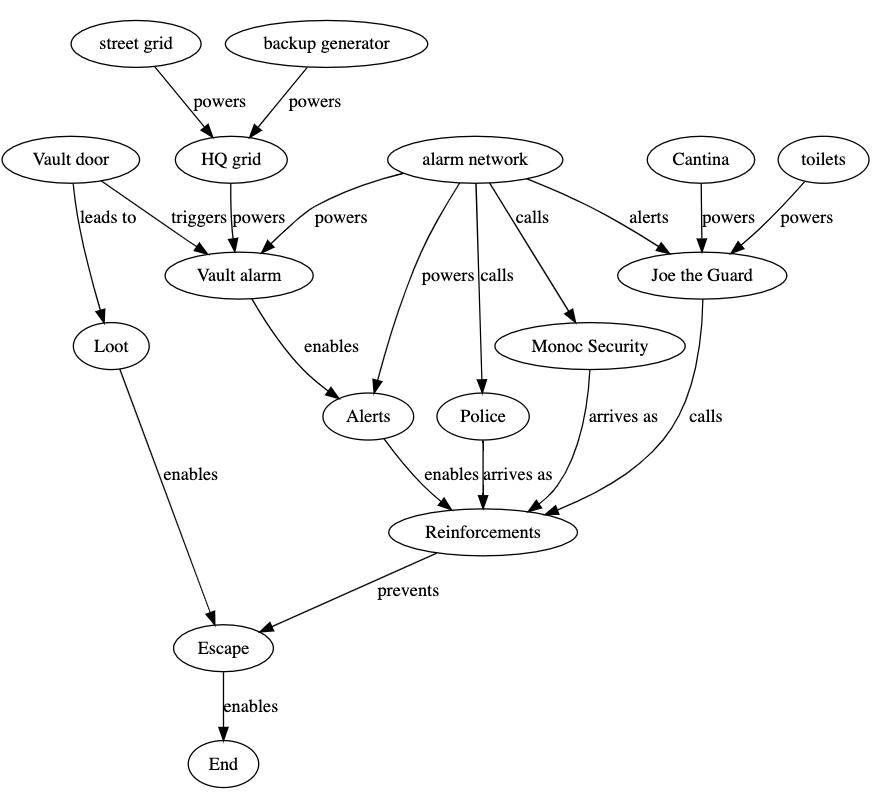
Lets start with the network map. It could look something like this:

The goal is to escape with the loot from the vault. Except that as long as there is someone or something to call reinforcements, things will go bad. And if the vault door isn't opened, they can't get to their loot in the first place.

Researching this network is the usual preparation phase for the players, where they can dig for information, ask around, bribe people, steal floorplans, and so on. It might even be that you, as the DM, don't even have the network map prepared but you create it with your players as you play along.

In the end, the map shows the possible choke points that need to be taken out, as well as the objectives that need to be met. Either directly, or indirectly.

And that is where the second core idea comes into play: Cascades. I'm stealing those from the boardgame hit Pandemic. Disease occurrences are marked by adding little cubes to a city. Whenever there are three or more cubes of the same type in one city, there is a virulent outbreak. That means that every neighbouring city also receives a cube. If that tips them over the 2-cube-is-safe limit, there is an outbreak too.

Let's apply the same idea here, but with a lower limit: If there are two incidents at one place, it triggers the cascade. So if Joe the Guard does not get his coffee from the Cantina AND the toilet is clogged, he'll fail at his job (calling the reinforcments in case he sees anything). And that means that the “Reinforcements” node gets its first little cube.

A similar effect could be achieved by simply taking Joe out (kidnapping, poisoning or bribery for example), but that might not always be possible – and it won't create a cube at Reinforcements.

So, the planning and execution phase means that the crew selects points in the network, take them out and hopefully create cascades that take out adjacent points for them.

This isn't playtested, but I think it should be fun to run things this way!


I also write about roleplaying games in english und auf Deutsch!