Orkpiraten

Thinking and Playing and Testing

I have had 3D printers in the house since 2015. But it took 5 years and a lot of frustration until I finally got to a setup where I am happy with what I am doing.

It began with a positively tiny M3D Micro – a very basic, consumer-grade 3D printer with a proprietary slicing software, no heated build bed, and not a lot of power. Especially the very small print area coupled with no heated bed made it a device I never really got a lot of use out of.

Eventually I upgraded to a CR-10S, then later tried to replace that with an Artillery Sidewinder, but the gist is: I love 3D printing, but not tinkering with 3D printers. And most, if not all of the <1000 Euro devices are in the end things you need to tinker with. Replacing the fan shrouds, choosing the correct hot ends and nozzles, upgrading the mechanics, the software, writing your own configuration files and measuring e-steps... it is the equivalent of owning a vintage car, so you can get your hands greasy.

Which is not me, so after the printer again ate all the filament and had the nozzle or extruder clogged, I gave all of the stuff away to a local maker space and was ready to give up on the hobby completely.

Based on the insight that there are printers made for me though, I finally caved and spent way more money than I initially intended for this hobby and bought an Ultimaker 3, quickly followed by an Anycubic Photon Mono SE. As a result, this is my setup:
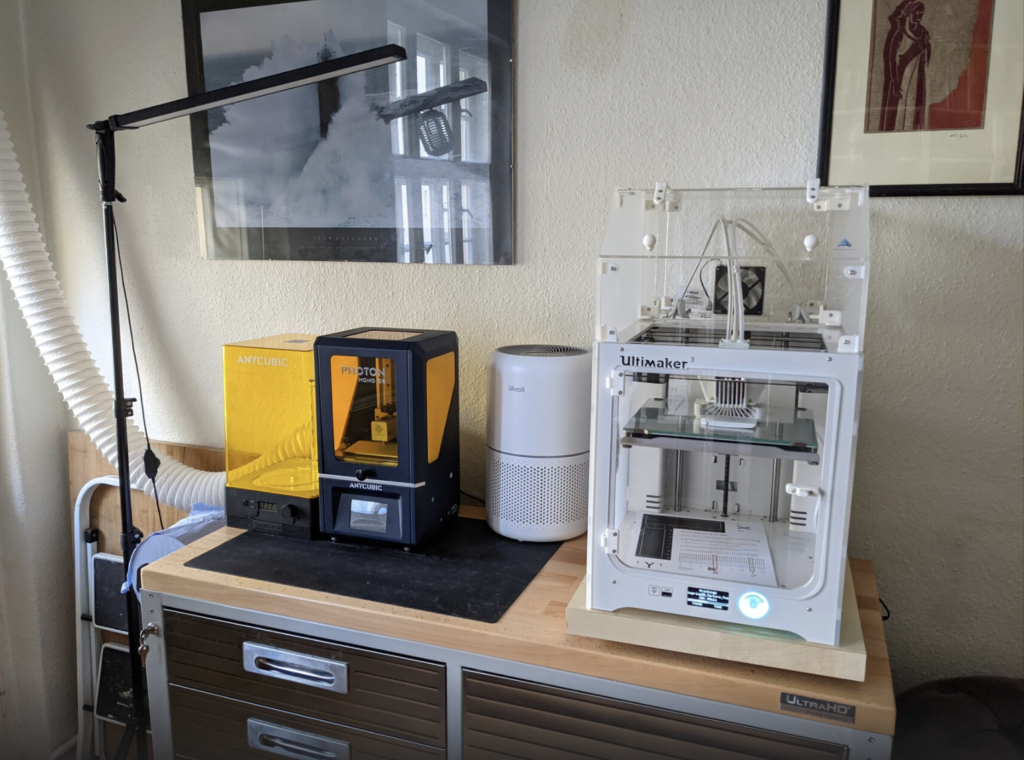
the whole setup

The sideboard is a workbench-on-wheels, so I can move it around in a pinch. It houses all the accessories for the printers: Extra filament, resins, isopropanol for cleaning resin prints, breathing mask, nitrile gloves, extra paper towel rolls, small tools, and so on.

On top of the workbench, you find the Ultimaker 3 (UM3), sitting on a thick countertop mounted on a rotating swivel. I added that because the filament spools are attached to the back of the printer, which is also where the feeding mechanism is. Getting to those is a bit hard, so having it easily swivel is a pretty handy thing. The heavy countertop helps to minimize vibrations spilling over onto the print.

https://www.youtube.com/watch?v=wG0PN5-iHGY

The UM3 is a Fused Filament Fabrication printer that takes spools of plastic filament, forces it into a hot metal tube where it melts and then through a fine nozzle drawing a line. Through an assortment of gantries and motors, it can draw these lines into basically any shape, lowering the print bed gradually to build up a true 3D model. The good thing with the UM3 is that it is designed for commercial use. That means that it comes with a good workflow for easy handling, and has parts that can be swapped out without any hassle. It “just works”. And when I want a finer or bigger nozzle, to have more details or more speed, I can swap those out in a few seconds without any special tools.

I also added a hood on top of it, to keep the warm air inside, which tends to make things a bit more reliable. But that is it really for modifications – otherwise, this is a stock printer. And I must say: For functional parts or bigger things, this is a very good machine, and I am very happy with it.

Next to the Ultimaker is a small air filter. I run that whenever I am printing with resin or filaments that emit obnoxious fumes. It has a VOC (volatile organic compounds) filter too, for extra safety.

Next to that is the Photon Mono SE, a masked stereolithography, or MSLA printer. It works by shining UV light through an LCD screen onto the transparent vat filled with resin. The screen lets only parts of the UV light through, and where the resin is exposed to it, it hardens. Then the build platform is raised a bit, liquid resin flows into the gap, and the process resumes until a threedimensional object appears from the toxic goo.

The upside with these printers is that they are insanely detailed. The downside is that their build volume tends to be rather small. The other upside though is that they are mechanically dead simple: Just a platform that moves up and down. That means that the main pricing factor is the LCD screen that blocks the UV light. As a result, even the cheap versions of these printers can be pretty good. You pay more if they are larger, faster, or have a better resolution (but keep in mind that the cheapest MSLA printer will probably blow the most expensive FFF printer out of the water in terms of resolution!)

The Mono SE that I have is a mid-priced one. It has a higher resolution and is a lot faster than the cheaper options. Also, the housing is made of metal, and that kinda appealed to me.

The printer and the Wash&Cure station next to it sits on a silicone mat, to make resin cleanup a bit easier. Because trust me: That stuff is nasty, and you do not want it on your skin, nor in your eyeballs or lungs! It is thankfully pretty easy to protect yourself though: Wear nitrile gloves and a respirator, or at least a paper mask plus eye protection in case of splashes (I already wear glasses anyway, because I have bad eyesight). While the printer runs, ensure you have good ventilation. I added a 4” hose to the back of the printer and use that to draw the fumes out of the flat, which works surprisingly well. The active air filter is just an extra precaution on my end.

Functionally, the printer is otherwise stock too – although I added a few accessories:

  • a lid for the resin vat, so I don't need to always put the resin back into the bottle between prints
  • a small plastic gizmo that allows me to hang the build plate over the vat at an angle, so the remaining resin can safely drip back onto the vat
  • a magnetic build surface. A sheet of spring steel that is magnetically attached to the build platform. When the print is done, I can simply pop off the models instead of having to handle a scraper, or worse...
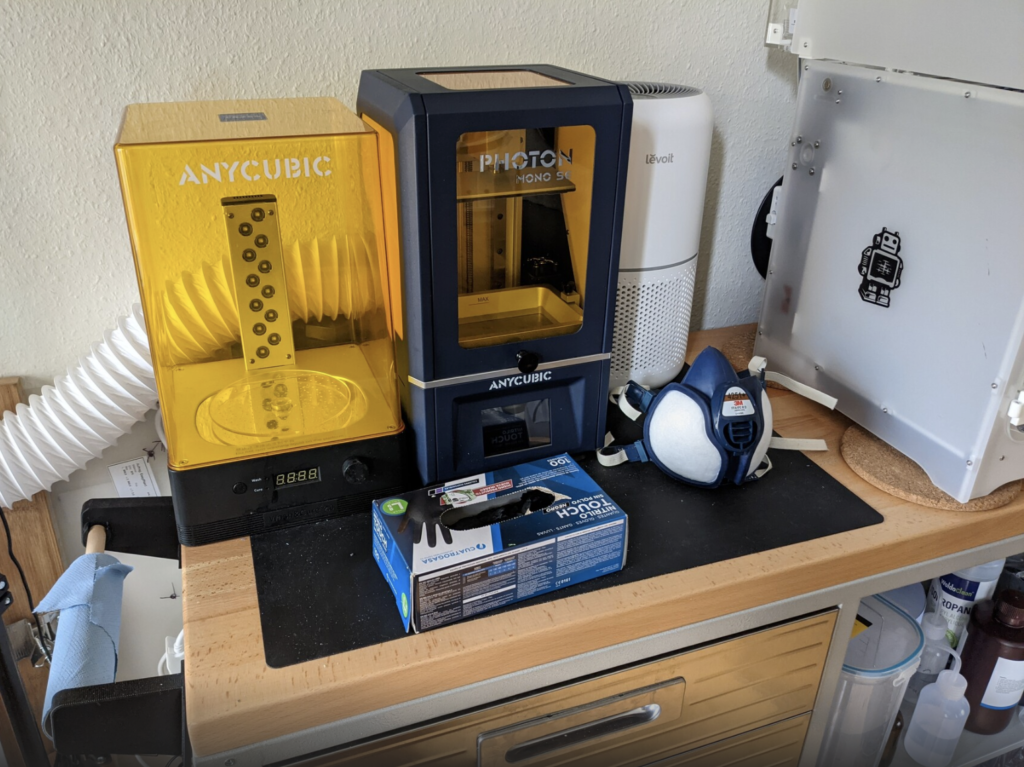
safety first

The last thing on the table is the Wash & Cure station. Once the prints are done, I'll pop them into a wire basket and drop that into a bucket of isopropanol. The bucket has a magnetic impeller at the bottom, and the W&C station has a motor that makes it spin, thus agitating the isopropanol and giving the prints a good rinse, washing off all remaining liquid resin. Once done, I dry the prints and replace the bin with a rotating plate on the W&C station. The prints get put onto that, a UV safe hood on and then the station slowly rotates the plate while exposing the prints to more UV light. That “cures” the prints, so they don't feel sticky anymore and are properly hardened. The results are frankly astounding:
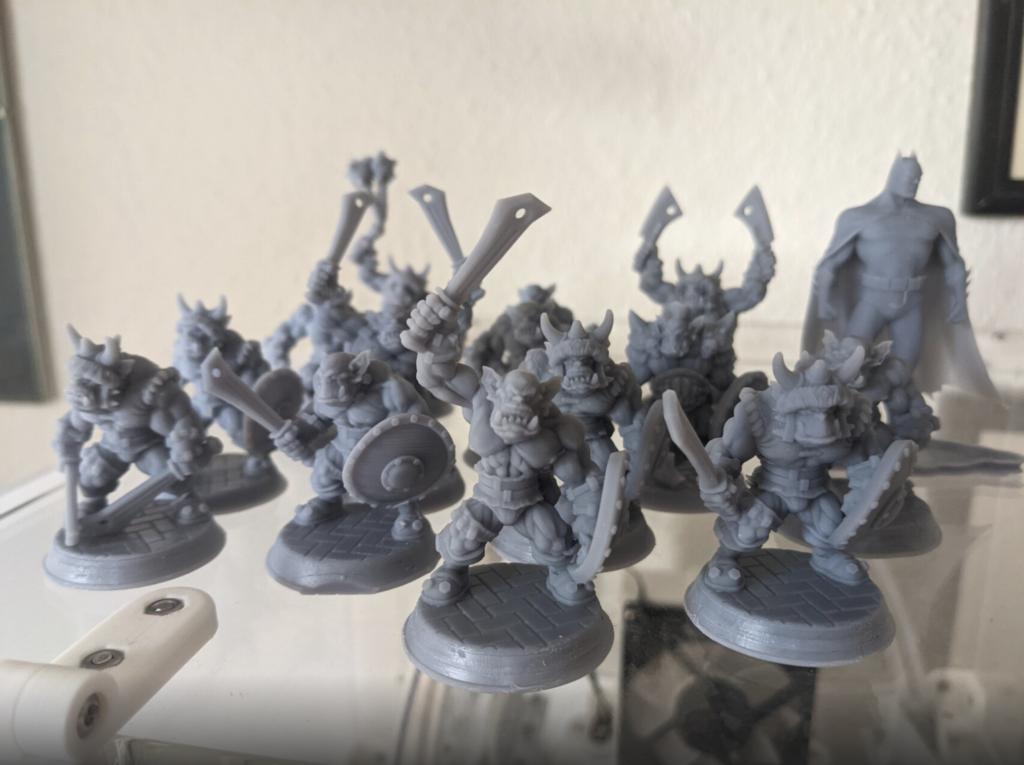
Batman and the Orks

At the side of the workbench is a holder for a roll of lint-free paper towels, to clean up messes and such.

Overall, I am quite happy with the current setup. Everything works fine, and I can start FFF prints from my desk (the UM3 has wifi). For MSLA prints, I still handle a USB stick, but that is actually fine for me, as I need to go there anyway to pour resin, prep the surface with paper towels, etc.

On the computer side, I use the following resources:

  • tinkercad.com and Microsofts 3D builder for creating or modifying models
  • thingiverse.com, myminifactory.com and thangs.com to get new models. (Also various Kickstarters. The Orcs from the picture above are from this campaign.
  • For the UM3, I prepare the prints with Ultimaker Cura (which can read the printers settings and inserted filaments through the network and also sends the print jobs directly to the printer)
  • For the Mono SE I am still figuring things out, so I am switching between the Photon Workshop that came with the printer and Lychee slicer. The latter seems nicer, but won't work without registering and connecting to their cloud on every use.

I also write about roleplaying games in english und auf Deutsch!
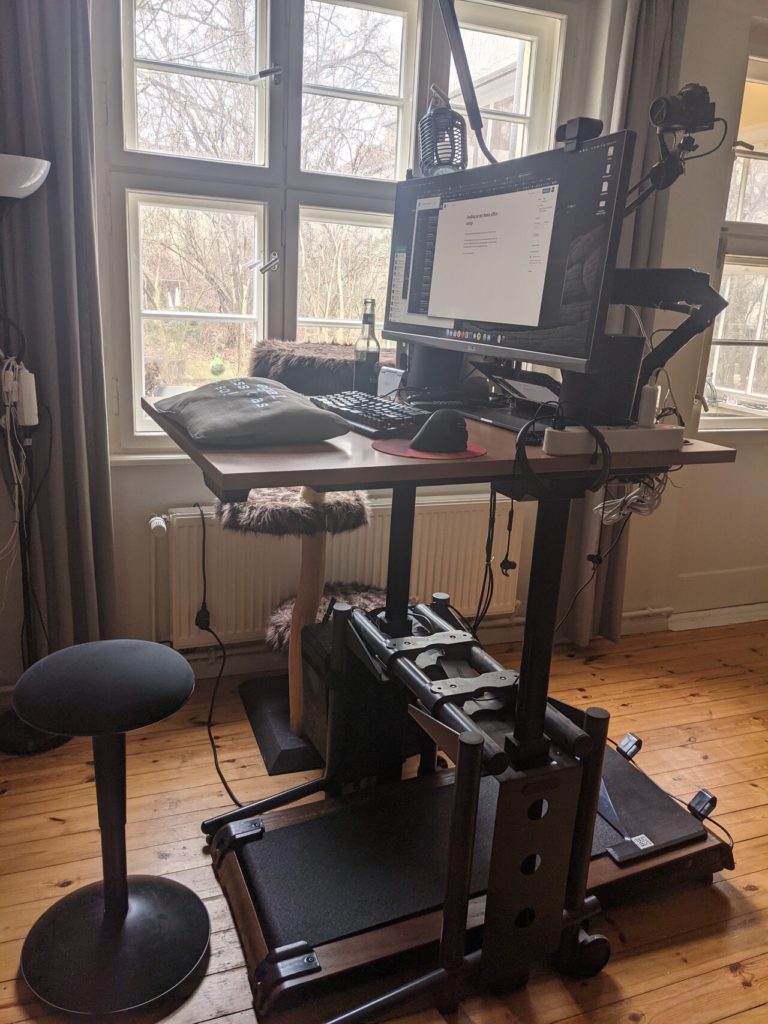
There's probably oodles of articles like this by now, but this is mine.

So, since roughly march last year, I've worked exclusively from home. At the start, I simply plonked down the company laptop on the dinner table, but then gradually reworked and upgraded the setup.

This is how it looks today:

Let's break things down bit by bit, and explain the history and purpose of the individual parts.

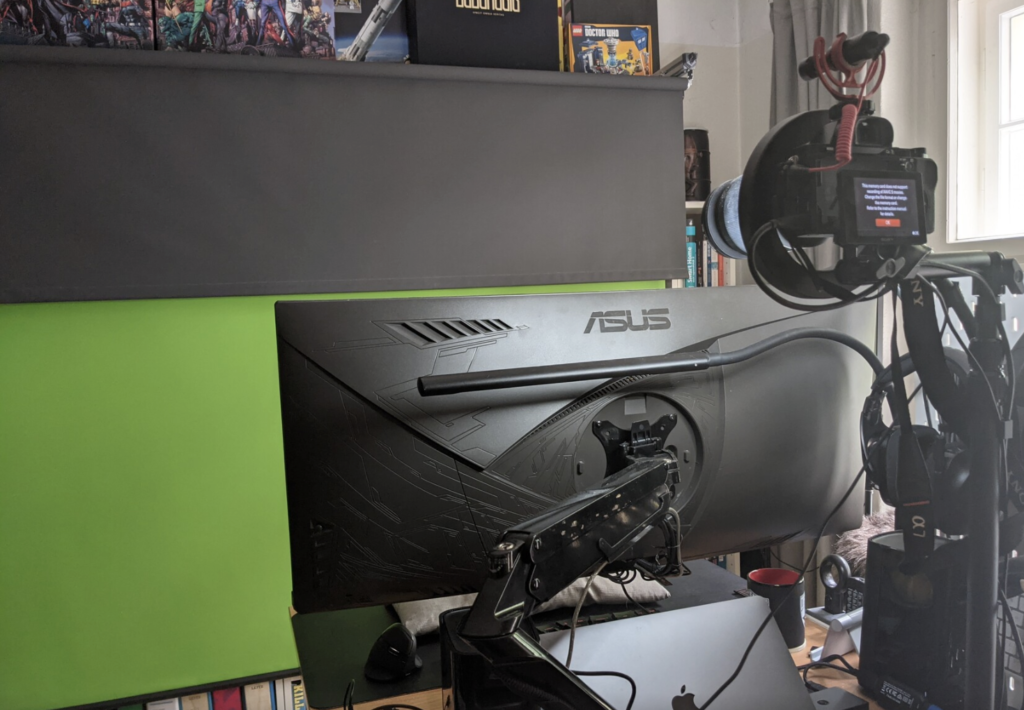
The monitor is an ASUS 34” gaming monitor that I bought when I finally retired my old All-in-One deskop PC and got a plain midi-tower unit instead. That PC is fit for gaming, and used to sit on top of the desk, behind the monitor. Alas, the company laptop wants to be used daily, so I needed a permanent space for it. That means that now the PC is strapped to the side of the desk.

The desk itself is a motorized standing desk. As you can see, it is pretty deep, but only 80cm wide. It is that deep because by now it is old enough to buy alcohol in the States. And back in 2000, desks had to fit ginormous CRT monitors. The small width is due to the fact that it originally was part of a combination next to a much larger desk. When I was still working in Hamburg, it accompanied me through several offices (all part of the same company group), and when I moved to Berlin in 2015, they let me take it to my new home. Having it in the living room is ok, as it doesn't take up too much space, and the cats appreciate its placement close to the window.

![](https://images.orkpiraten.de/ho_cat-1024x768.jpg)
Hop Sing appreciates the warm sitting place

When I sit, I sit on an IKEA stool. It is one of these ergonomic things that keeps wobbling a bit, thus allegedly strengthening my back.

Eventually I attached the monitor to a heavy duty arm. The main purpose of that arm is to free up desk real estate. The rather bulky original monitor stand, plus PC, plus Notebook, plus peripherals made the desk too cramped.

As the PC is strapped to the side of the table, I also managed to route all the cables more or less prettily.

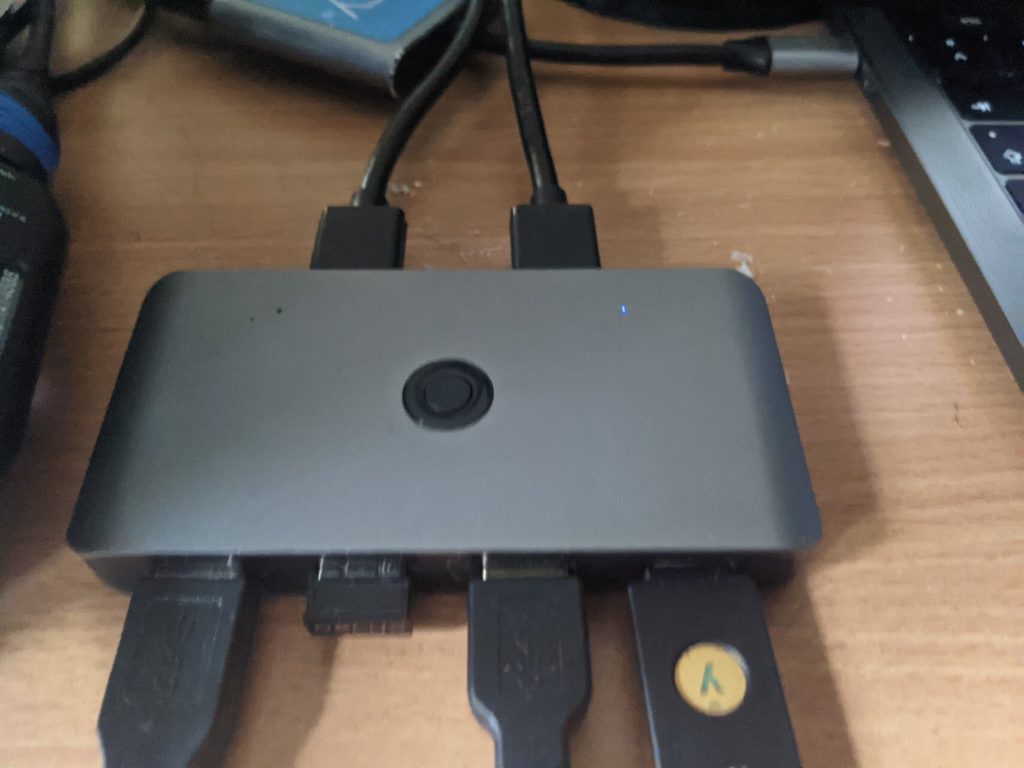
All I/O peripherals like mouse, webcam, keyboard, etc. are attached to the monitor and a switching USB hub. So when I switch devices, I press one button on the USB-switch and also select a different input on the monitor. That is pretty painless and saves me from constant re-plugging of devices.

For the longest time, I used a Logitech BRIO webcam. It is nice enough, and especially the built-in microphones are pretty decent. But as I do not live alone in this place, I most of the time use a set of Bose QuietControl 30 Bluetooth earplugs. The battery lasts for about two days of calls and the active noise cancelling lets me be undisturbed.

![](https://images.orkpiraten.de/ho_camera-1024x768.jpg)
the camera I am not actually using anymore

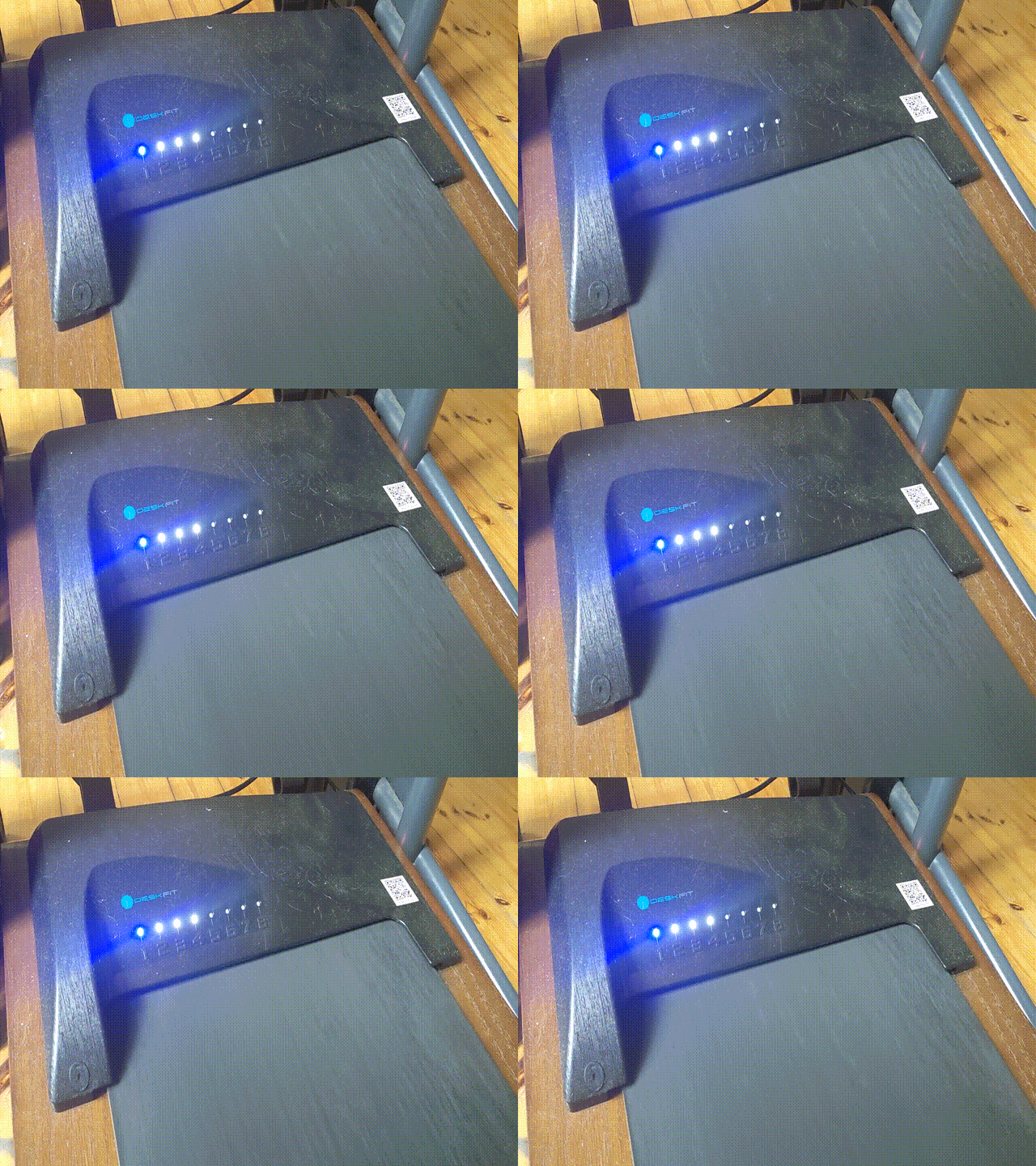
When I am not sitting or standing, I walk. Right under the desk sits a desk treadmill. To use it, I just push the desk back about 1 meter (it is on wheels) and start the thing up. That takes about 30 seconds of effort, and then I'm off. By now I can actually walk and work at the same time, this blogpost is being written as I am walking!

Overall, I spend about only a quarter of my desk time sitting, the rest of the time mostly standing or walking.

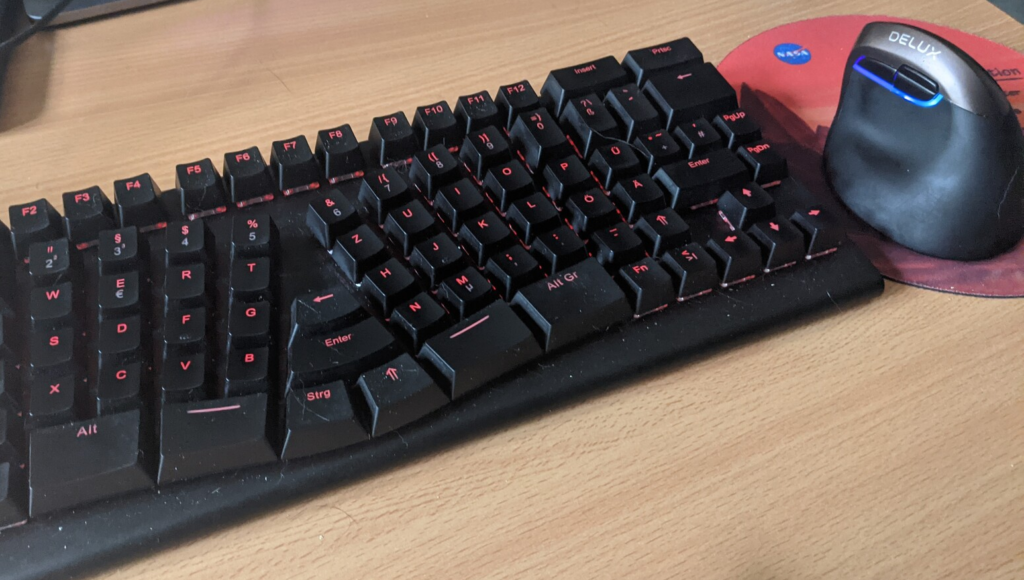
In order to keep my hands and wrists healthy, I have switched to an ergonomic keyboard and a wireless vertical mouse. The keyboard has a detachable numblock, and I am quite happy without that thing – I need it only rarely, and it does save that sweet desk real estate!

The monitor has built-in speakers, but frankly, they aren't the best. Instead I plugged in a pair of Creative monitor speakers. They are small enough but have decent enough sound for YouTube videos and the occasional game.

As my job has me do lots of videocalls with various degrees of expectations regarding my “professional look”, I eventually attached a simple dark gray roll-up shade to the top of my bookshelf. In day-to-day use, it is rolled up and hidden, but whenever I do not want to show off my collection of roleplaying books, I can pull it down to get a nice clean background.

Behind the gray roll-up is a greenscreen roll-up. Using Open Broadcast Studio I can key out the background and do other video shenanigans to make my life easier and looking more professional.

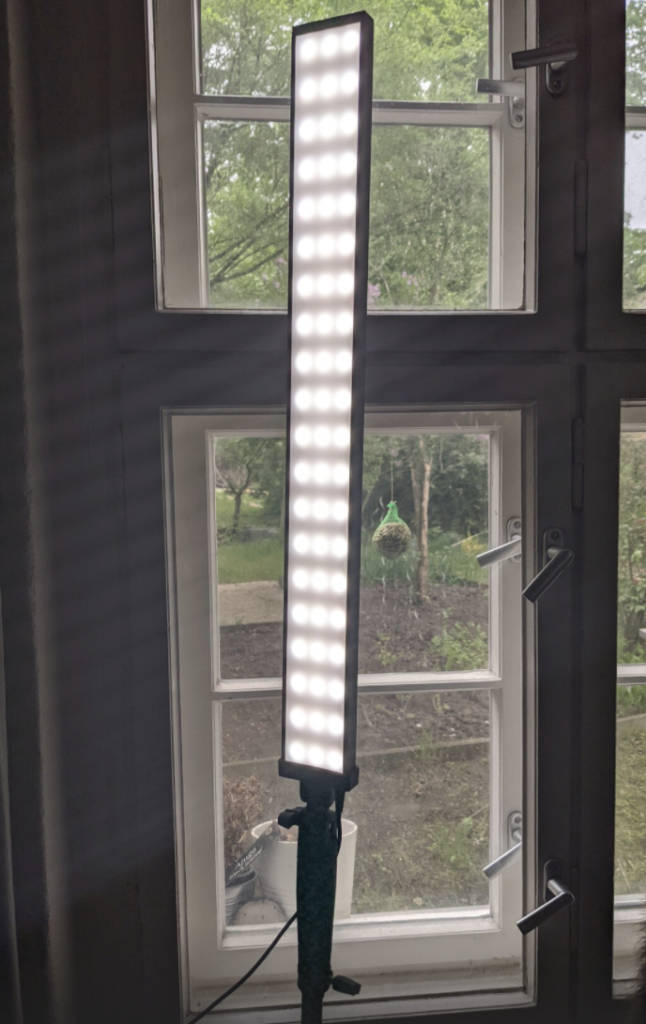
Pro-tip if you want to use a green screen: Do not skimp on light. The better your lighting, the easier it is to key out the green. I added two inexpensive Neewer brand light sticks to my setup – one lives inobtrusively in the corner and the other moonlights as a workbench light and gets carried over whenever I need to do “proper” videoconferencing.

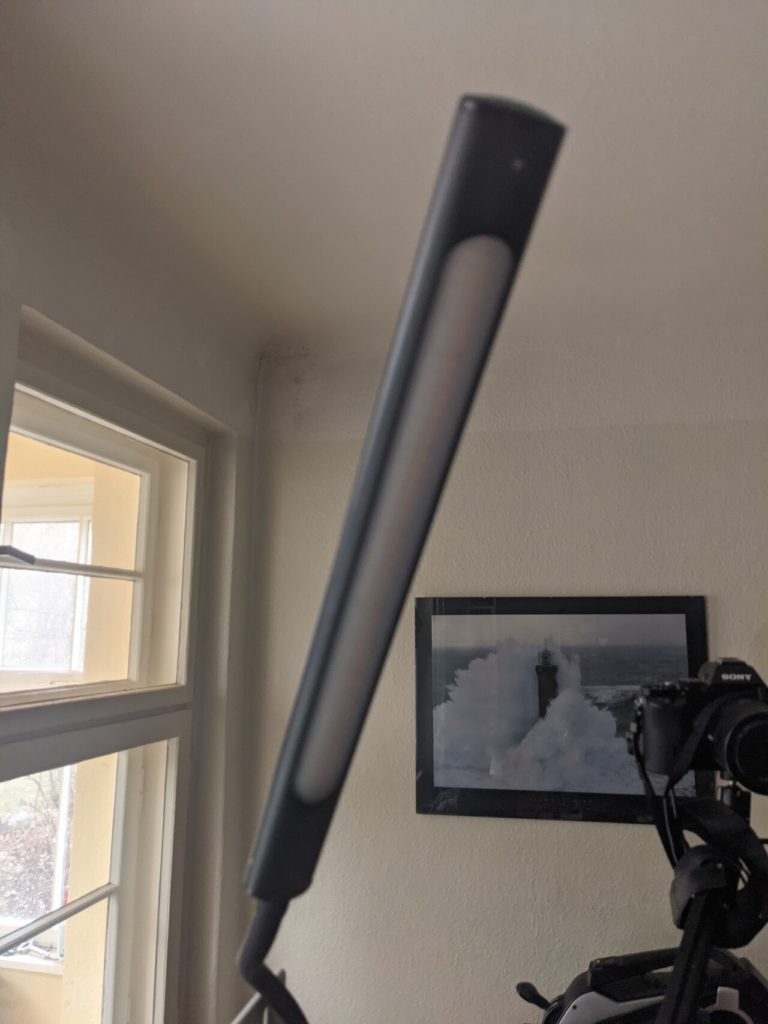
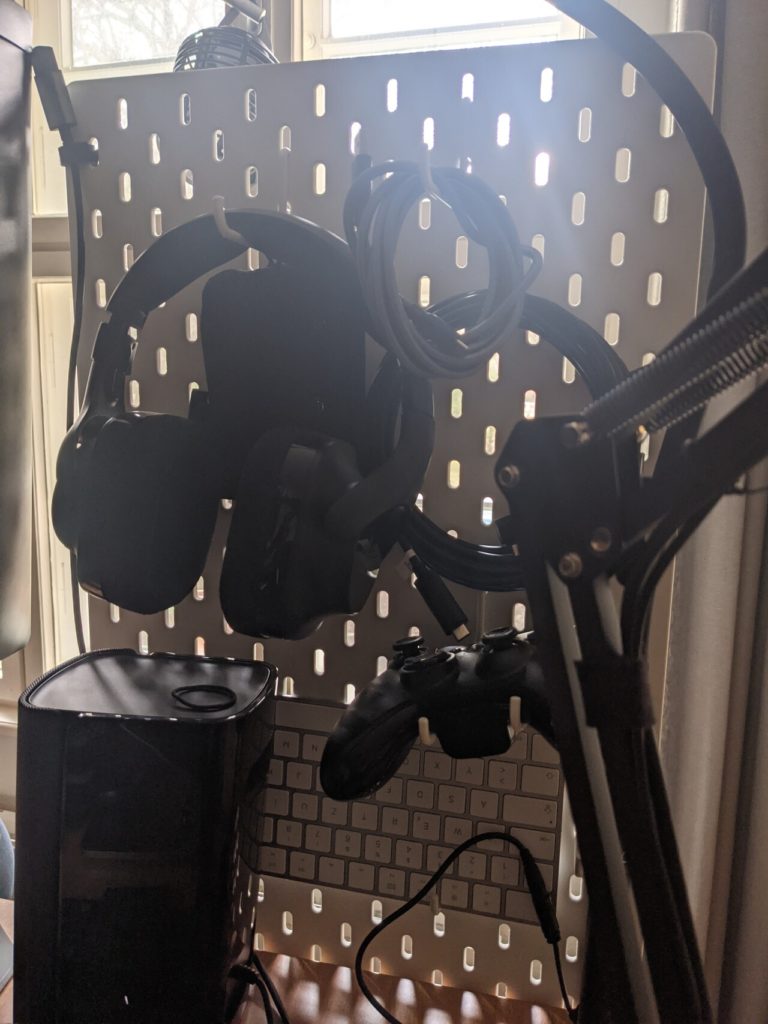
The desk has a simple LED light stick on a gooseneck stand attached to it. It has some brightness and light temperature settings, which helps a lot with eyestrain in the evenings. As the desk has no drawers or similar, I attached an IKEA pegboard to the side, to hold cables, adapters, headphones, and so on.

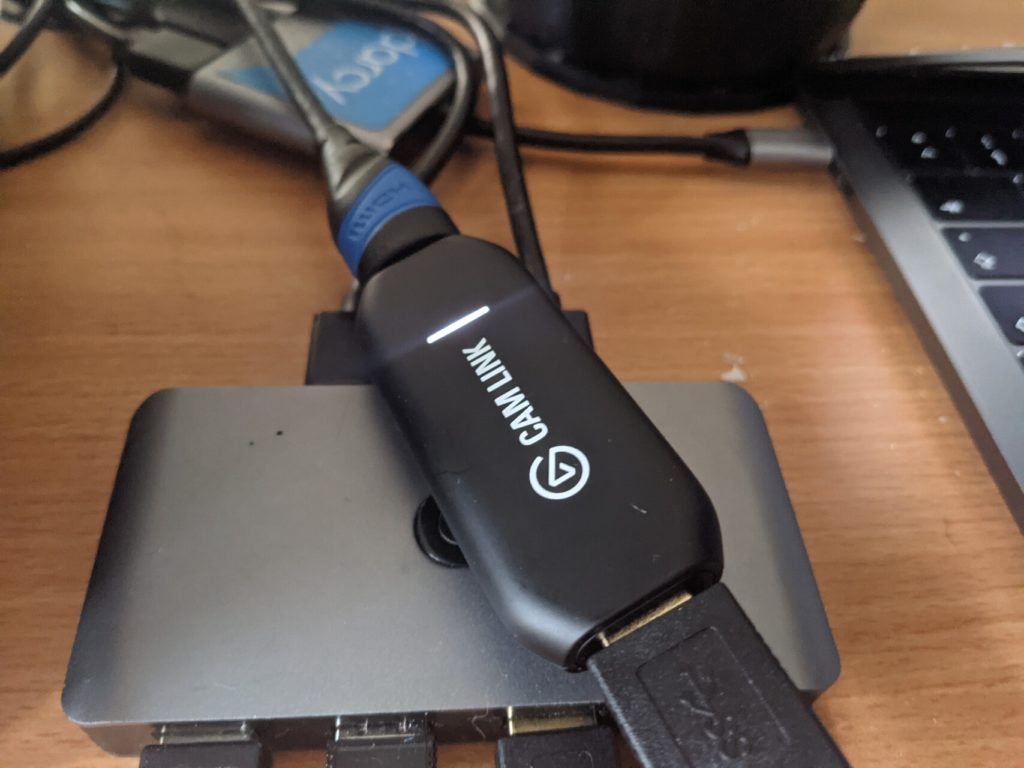
The latest addition to my setup has been a Sony A7S digital camera, sitting atop a cheap camera arm. It is attached to the USB-hub via an Elgato Camlink 4K stick and thus provides quite an excellent alternative to the Logitech webcam. People I videoconference with keep noticing the vast quality difference. Having the background blurred by actual optics instead of some algorithm is really an upgrade. (which I wouldn't have afforded myself if I hadn't gotten a good deal for the camera from someone who realized that they didn't use it all that often.

If you want to use your DSLR as a webcam: Check if it either has a firmware update that lets you use it directly through USB, or that it at least can deliver a “clean” HDMI output. The latter means that there are no on-screen menus visible on the HDMI signal. The Sony A7S does both, but I learned that the USB-webcam functionality is pretty bad. It requires a certain sequence of switches each time you turn the camera on, and doesn't work with all programs on a Mac either.

The Elgato Camlink solves that rather elegantly. The other thing I did was to get a so-called “dummy battery”, which you put into the camera instead of a battery and that then draws power directly from a USB charger. I set the focus to automatic, the camera to “video mode” and now I just need to power the USB cable and everything works.

(if you use Windows 10 and the stick keeps disconnecting – download the Camlink capture software, click on the preferences icon while holding down CTRL and then select “Isochronous” as USB Transfer Mode. That certainly helped me)


I also write about roleplaying games in english und auf Deutsch!
(this is a crosspost from darcy.is)

During the development of our second prototype “Shepherd”, we realised that permissions for truly distributed social media are a thorny thing. Within the decentralised design of Solid, we have to define how spaces are controlled in interactions between users. We also have to be mindful of preserving the context of the interaction, while also respecting the privacy of individuals who might belong to different networks, technical or otherwise.

Three models of organising content

To explain the whole issue, we need to lay some groundwork on what design decisions have been made, here at Darcy, and for Solid as a whole. Those design decisions define how users can control the spaces of interaction. Let me start with how posts and comments are modelled. All in all, there are three major models of how to structure content and reactions to the content in social media:

1. The Forum model

This assumes that someone sets up a space for conversations. That person (or group) takes ownership of the space and can usually control the terms on which people interact in that space: Who is allowed to post, what gets deleted, or who is allowed in the space. Inside that space, people can start a conversation around a topic and others can reply to it.

We see this in web forums that run for example the venerable phpbb or Simple Machine Forums, or, more modern, Discourse forums.

When it comes to permissions, forums are usually managed by either an individual or a group of “admins” who then set out the rules of who can see, write, react to, or even delete things. The individual user then rarely has to think about permissions at all.

Those administrators can remove whole conversations or just individual replies, although the latter can leave the remaining content stripped of context.

A byproduct of this model is that most forums are somewhat of a close-knit group. They foster a group-identity, and often everyone knows who else is around.

2. The Posts-and-Comments model

In this model, everyone can post content and then others can react to it – be it through emoticons, likes, or comments. We see this model very often, it is used by Facebook, YouTube, Diaspora, and countless other systems.

A particularity of this model is that it usually gives everyone who initially publishes content a set of fine-grained controls of who gets to see the content and who can react to it. These permissions then seamlessly apply to the reactions and comments attached to this particular content. This means that those who comment on something have usually no control over who gets to see their comments or reactions – they are visible to the same people who can see the original content.

When the original post gets removed, this usually removes all of the comments and reactions to it too. Comments therefore only exist in the context of the initial post.

As far as I know, most of these systems do not tell the commenters who exactly is able to see the original post and consequently the comments. Most often, the default is that everything is public. A lot of those systems also have a “visible to friends-of-friends” setting, so you can reach out to people you do not actively know, but still be sort of private.

3. The Everything-is-a-Post model

Twitter and its open source derivate Mastodon feature this model. Instead of having a thorough hierarchical structure between original content and the reactions to it, comments are modelled as original content of their own. If you reply to a tweet or toot, that reply is its own new and original content.

This has interesting effects: Replies can be the starting point of their own conversations, completely decoupled from the original starting point. Even if that original post gets removed, the rest stays untouched and can stand on its own. But it also gives a somewhat disjointed user experience, as people often find it hard to correctly piece together the whole conversation. (There is a whole ecosystem of web apps that help collecting threads into a single page.) And when people who reply to an original post limit who can see their content, others might only be able to see a portion of the conversation.

Another side effect is the lack of noise control. “Sliding into ones mentions” can range from being just slightly impolite to outright harassing. The larger the network gets, the harder it becomes to control who can partake in a conversation without limiting oneself.

Why we chose the second model

Darcy makes use of the Posts-and-Comments model of organising these things. We find this to be the best compromise between discoverability, self-moderation (as the original poster can remove comments attached to their post) and data sovereignty (the comments are still stored on the commenters' Solid pod, even when unlinked from the original post.

Distributed content and permissions

In Solid, the permissions to a piece of content are set alongside the content, on the Solid pod where they are stored. As a quick reminder, this is how it looks if Alice posts a picture, and Bob comments on it, we have the following data structure:

  • Alice's Solid pod
    • Picture
      • Link to Bobs comment
  • Bob's Solid pod
    • Comment on Alices Picture
      • Link to Alices Picture

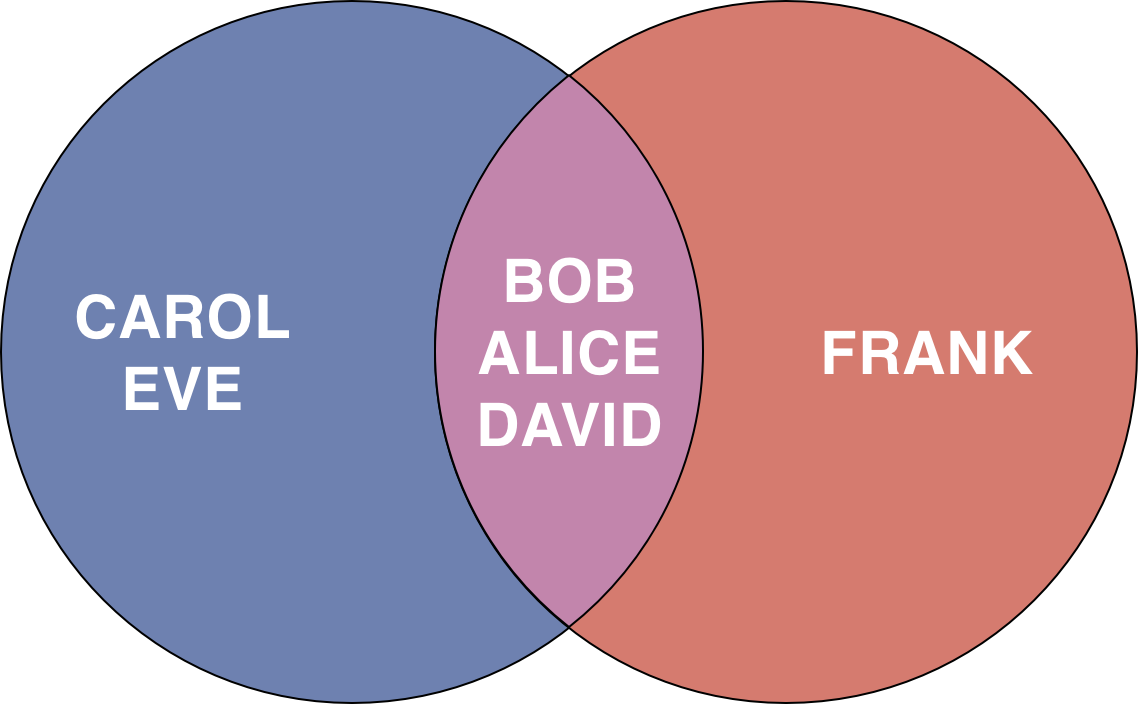
Now, Alice and Bob can freely decide on who gets to see what on their own pods. Alice might decide to show their picture to Bob, Carol, David, and Eve, while Bob has set his comments to be visible to Alice, David, and Frank.

Frank can now read a comment, but would not be able to see the original post (Alice would need to have set visibility for Frank too).

Carol and Eve can see Alice's picture, however they cannot see Bob’s comment underneath.

In the interest of having a non-disjointed conversation, we need to solve this. And when thinking of the solutions, we have to imagine that an imaginary attacker has a a good grasp of technical knowledge, and at the same time assume that the potential victim does not. That way we cover the broadest range of scenarios.

Possible solutions

The easiest solution is to simply have everything public, but that is clearly not working long term. People rightfully want to have the option to only have their content show up for a specific audience.

Solid supports two different approaches, both of which have up- and downsides:

Option 1: When commenting on a post, the commentator copies the permission list from the post and applies that to the comment. This has the advantage that the same set of people who can see the post can also see all the comments. The downside is that it exposes the whole (or parts of the) contact list of the original poster to all commenters. This is obviously fine in a close-knit group, however it may not be fine in larger groups. If Alice makes a post visible to all of her friends, family and coworkers, do they want Bob from accounting to know the names of everyone in that group, just by looking at the metadata of the post?

Another downside is that if Alice later on alters the permissions on the original post, one would need to alter these permissions on all the comments too, otherwise newcomers to the post could not read all the comments. But there currently is no mechanism to apply those changes to the Solid pods of all commenters.

(On the other hand, this second downside could be read as a feature: After all, Bob posted his comment under certain conditions. If Alice changes the conditions later on, then it might make sense that these conditions don't apply retroactively, because Bob didn't consent to that. Of course, that implies that Bob took notice of who could read the original post in the first place. And, for example on a site like Facebook, Bob might not have such fine-grained information in the first place.)

Option 2: All comments are always set to public while the initial post remains subjected to the permissions set by the initial poster. This isn’t as bad is it initially sounds. Due to the data structure of Darcy, the only way to access a comment is by either being the owner of that comment, or by knowing the exact path and filename of the comment. This path and file name are near-randomly generated by the unique IDs of the original post and the comment. Doing things this way somewhat contextualizes discoverability.

So when accessing a post, it will come with a list of URLs to the comments that are linked to that specific post. That means that only those who have permission to read the post get to know the URLs of the comments.

The downside is that if someone leaks the URL to a comment, everyone who receives that leak can access that comment. Anyone who can read the post can get to those comment URLs. One might argue that people could do that with a screenshot or copy-pasted text too, but with those, one can always claim that they are faked. In contrast, a comment loaded from my own pod is clearly created by myself. This makes such a leak in theory much more sensitive.

Ideal Option 3: The ideal solution from our point of view would involve cryptography and an extension of the current Solid protocol. There would be no access control list of WebIDs attached to a comment. Instead the Solid pod where the comment is stored on will rely on a cryptographic certificate that proves that the WebID trying to access the comment currently has permission to access the original post. Only then will access to the comment be granted.

In the above example, Eve reads the original post on Alice's pod. She sees a link to Bob's comment and follows it. In order to load the comment, Eve's client first loads of timestamped certificate from Alice's pod that has a signature from Alice and asserts that Eve's WebID is allowed to see the post. Bob's Solid pod can then verify the signature, the timestamp and Eves WebID, giving Eve access to the comment.

This would keep both the comment as well as the whole of Alice's contact list confidential – Bob will only know about those people who actively try to access his comments.

Why is this a problem specific to Solid?

In a centralised system like Facebook for example, this is actually a non-issue. All permissions are managed by the same central instance. That means that this central instance (and those who control it) is the single source of truth about which permission set is visible for whom in the user interface. Thus the central instance acts as the neutral trusted arbiter, making sure that the permission sets for posts and comments are in sync without leaking any information.

The highly decentralised nature of Solid is what makes this a problem in the first place, as the different actors need to synchronise each other while making sure to only transmit a minimum of information.

Conclusion

Alas, option three is, even though we think it would be best, currently way outside of the Solid specification. We had a lot of internal debate about which of the theoretical harms of options one or two would be worse.

In the end, I consulted with a few privacy experts and internet activists, and the unanimous vote from them was that the exfiltration of contact lists through option 1 would be way worse than potentially being critized for something you really did write on the Internet. This means that instead of for example relying on a (potentially forged) screenshot as proof of what someone has written, people who have access to the comment could now forward a link to the comment to others.

So we will adopt option 2 for now: Comments are formally public, but only addressable from the original post. To mitigate harm, we make sure that those who use Darcy will know that their comments are potentially public, if someone leaks the link to outside of the group. That way, users can take this into consideration when writing a comment.

For us, this was a very interesting challenge. It shows that there are a lot of tricky problems and opportunities when we commit to decentralised spaces. Any social media concept needs to spend a lot of time to think about the various levels of privacy, consent, information, ease of use, and other factors. And we need to make the outcome of these deliberations clear to those who then use the platform.

At the time I am writing this blogpost, the Parler hack happened. This prompted me to make another conclusion: Decentralising the social network through Solid, making sure to handle permissions and discoverability right, makes it a lot safer against this kind of data breach. There is no single point of entry that can be exploited, and no single service that would take the whole network down if compromised.

Of course, a lot of that changes once we introduce the moderation services, as those could in theory become an attack vector, but we do plan to implement them properly and safely.


I also write about roleplaying games in english und auf Deutsch!
As you may know, I am involved in https://darcy.is, an attempt to build a better social network atop of Solid. The developers are chugging along at a slow but steady pace, expect a new version to come out soon.

Solid itself is a really intriguing and awesome idea: Everything you want to share or publish, regardless of public or for a limited audience gets stored on your Solid Pod, completely uncoupling data from application and publisher.

So your theoretical Facebook posts and likes and comments would not be stored and owned by Facebook. They would just handle the presentation and feed and recommendations and so on. And if you want to change the network, you get to keep all your content and contacts.

Now, the way Solid is designed has one big constraint: You cannot change the URL that points at your pod, ever. If you do, all the links between your content and that of others would get lost otherwise. So, if a pod provider would got belly up, that would be a bad thing.

One of the earliest pod providers is solid.community. Or rather. Was. The service is shut down. Which is fine, it was advertised as experimental anyway, it was free and purposely only had a very small storage space. It was meant for those earliest of adopters and for developers to see how all this works.

Alas, someone thought it would be helpful to keep it alive and managed to migrate everything to solidcommunity.net.

Which is also fine and helpful, except two things:

  1. I, as a user on solid.community learned about this whole thing from someone completely uninvolved in this process, basically by accident. The move included my login data, whatever private data I may or may not have stored on that Pod, everything. I have never agreed to this, nor do I have any idea who the new person is. That is a major GDPR violation, and erodes a LOT of trust.
  2. The move is useless. As I pointed out above, now that the URL is changed, none of the linked data is properly linked anymore. It completely broke everything. And considering the amount of data (I think there was 2 MB of available space), it is not even a thing of “hey, people probably want to keep this!”.
![](https://images.orkpiraten.de/image-1.png)
useless people links on my Solid Pod

Seriously, my Fellow Nerds, especially if you work on something that promises privacy: These things matter! No one will adopt your project, if you fuck this up, and here, you fucked up quite a bit.

Before you rant at me: Yes, I am quite aware that what I was using was basically a test system. And I bet that 99,9% of all other users of that system knew this too and acted accordingly. I highly doubt that any actual private data was compromised. And I don't think there is any foul play involved. People did what they thought would be best. But, well, guess what: They thought wrong!


I also write about roleplaying games in english und auf Deutsch!
Back in december 2017 I summed up a bit of my crowdfunding experience. Since then, the number of campaigns I contributed to has about doubled, and of course, the delayed, failed or otherwise troubled projects have added up...

Let's start with the really bad ones, the ones I'd label actual scams in hindsight:

  • Spinward Traveller: What I wrote back in 2017 is still true. There was a brief flicker of life since then, but that doesn't change anything.
  • Zen Blanket: Yeah, this was me being stupid. 'Nuff said.

Then there are the outright failures, where I assume people put an effort in but went about in a naive or incompetent way:

  • The Pulse Dice: First timer dealing with overseas manufacturers and failing. That stuff just happens.
  • Webcam privacy cover: I'm still not convinced this wasn't a scam. Could've been, could've been someone being way in over their head and then cutting their losses. They probably were facing the decision to either fulfill and make losses or not fulfill and keep some profit, and then taking the profitable way out..
  • Rite Press: There are a lot of comparable french presses available, but this one promised the gimmick of having a removable bottom to easily get the grounds out. I think the creator really planned to deliver, then faced quality control issues and now has a stupid mess on their hand.

Of course, there are a bunch of projects that got delayed, but where I am still mostly hopeful that things will work out eventually. They come down into two categories, those with good communication about things, and those with, well, bad to nonexisting communication. Let's start with those that have really good communication:

  • Iron Harvest: Creating computer games is hard, and prone to a lot of failures. These people put in the work, keep everyone updated with excellent and in-depth information and also provided a pretty good beta version of the game too!
  • Reigns

Of course, there are a lot of projects that have too infrequent or outright bad communication:

  • Cartel, a game of mexican narcofiction: This is a heartbreaker game, and the playtest material already looks gorgeous. But it being a heartbreaker means lots of delays, as the writing takes ages, and the author isn't the best communicator either. Still, I'm hopeful.
  • Flying Circus: Another heartbreaker RPG, and it suffers from the same thing: The creator has high standards and little time, nor the planning capacity (in time and effort, not intellect) to have a proper timeline...
  • Velvet Generation RPG: A rewrite of an existing RPG, which seemed straightforward enough, but then got stuck in development hell. Add only sporadic updates, and you get a project that will probably deliver... eventually. Who knows when though.
  • Record of Dragon War RPG: This is a tricky one: I know most of the people involved personally and trust them not to cheat or scam anyone. But this project had to weather a company going bankrupt, a buy-out by a company owned by a japanese-owned corporation, which then merged with a large US one. All of which has lots of behind-the-scenes things that are way above the paygrade of this crowdfunding campaign and thus doesn't get communicated in updates. I still have hopes, but boy, I have no idea when this will deliver at all.
  • Grey Cells RPG: A lot of this has delivered in forms of pre-release PDFs, but there is still a lot missing and only sporadic communication about things. Which is a pity, really..
  • Satanic Panic RPG: Here you can see what happens to an RPG project when the main author has to pay their bills by.. taking on more RPG projects. And then disappears into them. The lesson here kids? Don't take on crowdfunding as your main source of income, you'll end up juggling a lot of plates...
  • Seance and Sensibility: This is sort of good, but could have been better. Still, I got the PDFs at least already.

And then there are those projects, where I completely lost faith in them delivering anything, even though it might still happen, the creatores are still occasionally clamining some sort of progress:

  • The Obsidian 3D Printer: When I backed this, I had done all the due diligence work: There were good reviews of the demo machine by 3rd parties, they already successfully delivered another 3D printer through crowdfunding, the reviews for that one were favourable, and they stated that they were good to go. Then they fell out with their main engineer, lost the rights to the machine as it were and spiralled downwards from there on, with only the barest and most superficial of updates. I don't think anyone wanted to scam the backers here, but this is a case of marketing people failing at hardware. Hard.
  • Making Waves – teaching refugees to build a boat. To be honest, I am happy with what has been done with this so far: A bunch of refugees got to learn how to built a small sports yacht from scratch. Having a launch party at some point would have been a nice extra, but really, I wasn't backing it for the party here.

Some campaigns have actually delivered, but in a way where I don't think that they kept their promises:

  • MagNeo Adapter: I mentioned this in the comments to the last article, nothing more to add here.
  • Lima, the brain of your devices: It worked. Sort of. By the time it arrived, it was too slow, too underpowered and relied way too much on central cloud services to actually be useful. I gave it away for small change on ebay in the end.
  • Snore Circle – anti snoring eye mask: The good thing about this? It was cheap, and is a decent enough sleep mask. The anti-snoring gizmo and the app that was supposed to control it? Well, it got delivered, but it didn't do anything even remotely effective or noticeable.
  • Enclave ANC headphones: They work. But not perfectly so, and weren't the most comfortable ones. Again, I gave them away for peanutes on ebay.

There are a bunch of projects that actually delivered since I started writing this post. All of these have sent me things that are about as good as promised.

  • Fiasco, the game of things going wrong: This is a reprint, where they adapted the core game mechanics to use playing cards. An eminently good idea for this game, and the package is great. They've delivered the digital versions of everything ahread, but logistics and other things delayed delivery. Great game, great update, good communications!
  • the Dun travel pack: Ah, another bag, because I don't have enough. (Seriously, I may have a problem. I am STILL looking for the perfect backpack / daily commute bag). This one was supposed to arrive by christmas, but they apparently had quality issues with a component, and when they figured it out, their supplier dropped out in favour of a bigger contract. That happens, and they communicated things well. The backpack is neat, although who knows when I'll travel again...
  • A workshop game book: Just so slightly delayed, but the reasons are communicated nicely. Good job!
  • Spyra, the fancy water gun: They had a truly overambitious delivery date and rightly moved that to “spring” this year. They overcommunicated these things in a good way, and already have the first 160 production samples in their office. This is how you do this! (Also, the water gun is truly overengineered and cool)
  • Inhuman Condition – a game of cops and robots: This is apparently already fulfilling in the US, and should start soon in the EU. As this is a board game with a bunch of slightly fancy components, delays were kinda unavoidable, but they were still nicely communicated. And they told their backers about tariffs, printing woes, conventions and so on, all useful and interesting information! The box is beautiful and I love it.
  • The Ultraviolet Grasslands: A high concept RPG, mostly developed through a Patreon. The people behind this shared every step of the way, telling the backers when art got submitted, what was missing, why work halted at some point, showed progress pictures and sent out PDFs with intermediate material. At no point were I left in any doubt whether things will be fulfilled, even with the delays that happened. This is an excellent game book, you should buy it!
  • X-Bows mechanical ergonomic keyboard: Before I had a luggage/bag habit, I had a keyboard habit. This project is an excellent example how people underestimated hardware development, especially when it comes to magnetic connectors. And at times, the updates were not as information-dense as I'd liked to have them, but they were there and let us know what happened. The keyboards are mechanically gorgeous, but the software is sorely lacking.
  • The Rainsaber: Nifty concept, and I truly believe that Ben wants to deliver, but boy does the man have bad communication skills and at this point, I don't know if he'll ever deliver. I am very close to formally requesting a refund here.. I got the saber by now, and it is as promised! And to be fair, Ben did throw in a lot of extra parts into the package because I told him of eventually putting together a “Darth Poppins” cosplay.
  • Turbo-Killer short movie: The trailer and concept art were so gorgeous, I had to back this. The backer communication was mostly very good, although there was a stretch of silence in the middle. Still, at no point did this feel like a scam, but always more like “ok, they have shit to do that is outside of this, so give them a break!”. Sadly though they kinda dropped the ball towards the end of the campaign, mostly because the movie rights got bought up by Shudder and that apparently made everything harder? Still, I got the Blu-Ray and all.

Final tally:

  • 5 out of 160 projects are complete failures or scams
  • 4 got delivered, but in a quality that should probably still qualify as failures.
  • 7 open with bad comms
  • 1 open with good comms

I also write about roleplaying games in english und auf Deutsch!
Oder auch: Spaß als Blockwart.

In Berlin ist auf allen Bahnhöfen der BVG das Rauchen verboten. Mangels Personal wird das aber nur halbherzig bis gar nicht durchgesetzt. (Es gibt da Lautsprecheransagen. hah!) Im Ergebnis sind fast immer Raucher auf dem Bahnhof.

So auch heute. Meine Freundin hat Asthma, und als ich da heute eine ganze Gruppe rauchender Jungspunde sah, konnte ich ausnahmsweise nicht an mich halten.

“Macht Ihr mal bitte die Kippen aus? Meine Freundin hat Asthma, das ist echt Scheiße.”

Innerhalb von gefühlt 5 Sekunden war ich umringt. “Was willst Du”, “verpiss Dich!”, “Du sagst uns gar nix!” und so weiter. Mein Hirn schaltete in diesem Moment auf stur, und ich sagte denen, dass das einfach Arschlochverhalten sei, Rauchen nicht ohne Grund auf Bahnhöfen verboten sei, und ich schon weggehen würde, wenn sie einfach nur die Zigaretten ausmachen.

Mehr Kontra, mehr umringen. An dieser Stelle war ich dann womöglich etwas blöd, und nahm einem die mir ins Gesicht gehaltene Kippe einfach ab und warf sie weg. Jetzt geht das Schubsen los (wir sind keine zwei Meter von der Bahnsteigkante entfernt), meine Freundin wird deutlich unruhig, Passanten aufmerksam.

Das Ganze endet damit, dass die Jungspunde sich gegenseitig festhalten, Drohungen ausgespuckt werden, und Passanten mich vom Geschehen wegziehen. Jepp, es ist nun einmal Sache des Opfers zu deeskalieren. “Der Klügere gibt nach” und so.

BVG schreibt, man solle sich an die Polizei wenden, dann könne man das Videomaterial sichten. Und dann? Das ist doch Humbug. Zum einen geht es mir gar nicht um die Jungspunde. Das sind (zwar erwachsene) Halbstarke, denen will ich das Leben nicht versauen.

Und was soll das bringen, jetzt die Polizei einzuschalten? Sollen die auf die paar Halbstärke, die auf den Videos wahrscheinlich nur so gerade eben erkennbar sind, eine Schleierfahndung ansetzen? Und dafür soll ich mir den Abend versauen und lange Zeugenaussagen machen? Ich will, dass die BVG ihr Sicherheitspersonal nicht dazu verwendet, Schwarzfahrer oder schlafende Obdachlose, die niemanden etwas tun zu kontrollieren, sondern um genau die Verhaltensregeln durchzusetzen, die zur Sicherheit da sind.

Aber das braucht deutlich mehr Personal, und dann auch noch geschultes.

Lektion? Was bleibt, wenn man sieht das wer am Bahnhof raucht, und das einen stört? Ignorieren, weggehen.

Was denn sonst? Sicherheitsdienst rufen? Bis der von drei bis fünf Bahnhöfen weiter weg da ist, sind Zigarette und Raucher lange weg. Polizei? Ich bitte Sie! Die Raucher ansprechen? Siehe oben.

Nein, das einzig richtige ist: Leise ärgern, weggehen, vielleicht zuhause noch etwas weiter ärgern. Und wenn dann später mal was anderes passiert, macht man das eben genauso.

Nein, ich hab hier und heute keine Moral anzubieten.


I also write about roleplaying games in english und auf Deutsch!
Ausgelöst von einem seit längerer Zeit latent schwelendem Konflikt in der deutschsprachigen Online-Rollenspielszene kamen mir neulich einige Gedanken zu der Frage, was denn eigentlich eine “Online Community” ausmacht, wo sich solche einfinden, und was unterschiedliche Erwartungshaltungen da anrichten können.

Halten wir einmal ein paar Begriffe und Überlegungen fest:

  • wenn Menschen das gleiche Hobby verfolgen, suchen sie gerne den Austausch zu anderen mit dem gleichen Hobby
  • Damit sind sie aber noch lange keine “Gemeinschaft”. Nicht alle Skatspieler sind dickste Freunde.
  • eine “Gemeinschaft” ist eine Gruppe Menschen, die sich grundsätzlich gut versteht, einen gemeinsamen Umgangston gefunden hat, und gerne Kontakt zueinander hat.
  • Es gibt Social Media Plattformen, “Communities” auf diesen Plattformen, Gruppen und Foren.
    • eine Plattform ist ein Stück Onlinesoftware, dass es Menschen erlaubt, miteinander in Kontakt zu treten. Man kann allerdings auch explizit den Kontakt zu bestimmten Menschen meiden
    • eine Community auf so einer Plattform erlaubt es, Menschen dieser Plattform zu einem bestimmten Thema oder Zweck zu verbinden. Die Community dient hier als Austausch- und Anknüpfungspunkt
    • eine Gruppe ist meistens einfach nur eine eher kleine Community
    • ein Forum ist eine eigenständige Plattform, die in sich eine Community abbildet.

Foren sind damit eine spannende Sonderkonstruktion: Man kann nicht aktiv der Plattform beitreten ohne nicht gleichzeitig auch Mitglied der dortigen Community zu werden. Dadurch, wie Foren die Übersicht über neue Beiträge präsentieren, wird es zum Beispiel in der Regel bewusst einfach gemacht, immer alle Bereiche des Forums wahrzunehmen.

Die Funktion “Zeige Ungelesenes”, die immer die neuen Beiträge zu einem Thema in den Vordergrund rückt, sorgt dabei dafür, dass Aufmerksamkeit auf viel diskutierte Dinge gelenkt wird. Als Thema X vor zwei Wochen aufkam, habe ich mich vielleicht nicht dafür interessiert und es einfach weggeklickt. Wenn die Foren Software mir aber das Thema jeden Tag mehrmal wieder präsentiert und mir damit mitteilt, dass viele andere das Thema behandeln, dann werde ich doch mal neugierig.

Das bedeutet aber auch, dass es schwierig wird, Bereiche oder Menschen bewusst auszublenden. Ein Forum “zwingt” alle Teilnehmenden in eine “Gemeinschaft”.

Eine Plattform wie z.B. Facebook funktioniert da anders: Von vornherein wird hier akzeptiert, dass nicht alle mit allen kommunizieren wollen, und diese Filter sind häufig auch auf Gruppenebene noch funktional – man kann sich leichter abkapseln und andere ausblenden. Alternativ eben auch eigene Gruppen bilden. (Das ist dann auch das Problem: Facebook-Gruppen ab einer bestimmten Größe funktionieren häufig nicht mehr als Gemeinschaft, sondern nur noch als Ankündigungsmethode.)

Problematisch wird das ganze dann, wenn Menschen ein Forum wie eine Plattform benutzen wollen. “Lass mich doch mein Ding machen und ignorier mich” ist ein Nutzungskonzept, dass von Menschen in einem typischen Internetforum sehr viel Selbstdisziplin und mentalen Aufwand erfordert – viel mehr als auf z.B. Facebook.

Lässt sich das auflösen?

Mein Instinkt ist, dass das nicht ohne grundlegende Änderung der dahinterstehenden Technik, bzw. der Benutzerführung geht. So oder so hilft es, wenn Menschen sich online tatsächlich bewusster damit beschäftigen und einigen, wie sie sich sehen: Als Gemeinschaft, lose Gruppe, Gruppe von Gemeinschaften oder etwas ganz anderes.


I also write about roleplaying games in english und auf Deutsch!
Von Zeit zu Zeit schaue ich mir ja bewusst und gerne Filme an, die alle etwas älter sind. Manchmal, weil ich die aus Jugendzeiten in guter Erinnerung habe, manchmal um Lücken in meinem (Pop-)Kulturwissen zu schließen. Hier also mal ungeordnet die Ergebnisse der letzten zwei Monate:

The Associate – Dieser Whoopi Goldberg Film lief in Deutschland als “Wer ist Mr. Cutty” – ein Name, der erst nach gut der Hälfte des Films überhaupt erst genannt wird, als Whoopi ein männliches Finanzgenie erfindet, um als schwarze Frau an der Wall Street ernst genommen zu werden. Der Film ist auf der einen Seite sehr deutlich 20 Jahre alt und wirkt an vielen Stellen überhaupt nicht modern. Auf der anderen Seite ist das Thema immer noch aktuell und relevant. Alles in allem ein amüsanter Film, wenn auch kein Meisterwerk.

Risky Business – Jeder kennt die Szene mit Tom Cruise auf Socken im Wohnzimmer, aber ich hatte den Film bis dato nie gesehen, genau wie Oliver, der ihn auf seinem Blog als richtig geilen Film empfiehlt. Recht hat er.

The Return of the Musketeers – ich habe ja ein Herz für Mantel-und-Degen Filme, und ganz besonders für die Musketierfilme von Richard Lester. Dieser wurde gut 15 Jahre nach The Four Musketeers gedreht, und ist mir lange völlig entgangen. The Return... leidet ein wenig an den viel zu zahlreichen Voice-Overs, und mehr als einmal wollte ich dem Fernseher “Show, don't tell!” zurufen. Aber irgendwann ab der Mitte findet der Film sich, und die Kampfszenen sind wunderschöne Mantel-und-Degen-Kost.

Cutthroat Island – Ein Piratenfilm, der 100 Millionen Dollar gekostet hat, aber nur 10 wieder einspielte. Unter dieser Prämisse betrachtet, ist der dann gar nichtmal so schlecht. Ein klein wenig übertrieben viele und große Explosionen vielleicht.

Pets (1973) – Schmieriger Sexploitation Sleaze um eine junge Frau, die von einer mehr oder weniger hilflosen Situation in die nächste stolpert. Diese sind allesamt überzeichnet und sowohl Männer wie Frauen wollen unsere Heldin mal für Geld und mal für Sex ausnutzen. Am Ende entkommt sie einem irren Kunstsammler, nur um sich dem nächsten anzuhängen.. Dennoch nicht langweilig und ein schönes Sittengemälde der 70er.

The ApartmentTorsten Kleinz hat da eigentlich alles Wichtige zu geschrieben.

Josie and the Pussycats – Hier wiederum hab ich schon alles Wichtige geschrieben.

Vampire's Kiss – das You Don't Say? meme ist recht bekannt. Der Film dahinter nicht ganz so. Zu Unrecht sage ich, denn das ist eine Tour de Force die American Psycho nur unwesentlich nachsteht. Der Film lässt es recht unklar, ob Nicolas Cage hier wirklich von einer Vampirin gebissen wurde, oder ob das alles nur Wahnvorstellungen sind – da wir fast alles nur durch den Protagonisten erfahren, wirkt das Erlebte nur um so mächtiger.


I also write about roleplaying games in english und auf Deutsch!

I'm not entirely sure why I'm doing this, but man, this is a treasure! I'm liveblogging, so this might be disjointed...

The movie first shows you an absolute inanely hyped boy band that has to die when they figure out some nefarious plan from their record company representative played by Alan Cummings.

How do they die? Plane crash. How does Alan Cummings order it? “Take the chevy to the levy”

We then get introduced to the titular girl band and learn that they don't have any audience at all, but they are obviously cool, full of rock'n'roll and generally loveable. Also some interpersonal tension and we get to know the handsome but clueless love interest.

Then we realize how full of product placement the movie is. Like, two brands a second full. I think there is no shot that doesn't feature an obnoxiously obvious brand logo. Apparently this ties in to aforementioned nefarious plan, but right now, we don't know how. But an emo girl gets annoying enough that Alan has to order her kidnapping: “smells like teen spirit”...

A short 4th-wall break later the band is hired. (After a short gaffe by Alan which hasn't memed at all: He says he's so proud to meet all the Pussyhats) Everyone and the annoying hanger-on girl gets on a plane to New York. Why her? Because she's in the comic, she tells us.

Finally we learn what the evil plan is: The Mixmaster 6000 adds in a bunch of subliminal messages to get kids buy lots of stuff. Evil. Genius. MTVs Behind the Music just exists to explain the downfall of those bands that don't play ball...

A week later they are #1 on the billboard charts and the band will get a biopic, starring Drew Barrymore. Everything is peachy – or is it?

(also: It's funny to see how many of the internet brands prominently displayed in the movie are defunct now. Everything non-internet is still relevant though)

Then the ditzy band girl ignores the creepy warning about the music and we cut to the romantic confusion between Josie and the loveable but dumb love interest. The sexual tension immediately gets defused by Alan Cummings bursting in and sweeping Josie away to some gala.

At the big party the girls get suspicious and the evil record label owner and Alan cumming plot murder and do dramatic evil laughs. But they can't kill the whole band, because they have already ordered a gazillion electronic mind control pussycat ears

(also, there's even advertising inside a frigging giant fishtank. Evian water, if you need to know.)

The murder plot is underway while love interest tries to get a gig and Josie soaks in a bathtub after being pressured into compliance by Alan Cummings. It gets foiled by “if I weren't a key player in this nefarious plot to brainwash americas youth, we could totally date”, cued by ditzy bandgirl smashing some brains in.

But woe! The bathtub soak came with listening to brainwash-music, so Josie is now convinced that she doesn't need the band, so DRAMA!

The band is broken up, Josie is slave to the brainwashing CD and who knows if friendship will ever prevail?

Ah, she is running, and then she falls, the CD stops and she finds the magical bus pass of friendship and ominous music shows us that things will get better!

Only that now the other two girls are gone, “like a flock of seagulls!”

To the studio to inspect the CD! And lo and behold, they find the hidden message, voiced by Mr. Moviephone. The plot is uncovered and what happens now? (they actually played the dramatic dun-dun-DUHN! jingle for this!)

Some blackmail about fiery car-death, Josie agrees to play the concert that will brainwash the masses. But not before some heart-to-heart friendship talk that hopefully will make things everything up. Shot while Mel and Bel are in a car that is slowly revolving on some presentation platter.

AND HERE'S THE TWIST!

The boyband from the movies beginning is NOT DEAD AND SAVES THE DAY! They landed the plane just fine, but they got beat up by Metallica fans, which is why they kept being missing.

Ok, they don't save the day, but they were a good diversion and now we have a cat fight and can watch Rosario Dawson beat up Alan Cummings.

Josie is clever and tricks the evil record label lady into smashing the brainwashing machine.

Turns out, the actual evil plan was to brainwash everyone into loving evil record label lady, and to hide her lisp. And this is the moment where Alan Cummungs recognizes her as Lisping Lisa and reveals himself to be Whiteass Wally, so the two former high school losers admit their faults and love to each other. IS THIS THE TOTAL HAPPY END?

The government that wanted in on this shuts down the whole thing and arrests the bad persons because it turns out, subliminal messages work better in movies!

And then we do get the big final concert. Will the band actually rock, or was it all smoke and mirrors? (spoiler: No, everyone still loves them, after a short tense moment where the audience just stares wordlessly, now that the mind control headsets are off)

And then we get the inevitable love confession between Josie and Love Interest. They kiss, but Bel has to remind them that they are actually in the middle of a song and should shelve it for later...

And that's it. Yes, you want to wach this movie. It is stupid, but fun.


I also write about roleplaying games in english und auf Deutsch!
I'm your prototypical nerd, sports never came easy to me. Over my childhood and youth, various teachers and trainers tried to change that, but I was content being unsporty and reading books.

Thankfully, my metabolism and various eating and movement habits formed in my youth prevented me from gaining too much weight. As a resuilt, I am still overall slim and have retained some minimum level of physical fitness so I can take the stairs if I need to.

But I am also in my mid-forties and work a desk job. There aren't enough trained muscles to keep my back healthy. Some parts of me go slightly flabby and I carry more than a bit of superfluous around my mid-section. All of this gets even more noticeable due to the lack of muscles being trained to keep everything straight.

All this, and the drive to LGN (Look Good Naked), kept nagging at me in intervals to adopt a sporty habit. I tried a lot of things: Gym memberships, running, martial arts, biking, pilates, using an ergometer at home. Alas, nothing really stuck for more than a month. Sports is just so damn boring, and often also frustrating. I don't get any sense of achievement except of being exhausted and sweaty.

I realize that for a lot of people that state of exhaustion is what they perceive as achievement and that they get satisfaction from it, but I never made that connection. I'm just miserable from it.

Then, earlier this year I discovered Virtual Reality as a fitness motivator. First Beat Saber, and then BoxVR, which turned out to be even better for this purpose. The basic game is simple: Blobs fly at you and you have to hit them with your fist at the right time. The blobs come in at various heights and you have to hit them at different angles. Occasionally some obstacles appear, forcing you to duck out of the way.

There's music and a highscore, all the trappings of a videogame, so the whole thing doesn't get pegged into the mental space of a “workout”, but, well, a videogame.

But make no mistake: For the average un-fit nerd, this is very much a workout! On average, I burn about 400 calories within a 30 minutes session. That rivals running a treadmill in HIIT or joining a vigorous spin class.

The great news: I have been doing this for nearly every weekday for a few months now. There was a break in the routine when my PSVR headset broke down. Eventually I replaced it with an Oculus Quest, which rids me of all the cables and thus gives me more flexibility in terms of location and time.

Two weeks ago, I added Guided Tai Chi to my routine. I make no assumption that this is anything like real Tai Chi, and the girlfriend says that the end result looks rather amusing instead of elegant. But it is surprisingly relaxing and taxing at the same time: You stand in a simulated landscape that is quite beautiful to look at. Then there are two translucent spheres dancing slowly through the air in front of you, while you try to follow them with your hands. The end result sort of resembles Tai Chi.

And it is effective: Keeping the arms stretched out in front of you, and moving them in precise and slow movements is surprisingly taxing. After 10 to 15 minutes the arms start to ache a bit, and I feel the muscles holding my spine.

So this is my routine now: When I get up in the morning, I don the VR goggles and first do 15 to 20 minutes of sort-of Tai Chi, then another 30 of sort-of boxing. This has become an actual habit, which is a new thing for me and sports.

I don't follow it completely on weekends when I occasionally sleep in, but for weekdays, this is set. And I start to notice the effects too. Nothing outrageous, but a bit more tone to the upper body and arms, a bit more stamina.

So, if you're as nerdy and unsporty as me, you might want to look at getting into VR. It works for me, and the technology has matured enough to be really simple to use and setup.


I also write about roleplaying games in english und auf Deutsch!