Roleplaying Games

As much as I love being an “improvise first” game master, I do fair bit of preparation ahead of planned game sessions.

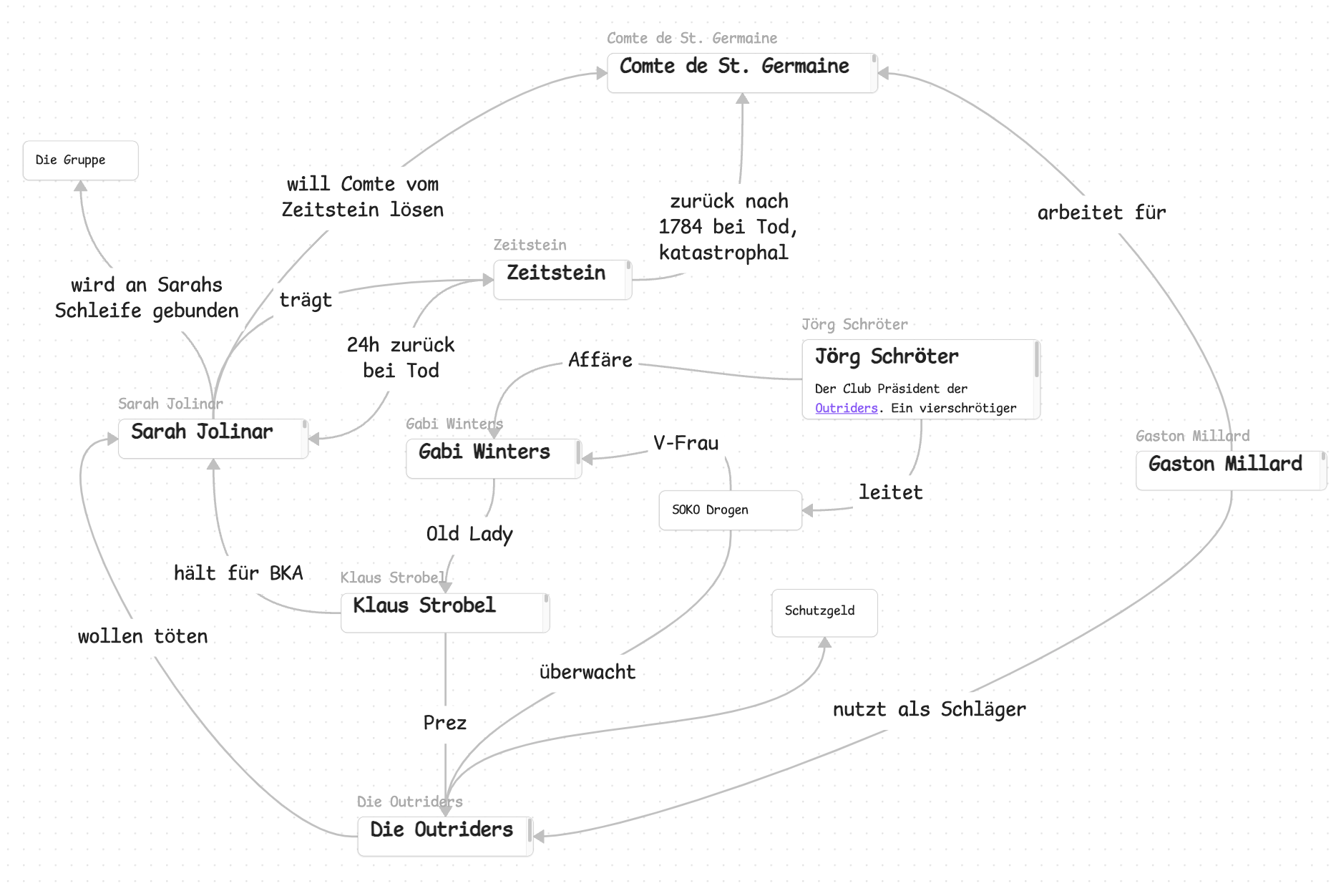
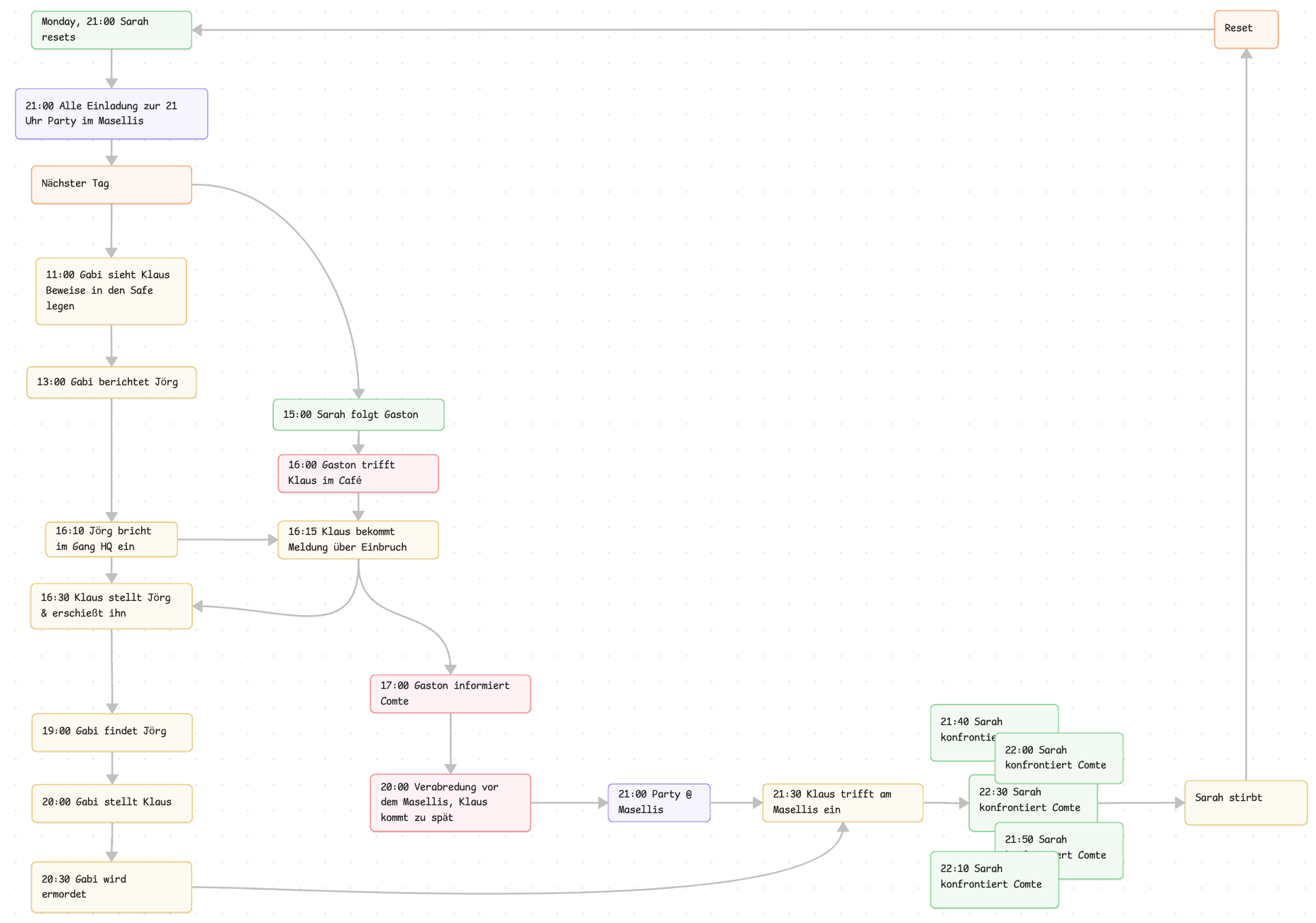
At the very least, I have a decent diagram that shows me the different factions, events and locations.

For example, here's two graphs that I set up for a Dresden Files RPG session I did a while ago.

First off, there's a mindmap of the major players, objects and things they do. A mindmap showing different persons and their relationships

And then, because it is a time loop adventure, I needed to make sure I grokked the timeline: A colourful graph showing a timeline of events

(Apologies to my non-german peeps – the text is all gobbledygok to you now :) )

Anyway, this sort of thing is nearly always part of my prepwork. Additionally, I of course set up at least rudimentary stat blocks and rules for the different NPCs and enemies, but how much I do here varies highly from game to game.

And when I run a Raiders of Arismyth game, which is very much focussed on battlemaps, 3D terrain and miniatures, I of course need to set those things up too. I prize myself for being a fast game master.

That means that I put a lot of effort in to prevent those moments where a player announces and action or asks me something, and I then need to look for the answer in a stack of paper for a few minutes, or where I'd fiddle with the music to get it juuust right, or having to fetch a miniature from the other room.

So I stole an awesome idea from Wyloch – The staging box: I have boxes that have shelves in them, where I can “stage” different parts of the adventure: Whole rooms, areas, corridors, encounters, and so on.

So when I need them, I can just reach into the right shelf and presto, the new dungeon set piece is on the table. Mine are actually a bit bigger though: That way I can use pre-arranged and decorated rooms, made from Dungeon Blocks. To make them nice I decorated the boxes with old RPG posters and illustrations, Mod Podge is good for that, and it makes the boxes even sturdier.

I do recommend doing prep, even if you're otherwise mostly improvising. #pnpen #preparation


Für deutschsprachigen Rollo-Content gehe zu https://write.orkpiraten.de/rollenspiele/

As you might have noticed, I've been busy in my free time with my completely self-written new roleplaying game “Raiders of Arismyth”.

Unlike “Mail Order Apocalypse”, which was me applying a wild hair setting idea to an existing ruleset, this project has a different background: I wanted to play in a particular style, and was lacking a game system for that. Not to say that there aren't systems that could work for this, but there would be compromises and homebrew rules and so on, so I might as well start from scratch!

It is now a bit over a year later, and I'm nearing the finish line. A good moment to take a look back: What design goals did I have in mind, what kind of fun did I want to capture, and do I think I succeeded?

The main drive was that I had accumulated a lot of painted and unpainted fantasy miniatures over the past 30-odd years I'm playing this sort of games. And most of the time, they have been sitting in display shelves or boxes, not being used at all. And I really wanted to use them!

So, I wanted a regular game where I could bring them to the table. And there is a fun in moving them around, counting squares and looking at possible tactics. The game I wanted should support this.

Wanting to have miniatures on the table also sort-of dictates what kind of scenarios and adventures you play: There is little sense of setting up miniatures for a court intrigue, or a detective adventure where the majority of the session involves talking to a bunch of people.

So, combat scenarios it is, and most often, this means dungeon crawling.

And that brought up the next requirement for my prospective new game: I didn't just collected miniatures over those 30-odd years. Of course I also have a library of adventures and scenarios. It's a hodge-podge of systems and settings, ranging from one page scenarios to sprawling megadungeons. I should be able to use those in the new game!

Let's make this a list:

  • I want to use miniatures

  • I want a dungeon/combat focused game

  • I want to be able to easily drop in lots of different scenarios and adventures

Some other things are also important to me, regardless of the game system or setting I play: I like to play fast and player-centric. While I do enjoy the storytelling parts of being the dungeon master, I don't want to monologue. Instead, the players should be the ones who talk most and who drive the action as much as possible.

I'm most content if I can lean back and react to the players, instead of dragging or pushing them towards a goal of my own.

That also means that I don't want to be bogged down by too many complicated rules. Every time I have to stop the action and look something up, things get delayed too much in my opinion. So the rules should be very clear and concise, and allow me to come up with rulings on the fly that don't feel out of place.

So, let's add two more requirements:

  • Have simple and consistent rules

  • allow for as much player-empowerment and player-centric game as possible

That said, I wanted the game to be accessible to new players, but also provide mechanics and crunch for them to sink their teeth into. Videogames have these skill trees, where one can plan and map out a progression, looking forward to that juicy power at the far end of the tree.

That makes another two requirements:

  • easy enough to start playing within 15-30 minutes of introduction

  • deep enough so that experienced players can plan ahead and spend time “tinkering”.

And then I added one last requirement simply for personal taste:

  • Certain tropes and “problematic” content should be left out. I always for example hated the pseudo-dilemma of “orc babies”.

Let's have a look at the individual requirements and how I tried to meet them in terms of game design:

I want to use miniatures

“Just put them on the table.” might be the most straightforward answer, but I also wanted the to be useful for the game. So squares-based floorplans, movement rules and other mechanics that are derived from miniatures were added. I didn't want to overcomplicate things, so I left out things like which way a miniature is facing and the like.

As a corollary to the use of miniatures, I wanted to make combat a very dynamic thing. Combatants should be moving around a lot, instead of just standing there and bashing at each other. I tried to help this by adding skills and rules that promote lots of movement, and penalized standing still.

I want a dungeon/combat focused game

This didn't need a lot of conscious effort to make it happen, but having it listed as a requirement did inform me a lot on what I could leave out of the game. There are no rules for social conflict, diplomacy, ruling fiefdoms or similar things. I left out rules for overland travel, or rules to keep track of consumables.

I want to be able to easily drop in lots of different scenarios and adventures

This led me to two things:

  1. I needed to make the game world open and vague enough so that I can drop in a broad variety of other content into it with minimal fuss

  2. Have some sort of idea of how to easily convert monster and NPC statistics into my own ruleset.

To be honest, I haven't really tackled the second part yet. Mostly because I didn't need to so far, but I think it won't need a lot of work. My monster stat blocks are usually short enough anyway, so adapting others should be easy.

For the first part, I found inspiration in the world setting of Earthdawn: The world gets rediscovered after the survivors of some cataclysm finally come back to the surface.

My worlds cataclysm was a war between an evil goddess and the rest of the world. In the end, she was defeated, but half of the continent became inaccessible for a thousand years. That made the south both known (from really old maps and books) but also unknown and dangerous (a lot could happen in those 1000 years).

The player characters are those brave adventurers who venture into the south to rediscover the lost parts of the world, and just maybe preventing that evil goddess from rising again.

All this really allows me to drop in nearly anything that is even remotely of the “fantastic” genre. The world in the south is mostly just the sketch of a map, leaving enough room for nearly anything.

Have simple and consistent rules

When writing “Mail Order Apocalypse” I really fell in love with the Into the Odd ruleset again. With just three stats and an “everything is a save” mechanism, one can easily find rulings for every situation.

Except, I don't really love-love stats. And I especially didn't want too much randomness for character creation. No randomness at all might even be best, at least for the core character bits.

Instead, I came up with the idea that “everything is a skill”. Those can be purchased with advancement points, and that's it. And each skill is a competency. You either are competent, or you're not. No “I'm 64% good at swimming”

Mechanically, I settled on a pool system, where you throw as many dice as you have skills connected to the task at hand, then count the successes – with each single dice having a 50:50 chance to be a success. Figuring out things usually simply involves sorting and counting dice. No complicated addition or subtraction needed.

That base mechanic is used throughout the game and it proved to be working well throughout playtesting. And I could easily adapt things to new situations on the fly: You get extra dice when something helps you, or you loose successes in certain circumstances.

Player-empowerment and player-centric game

This ended up being more a “how to run the game” philosophy than hard rules. This is not a story centric game where players have rules-encoded ways to create facts like in Fate. Instead, the rules are written in a way that explicitly leaves a lot of decision-making with the players, and only demands dice rolls when things are very unclear, otherwise favouring the “yes, that works” answer from the referee.

Easy enough to start playing fast

It is really important to me, that people can jump into the game pretty easily, if guided by a referee who knows the rules.

I prepared character sheets that have all the important bits as checkboxes and easy-to-fill forms, as well as a simple random table to populate ones inventory in one go.

All in all, creating a character takes only a few choices: What five advancements to take, how to distribute life points, and what to put into the inventory. Add a name and a quick description and you're good to go!

There is very little math involved in this, next to no dice rolling, and not too much agonizing over the skill choices: Five advancements is not a lot, and people tend to spend them fast.

Deep enough for experienced players

This is where the skill tree really starts to shine: People can explore and test and think about different combinations of skills and magic. There are a few obvious combinations, but also a lot that are not so obvious.

The skill tree really offers a lot of flexibility but also planning-ahead material.

Avoid “problematic” content and tropes

The classic thing I wanted to absolutely avoid are things that can be tinged with racism. In-game populations that are evil by birth just rubs me the wrong way, and it creates moral pseudo-dilemma like the “innocent orc baby that will absolutely grow up to be a bloodthirsty monster, so should you kill it right now?”

I scratched the whole notion of lots of different sentient “races” and instead ruled (inspired by this blogpost by Cavegirl) that there are no other sentient populations or “races” than humans. Of course, there are monsters that do monstrous things, but there are no civilizations of orcs that are jus there.

(In fact, in my game world, Orcs are human corpses brought back to beastly life by some otherworldly evil entity)

Similarly, there are no elves or dwarfs in the game world (although there are humans that might fit the stereotypes in some way). Getting this right while keeping to some “fantastic” vibe is still a work in progress, but I'm getting there.

Generally, the world is more and more borrowing from classic “medieval” tropes and clichés, so my players can expect a lot more monsters from that sort of place.

Conclusion

I think in terms of the rules mechanics, the game is done. Of course, there's always more spells and skills and abilities I could add, I should probably revise a few of the random tables a bit, write out more examples and have an editor have a go at the rules to make sure they are really as legible as I want them to be.

And then there is the world: It is evocative, but with only very broad strokes, leaving a lot of room for anything I might want to add later.

It very much supports a West Marshes Campaign style of gaming, where groups from a large stable of characters form and disband to explore different places and return home to report. I have managed to set up some sort of overarching thread and threats, but the player characters are still trying to get a grasp of what exactly these are.

I do wonder if I should write the background of these threads and threats into the gamebook, as inspiration for other referees, or if that would ruin the blank canvas and rob others of the chance to build their own world of the Kari. (Kari being the name of the human empire the game world is centered on)


Für deutschsprachigen Rollo-Content gehe zu https://write.orkpiraten.de/rollenspiele/
It is a few months since I finished Mail Order Apocalypse, and apparently, writing games is a tiny bit addictive: I'm already about 70 pages into writing the next game. (For comparison: MOA clocks in at 106 pages, a lot of them being random tables)

So, the next game, what is it?

The working title is Raiders of Arismyth, and it is supposed to be a modern dungeon crawler. Which is slightly unusual territory for me. My gaming shelf has lots of “story” games, with abstract mechanics, collaborative narration, player empowerment and so on.

But I also have collected a few hundred gaming miniatures over the years, and I wanted to use them again! I prefer games that are rules-light, easy to grok, and ideally have not too big character sheets. There are a few options of course, but none of them really appealed to me.

With Mail Order Apocalypse, I decided early on that I didn't want to reinvent a whole game system, and thus chose Into the Odd for the mechanics. For Raiders of Arismyth, I wanted something that feels similarly simple, but does offer more crunchiness on two fronts: Character generation and advancement, and combat. Especially the latter – it doesn't make sense to bring miniatures into the mix when distances and such isn't particularly relevant.

At the same time, I didn't want the system to be too mathematical. Choosing how to advance ones character shouldn't require too much in-depth system knowledge. Choices made today shouldn't completely block later choices.

In the end, I have settled on a few things:

  • There are no attributes, just skills

  • There is no vancian magic, and no mana points or similar either. You know a spell, feel free to cast it as often as you like!

  • Dice are rolled in pools. Any result on a die that is greater than half the total value (ie. 4+ on a 6-sider, or 11+ on a 20-sider) is a success.

  • Combat should be about movement. Those miniatures want to be moved around after all!

  • The rules aren't just there as mechanical abstractions, they are there to form the game world and its metaphysics.

Sadly, all this means that where Mail Order Apocalypse managed to cram all the rules onto one single page, the core rules of Raiders of Arismyth need about 10 pages. Let's dive into how magic works a bit, so you can see what I meant with the last bullet point about the rules influencing the game world:

Magic spells are learned as skills. Learning a new spell skill allows you to perform the least powerful version of that spell with an uttered incantation plus necessary hand-movements using both hands. With additional advancements on that spells skill allows one to make it more powerful, extend the range, or be able to cast it without an incantation or moving the hands.

In order for this to work, the spell and the advancements are tattooed onto the skin of the magic user, anchoring the mystical energies. The positioning of these marks is important, especially if the mage still needs to touch it to perform the spell. One can learn a lot about a mage by looking what sigils are placed where. And of course, seeing someone who chose to spend their precious advancements in order to be able to perform a simple light spell without any hand movements or spoken incantations tells you something about them too...

I did a few test runs with the system already, and the results were quite promising: It played smooth and easy in turns of rules application, but also allowed for some a lot of interesting tactical choices during combat. The latter felt deadly enough to the players, but not overwhelmingly so.

A lot of things are of course still missing: The skill list needs to be finalised, I need to flesh out the example magic rituals, think about equipment, or at least rules on how to improvise weapon statistics in a coherent way, and the world wants some more fleshing out.

But overall, I am quite satisfied with this, and really think this is actually a more complete game than Mail Order Apocalypse (which is more of a setting than a game). You can buy the Ashcan preview edition for a buck at DriveThruRPG if you're curious. But please, let me know your feedback!


Für deutschsprachigen Rollo-Content gehe zu https://write.orkpiraten.de/rollenspiele/
…so many people over the past few days again, it was delicious. It was that time again, where a plethora of nerds descended upon the non-existent town of Bielefeld and gathered to eat, drink, be merry – and play games!

The food was delicious, the drinks came in just the right amounts and potency, the merriment filled the days but I guess what you really want to hear about are the games. Let me indulge you. I've been…

…a progressive alien species, trying to gain control of the galaxy during its second dawn. Alas, I could not make use of my extraordinary powers of research, as every attempt to expand my realm was thwarted by the vicious robotic remnants of the Ancients fleets. During most of the game I just held on to my meager three sectors, eking out some technological progress. Only once I managed to assemble a fleet and watched it get annihilated by the Ancients in a short but brutal fight. (Eclipse, Second Dawn of the Galaxy)

…a successful Unicorn Breeder, filling my stable with the most wondrous of creatures, scheming and plotting to bring misery to my fellow Unicorn enthusiasts, trying to be the first to fill all slots in my stable. A hilarious game, full of puns, innuendo, and most of all, unicorns! (Unstable Unicorns)

…a sailor, a pirate, no, a cultist, trying to direct the course of our ship to the chosen location. Covert collaborations with fellow pirates or cultists, mutinies, bluffing, and the occasional surreptitious changes to the logbooks steered our proud ship. And never did it reach the safe harbor of Bluewater Bay, but instead got fed to the Kraken or entered the dreaded pirate island… (Feed the Kraken)

…a greedy innkeeper, luring adventurers into a near-certain deathtrap. My cunning plan was to feed them to the naked-bear-thing I had chained to the dungeon below my humble establishment. But the motley crew of ne'er-do-wells and murder hobos managed to not only dispatch my minions and beasts, nay, they made off with all of my ill-gotten-riches and escape through the undersea on a magical obsidian rowboat. (The Undertavern, run with Into the Odd rules)

…Loddar, the DIY-King of YouTube, hiking through the black forest as part of a streamed challenge, with four other more or less well-known internet celebrities. Loddar, a cabinetmaker in retirement, gained internet-fame when his grandson filmed his antics testing how well the new rip-stop trousers would protect him against a chainsaw. Clueless about technology he now got thrust into a gaggle of youngsters who film themselves doing weird and (to Loddar) incomprehensible things for the sake of something called “Likes”, which he didn't quite got. But his grandson said this was good stuff, and the likes would translate into income somehow, and Kevin knew computers after all. What followed was deliciously silly, full of drama and eventually even action, with high speed car chases and bullets flying everywhere! (a custom adventure with a d100 FATE derivative)

…an english industrial baron of the 19th century, building factories and transport links all across the Black Country, vying for domination through two distinct eras of early industrialization, seeing train tracks started to displace the narrow boat channels. A brainy but accessible game with glorious artwork and theme. (Brass Birmingham)

…Peter Rath, the holy sinner and bearer of the tome of 99 demons. A moderately famous fiction author, secretly a vampire of the White Court, Peter spent the past few years very privately, minding family and his own affairs. But the recent devastation of Berlin and the retirement of his sister from her office as head of the paranormal investigation unit drew him out of hiding once more. He joined a small task force trying to figure out what eerie things were responsible for recent oddities around the local cemeteries. Weird Pterodactydemons were fought, ancient religions uncovered and a long-term plan on keeping these forces of evil at bay became implemented. After an inspired lecture, Peter found himself the head of a new holy catholic order, secretly blessing places to protect them, and doing who-knows what else! (Dresden Files RPG)

…a middle-aged summer camp guide in the Midwest. She desperately needed a job, and found a lot more than expected, when she walked into the lone guy who squatted in one of the camp huts, hastily shoving something into a freezer. A few hours of increasingly bloody and campy fun and drama, topped by two women chainsawing a Wendigo into sausages. (Fiasko)

All in all an excellent few days, a fun NYE party and a welcome reminder of good friendships.


Für deutschsprachigen Rollo-Content gehe zu https://write.orkpiraten.de/rollenspiele/
If you have followed this blog for a while, you know that I do a lot of crowdfunding as a backer. Kickstarter alone lists over 200 projects that I have backed in some way.

Well, now it is time for me to jump into the other end of the pool: I have just launched the Zine Quest 4 campaign for Mail Order Apocalypse! Follow this link to the campaign:

https://www.kickstarter.com/projects/jollyorc/zine-quest-mail-order-apocalypse/

What is it about?

Mail Order Apocalypse (or MOA for short) is a dark future roleplaying game, where capitalism eventually shut all humans out. Paradise is within humanity's reach, but our ancestors made sure we cannot afford it.

This may look to be a game about survival, figuring out how to eke out an existence when the machines have claimed everything worth anything. But that isn't entirely true. This is a game about daring heists and robberies!

See, the machines don't hate us. They don't actually want to kill anyone, but the laws humanity put into their programming don't allow them to give us anything for free. And we don't have currency to pay with. So survival takes the form of trying to make a living in the wastelands, trying to farm algae, or to recycle the scraps we find.

But the more efficient and much more fun way is to trick or rob the machines:

We hijack their communication network, set up a pretend address and then have a drone deliver your order while the fake credit score is still good. Or you hold up one of those post trains that link the factories, overcome the guard machines, and live richly!

Some have learned how to infiltrate the automated farms. One can live well there, provided the machines don't recognise you as the pest you are.

Of course, there are also those who live on the work of others, who raid settlements for their own gain. Maybe you are one of them?


Für deutschsprachigen Rollo-Content gehe zu https://write.orkpiraten.de/rollenspiele/

It has been a while. So long that I couldn't even find my stack of characters and had to roll up a new one.

But yesterday, I returned to Hypogea, the karst under the valley of fire. Joining the Clockwise Observatory as Alpascal, a short, stocky first-year student of the School of Artificers with an everful crock of shit.

This was a very happy reunion, even though I didn't know any of the other players yet. Still, Alpascal was quickly welcomed by his peers, and the backstory involving Alpascal, a frog, and the chimerists love spell ended up happily for me, as the chimerist now has to care for the five pollywog-creatures. (Who are adorable, but Alpascal isn't ready to be a father yet, and Fred the frog needs the help,)

The group made its way to the sickle marsh, looking for the lone savant that imprisoned a few errant students into some gem. They swam, stomped, rafted and walked on the way, met water vipers, cephalopod patrols and other assorted creatures and during the whole time never stopped punning.

Really, the punning, it was bad. So bad. All the time. All the punning.

Can't wait until next time!


Für deutschsprachigen Rollo-Content gehe zu https://write.orkpiraten.de/rollenspiele/

And no, we're not talking about war. We're talking warGAMING and roleplaying games.

I was in town for Bread & Net, and when we were walking the city on sunday, we came across a game store: Multiverse. And frankly, this place is awesome:

![](https://images.orkpiraten.de/IMG_20191117_143706-1024x768.jpg)
It is mostly board games though

The staff is actually pretty knowledgeable and full of hustle. They know their games, have several painting stations for the table top gamers in the cellar, host regular wargaming and MtG tournaments, you can rent tables and play a wide variety of board games (sorted in terms of complexity, so you can easily grab something easy for the family from the shelf), and then they told me they also have a dedicated D&D room.

“What?! I need to see this!”

Behind a door labelled “Emergency Exit”, I then first was greeted with this...

![](https://images.orkpiraten.de/IMG_20191117_143323-768x1024.jpg)
yeah, this thing is a bit cheap looking, but A for effort!

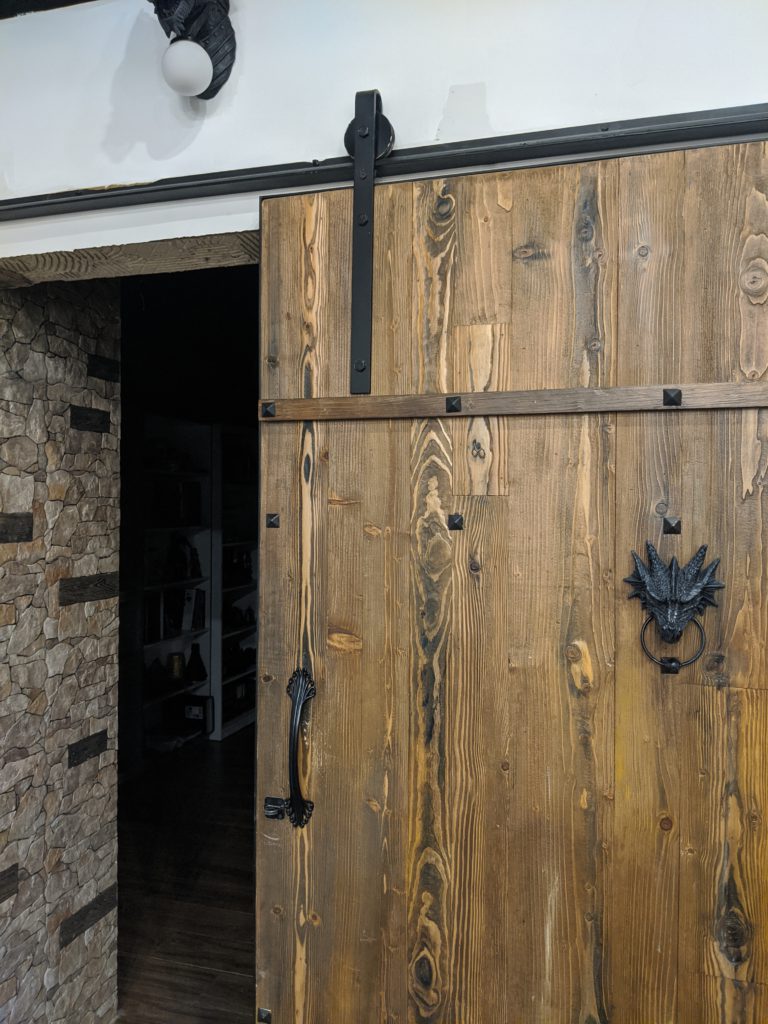
And then there was a foreboding doorway..

Let's light this up...

![](https://images.orkpiraten.de/IMG_20191117_143307-768x1024.jpg)
oooh, this looks promising!

You can see the D&D library. Plus a bunch of self-printed PDFs, downloaded from online stores.

![](https://images.orkpiraten.de/IMG_20191117_143300-1024x768.jpg)
yeah, I was pretty amazed.
![](https://images.orkpiraten.de/IMG_20191117_143131-768x1024.jpg)
really, I like this.
![](https://images.orkpiraten.de/IMG_20191117_143148-1024x768.jpg)
I could get used to this.. All the space for the savvy GM.
![](https://images.orkpiraten.de/IMG_20191117_143138-1024x768.jpg)
looking at all the nifty stuff on the walls.
![](https://images.orkpiraten.de/IMG_20191117_143129-768x1024.jpg)
but wait, what is THIS?
![](https://images.orkpiraten.de/IMG_20191117_143124-1024x768.jpg)
THEY EVEN HAVE A DICE TOWER!
![](https://images.orkpiraten.de/IMG_20191117_143207-768x1024.jpg)
need monsters for your campaign? We got you covered!
![](https://images.orkpiraten.de/IMG_20191117_142655-1024x768.jpg)
a bunch of custom lasercut 3D signage all over the place.

They even get you in touch with GMs that can run games for you, if you find yourself in Beirut without a group. Really, this place is magical and apparently thriving too!

So, when in Beirut, go to Multiverse!


Für deutschsprachigen Rollo-Content gehe zu https://write.orkpiraten.de/rollenspiele/

I can't quite believe it, but it's been one and a half years since I started writing my own RPG, Mail Order Apocalypse.

On the upside, it is mostly done by now. What is left is a lot of editing and layout, both things that will mostly be done by people better at these things than me. Looking back to the past 18 something months made me realise quite a few things though:

  1. Commissioning artwork for your prospective new game is a neat thing to kick yourself in the butt and get going, but it is no cure all. I commissioned mine from Alex Mayo – that man is a pleasure to work with.
  2. MOA started out as a “powered by the Apocalypse” game. I wrote a all the basic moves and a lot of the class-specific ones, but eventually hit a dead end. My main problem was that I had nifty ideas for a “Desperation” status, which never quite came together.
  3. So, when Paolo Greco mentioned Into the Odd to me, I got me a copy (thanks Harald!) and things immediately clicked. This is the simple basis I was looking for.
  4. “Simple” means that MOA is a great pick up game. A new character is made within a few minutes and the rules are super easy to grasp.
  5. Providing simple stats and a randomized but eclectic starting equipment also means, that players have just a handful of things to grab on to when starting the game. But these things are evocative and inspiring. Every player I had so far did something interesting with the starting equipment within the first hour.
  6. The loot and encounter tables started out as an exercise of coming up with “silly, but believable” stuff. But in the end, they have constantly created a set of loot that felt rewarding enough and also inspired players to, again, do something interesting with it.
  7. One leftover from the games PbtA roots are found with the referee instructions. Adhering to them ensures that the game coasts along the fine line of forcing the survivors to constantly do something, but never made them succumb to desperation.

I look forward to finishing this, and who knows, maybe more than a handful of people will buy it.


Für deutschsprachigen Rollo-Content gehe zu https://write.orkpiraten.de/rollenspiele/

Life is full of coincidences: As I am reworking Mail Order Apocalypse into an Into the Odd hack, Norbert is tinkering with the same rules too: He is adding active parry to the game.

The rules he adds are pretty straightforward, but while I wouldn't go as far to call them heresy, I won't adopt them. It'll make a “roll once to determine damage” thing into three (the number gets significantly higher if you add initiative) rolls with a bunch of arithmetics.

I can understand what Norbert wants to achieve here, but it is way too much dice rolling for my taste. One of my core tenets for a good roleplaying game is that it should be fast. The faster I know what is happening next, the better. And this bogs things down. Still: Hooray for tinkering. Tinkering is what brings us forward!


Für deutschsprachigen Rollo-Content gehe zu https://write.orkpiraten.de/rollenspiele/

Yesterday evening, I spontaneously joined the monthly RPG night at our friendly local game store Otherland. Without any real preparation I offered to run a game of Mail Order Apocalypse and actually got 5 players. To cope with the minimal prep, I again used the simple “let's rob a train” starter scenario that I also used at the last LasagnaCon. This is what happened:

A Barn Rodent, the Equity Scion Baron Monsanto-Unilever, his court Genealogist, a Preacher of the machine cult and one daring Post Robber faced the ugly truth that their small settlement only had enough cans of mediocre Chili con Tofu to last them over the next three days.

Being thoroughly sick of the stuff anyway, as this was the only food option they had for the last month, they decided to get proactive. The Post Robber got onto his motorbike to scout out the train tracks, and check if they could use the same ambush spot as last time.

The spot still looked useable enough, but there was also a squarish looking droid working on the tracks. The Post Robber made a daring jump from his speeding bike onto the back of the droid. There he could see the stencilled logo: “Grip-Master-3000”. Apparently, the box was busy making the tracks more “grippy”, so trains wouldn't have to slow down on this slope – foiling just the thing the Post Robber used to exploit on past heists!

So, the decision was made: This droid had to die. Or at least be stopped! So he took his trusty halberd and smashed it right into the control panel – stopping the Droid dead on the tracks.

This apparently triggered some emergency notification system: For the next few minutes, signal flares got fired from the Grip-Master-3000, undoubtedly calling for more droids to help it.

Thankfully, this was also seen by the rest of the merry gang, who soon joined the Post Robber. Together, they soon came up with a plan: Use the Genealogists blowtorch to cut the tracks, make the grippy tracks extra slippery with the hydraulic oil from the damaged Grip-Master-3000 and thus make the next freight train run off the rails.

It wasn't too hard to enact this, but in the middle of all the cutting and oiling, the Barn Rodent heard an electric whine of an armed surveillance drone coming closer steadily...

In the end, the group managed to defeat the drone, derail the train, disarm the trains self-defense mechanism, use dry ice to create an impromptu bomb, blowing up the second surveillance drone while hiding from the blast in king-sized fridges and made off with 144 cans of spam, barrels of light beer, half a ton of frozen peas, and novelty bow ties for everyone!

The players had a great time. Shifting the underlying rules from PbtA to the really simple OSR-rules of Into the Odd enabled me to get the players started within a few minutes with minimal introduction. My new random tables to pick archetypes and their gear gave everyone just enough things to have a feel for their survivors and the varied equipment made them come up with quirky solutions to the problems they faced.

I did realize though that the loot table needs to be seriously expanded to be not too repetitve, and some extra notes on how to create more complex scenarios need to be included too.

Nonetheless, I am very pleased about yesterday evening.


Für deutschsprachigen Rollo-Content gehe zu https://write.orkpiraten.de/rollenspiele/