Orkpiraten

Thinking and Playing and Testing

This morning, I had a conversation with Karl H. Richter about data. He argues that data is money – and I mostly agree with him:

Sometimes we may want the tech companies to be trustworthy custodians, holding our data safely without being stolen or used without our consent – or we may want them to actively invest some of our data on our behalf, to work productively in the economy in exchange for a risk-adjusted return.

Karl on expectations with regard to handling data

I quite like this change of perspective. But I think there is something missing here – what happens if these custodian or “investment managers” fail to keep our data safe? If we stick to the “money” analogy, that would mean that the data is simply gone.

And yes, occasionally, this actually happens; just ask MySpace. Most of the time, though, data doesn't get lost, but instead gets copied. It is a pet peeve of mine when these get labeled as “data loss” or “data theft” by those who report on it. Often this gets confounded by saying that the company who was the custodian of that data would be the victim here.

Please, nothing could be further from the truth, let me explain why and how:

  1. The data is usually still there. The company whose database was breached still has all their data. They can continue their normal operations, deliver goods and services, write bills, everything.
  2. The incident involved the companies servers, but they are not the true victim in these cases – it's the users whose data became compromised! I would rather say, that the companies in question were more of an accomplice in this, by being (often willfully) negligent about their security practices.

The more fitting analogy for most data breaches is an environmental disaster. Think of it as a containment breech in a nuclear reactor. The reactor still produces energy, but the environment around it is damaged in ways we cannot entirely foresee. The long term effects are rather unknown and vague, depending on lots of external factors no one can fully control.

Worse: As with environmental disasters usually hit hardest on the most vulnerable or marginalized people, so do do breaches. And as with environmental damage, they are cumulative: Once the data is out there, it usually never goes away. And the more small pieces of my private data are known, the more they can be combined into something more dangerous.

For the privileged, it is easier to cope with data breaches. If I'm a millionaire, I can simply move when my home address gets compromised. Sure, it's a nuisance, but it is completely doable. If I am living on minimum wage in an area that is under gentrification pressure, I won't be able to afford a move.

If my sexual orientation, religion or race gets published (I'm a white, cisgender heterosexual atheist), I'll have exactly nothing to fear. If I were gay and lived in Saudi Arabia, the same data piece suddenly becomes life-threatening.

So, we should think about data as if it were radioactive money. Whoever controls it can use it to generate wealth with it, but if it spills, there will be long lasting unfathomable damage.

We need to hold the custodians of our data accountable to the highest standards. And if they fail at their jobs, we shouldn't let them get away with it as easily as we do today.


I also write about roleplaying games in english und auf Deutsch!
Let's start with some context: I'm a Kickstarter backer for the Kodama Obsidian 3D printer. The thing is long overdue, as so often happens for hardware crowdfunding campaigns. The backer communication was spotty at best, but two weeks ago, CEO Michael Husmann started posting video updates where he gave an apology for all the delays and promised more regular updates for the future. So far, that promise holds, and I also had an opportunity to do a quick visit of the Kodama office in Berlin.

The office is as tiny as the Kickstarter Update video shows: One room in a coworking space, crammed full with four desks and a shelf holding 3D-printers and parts. There are printers on the desks too!

![](https://images.orkpiraten.de/image-1024x768.png)
me (on the right) and the Kodama Berlin team

So, right from the outset: Kodama is definitely an existing company, and I do believe they are working hard on finishing and delivering a 3D printer.

The Furling situation clearly doesn't sit easy with the Kodama team, and I can't say how things exactly broke down, and right now, I also don't care.

In the end, the situation is as it is: Kodama had to transition from “marketing, product management & fulfilment company with a trusted partner to develop and oversee production” to “do everything on your own and from scratch”. That is a major pivot with a very steep learning curve.

So yes, they did burn more money than planned when calculating the Kickstarter, but Chris and Michael reassured me that they do have the funds to finish production and ship everything. There's still revenue from the Trinus coming in for example, and they are also releasing a new Trinus version soonish.

Having to switch their sourcing agent in China didn't help the schedule either, but the new agent seems a lot more helpful and active.

![](https://images.orkpiraten.de/IMG_20190430_134610-1024x768.jpg)
The Obsidian without housing, but with the penultimate version of the PCB. The build bed is a BuildTak metal sheet (covered in blue tape here) that is magnetically attached to the platform.

Nonetheless: I saw a working printer prototype, and the team obviously understands the machine down to every detail. They know exactly which parts will end up in the production model, and are in the process of reviewing all the sourcing offers for them.

A thing that I didn't exactly realize until today was that they won't use the standard nozzle/heatbreak system that you for example find at Ender type of printers. Instead the nozzle will be in a proprietary form-factor and being held by a quick-release system, so you can exchange it quite easily. Might be old information to some, but I didn't know :)

I also quite like the quick-clamp mechanism on the bowden feeder. My current printer is a CR-10S, and the one on the Obsidian looks&feels a lot more finger-friendly!

https://youtu.be/yaGdlTqfjWM
The printer in action

The PCB has iterated a few times and as of Tuesday, they were eagerly waiting for the courier service to deliver the latest version. The one before had minor electrical noise, easily fixed. If that one tests out fine, they'll have the golden sample and the PCB can go into production.

But other things are in a bit of flux: The LCD UI isn't done yet, the app is still being worked on, and most of the parts that comprise the Plus and Deluxe versions are not final yet either.

When I asked for status on the sourcing, I got an exhaustive run-on-sentence answer on how they do it, what kind of things are on the desk right now, and that things are progressing, and so on. What I wanted to see though was a simple burndown chart: We need X parts, have sourced Y, which leaves us with Z. Once we have everything, we need to do steps A. B, and C.

They obviously do know what they need to do and what the status of all these things is. But they don't have them in a simple list where they can cross them off. Because no one has the time to make that list.

It's something I recognize as similar to what I've seen as an consultant when I was visiting overworked IT departments: They know they have a ton of work ahead of it, and so many people feeling let down and being impatient, they just hunker down and get crunching, pulling ever-longer hours and digging down ever-deeper, never actually getting the breathing room to implement the things that make work easier or faster.

So, when I mentioned that burndown chart, I think I accidentally broke through the fog: Michael immediately understood what I meant, and why it is obviously something they need, so we should hopefully see that in the next Kickstarter update.

To summarize: Those are passionate folks who really want to deliver what was promised. They are fighting an uphill battle. This is partly due to things that happened outside their control, and partly because there were probably some overly optimistic assumptions when starting the Kickstarter campaign.

But they seem to have all the things they need to finish this. As to the when – I am no hardware production person, so I can't comment on that. But I also understand Michaels reluctance to give any sort of specific timeline after having overpromised one time too many.

Still, I'm pretty positive that I will have my own Obsidian Deluxe eventually. To say it with 3D Realms iconic words: “When it's done!”

Disclosure: This post would have included ramifications on an idea that a few backers voiced on the Obsidian Creatives Facebook group. Everyone at Kodama seemed pretty excited about it, as it would help avoid delivery delays for a portion of backers. Alas, that idea might very well not work due to technical restrictions, and Chris and Michael asked me to not get anyone's hopes up, until at least they've cleared the unknowns on this. I think that is fair enough, so I leave that part out.


I also write about roleplaying games in english und auf Deutsch!

Last year, on a whim, I backed the Rainsaber on Kickstarter:

https://www.youtube.com/watch?v=cPK1Dzc3tYY

Then, while waiting through the inevitable Kickstarter Project delivery delay, we watched Mary Poppins Returns – a movie that is sort of ok, but Emily Blunt ain't Julie Andrews, sorry.

Anyway, while watching the movie, we riffed around the title, and ended up saying that it being the second movie, it should've been called “Mary Poppins Strikes Back”. And then I mentioned off-handedly that we're getting a lightsaber umbrella kinda soon...

Your parents lied to you... I am your nanny!

Darth Poppins

So, with Nordcon coming up in June, and the saber hopefully arriving before that, we're working on a Darth Poppins Cosplay. It'll revolve around the umbrella, and of course it'll need the correct pommel.

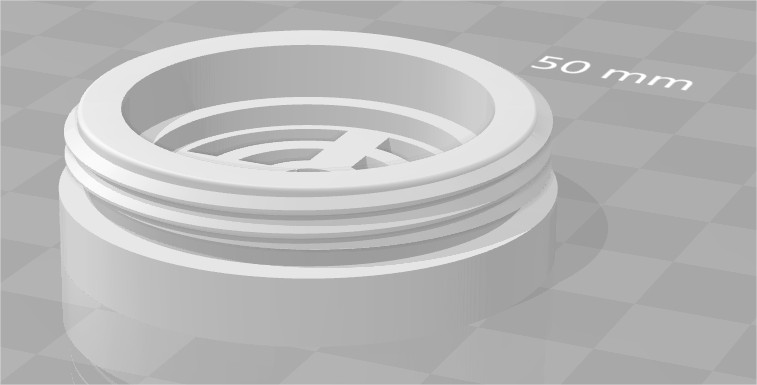
Thankfully, Ben was game and sent me the 3D file for the pommel cap:

And with some 3D builder magic, this emerged from my printer:

![](https://images.orkpiraten.de/Darth-Poppins-adapter.jpg)
Spit Spot, this death star won't built itself you know!

The parrot head was a bit more challenging though. The first try came out WAY too big:

(yes, that is 14cm width. Basically impossible to hold comfortably.)

I tinkered a bit more, and now got it down to a comfortable size, it just needs painting and, of course, the actual saber. In the meantime, the girlfriend needs to do the sewing for the actual costume, but that's not my department anymore.. :D

![](https://images.orkpiraten.de/Darth-Poppins-right-size.jpg)
Use the force, choke them, the lads. choke them, choke them, choke them, the lads.

I also write about roleplaying games in english und auf Deutsch!

Yesterday, I had a lengthy discussion with a proponent of big centralised social media platforms. Not because they have a particular love for big companies, but because moderation is actually one of these issues that are hard to do right.

The numbers I could find say that about 20% of all content posted in social media needs to get removed from moderation. Most of this is probably automated spam and similar, but there is also a fair amount of graphic violence, outright porn and, because humans are terrible, abuse and hate.

Moderators who have to sift through all this have the worst life, not few of them have to get counseling after a while.

So if you do moderation, you have to have the infrastructure in place to deal with large volume of content, the wellbeing of your staff, all the hassle of dealing with complaints about your moderation plus whatever regulatory requirements are needed.

Typically, this calls for a large scale operation.

Now, one of the reasons this happens is because people behave differently in a large-scale corporate environment than within their smaller circle of friends and acquaintances. If your social media pod is run by someone closer to you, you tend not to shit the bed so to speak. Because you know that your behaviour will possibly reflect poorly on your host.

If you federate the system, good moderation will still be needed, but it is entirely possible that one won't have to deal with that many bad things, especially if there is an option to cut off whole pods from the federation if they behave too badly.

Of course, that last bit needs to be very carefully tuned, lest it results in censorship.


I also write about roleplaying games in english und auf Deutsch!

While going through the Spreadsheet I created as a tool after writing the last blogpost here, I realized that what was completely obvious to me, isn't necessarily to others. Mostly because the whole argument about the details was mostly in my head.

So, let's write it down:

To start, and to have a common vocabulary, we should set down a few basic communication model parameters:

  • Realtime versus Asynchronous.
  • One to one vs One to Many or even Many to Many
  • Closed vs Open
Realtime is the discussion we have at the breakfast table, or when we trashtalk our opponents inside a videogame, in a meeting, over the phone or even text or video chats. The key element is that it happens in real time, attendance is perceived and people generally consider it rude if you make them wait for an answer too long. Asynchronous communication is much more robust in regard to time constraints. In olden times, we simply knew that the messenger pigeon will take a while to deliver that missive to the King, so we waited. Letters took their time, and it was acknowledged that the recipient will then need time and effort to compose a proper answer.
One to One is a discussion with just two participants. That can be realtime (a phone call) or asynchronous (a letter). One to Many used to be the prerogative of official proclamations, public speeches and, later, newspapers and radio or tv broadcasts.
Many to Many is something that we have quite a lot today on the Internet. A group of people communicating within itself, or with another group of people. Sometimes in there, you have a few separate one-to-one conversations. Sometimes everyone is listening to just one person, sometimes everyone is broadcasting at once while no one listens.
Closed communications strive to be private – no one outside the elected circle may listen in – or they may listen in, but they are not allowed to participate. Open on the other hand is there for all to see, hear and join.

And on top of those models, we have the selectors by which people decide which communications they want to see or even participate in:

  • Serendipitous discovery
  • by topic
  • by curator

Serendipitous discovery of new topics, persons and discussions is something that is, in my mind, incredibly important these days. We need to be exposed to ideas and persons we wouldn't have thought of otherwise. We often don't know that we were missing an idea or something before we actually found it. I cannot search for unknown unknowns.

What I can look for are topics: Show me articles about that car I plan to buy. Or I'm looking for a place to discuss my new favorite game. Systems that make it easy for me to find those topics are helpful – but they tend to keep me in that bubble, I don't often learn about things outside that topic.

Human Curators of content are incredibly important. Malcolm Gladwell calls them “Mavens” - a group of people that hunt out information about things and then strive to educate people about those. These curators are often very similar to a discovery by topic, because they usually have a theme, a thing that they are mostly interested in. But not exclusively so. Everyone has side hobbies, interests that are not obvious, and these make their way into the communication stream of a curator too.

Finally, we need to look at the different bits of communication and who owns them: This is less interesting in a face to face conversation in a room, without any technical tools, but gets really important very fast if you do things over the Internet.

Take this blog article here. It is written by me, posted on my Blog. I wholly own and control it – I can delete it if I want to, I can edit and revise it.

I also control the comments that are submitted on this Blog. If you have something to say about this and want to correct me, you can submit a comment here, that everyone will then be able to read.

But I will still own the comment in some sense – I will be able to hide it, delete it, even completely ban you from ever commenting again. Heck, Wordpress even allows me to edit the comment, putting words into your mouths that you have never intended to write!

(I could have a variety of reasons to do so: I found what was written offensive. Or deemed it to be just not helpful for the discussion I wanted to have. Or I just don't like the commentator. Some of these reasons can be completely legitimate, some are somewhat to very hostile)

If you want to assure ownership of your writing, you will have to do so on your own Blogpage. You could write an article of your own, pointing at mine and say whatever you want to say and I could not immediately delete it.

Different communication systems handle this ownership differently – Twitter, Mastodon and similar systems don't know any post-comment separation. Everything is a post, and every post fully belongs to the person who made it. That has upsides (as no one can maliciously remove your contribution) but also downsides (no one can easily take stewardship of a discussion, not even with the noblest of intents)

Lastly, there are some concerns about safety: Sadly, there will always be people who use communication systems to harass others. They could use technology to stalk people, flood their screens with hateful messages or simply spread rumors and lies about them. A good system will need a few tools to address that:

  • mute a person (prevent them from talking to you. They can still see your content, but are unable to show up on your screen)
  • block a person (same as muting, but they will also be unable to see your content)
  • throw someone out of the whole communication network (they cannot interact with anyone on this system anymore, at all.)

Not all of these tools should be in everyone's hands (I should be able to decide that someone cannot see my things anymore, but a complete ban needs a higher and accountable authority), and not all of these need to be applied for a lifetime – sometimes it is sufficient to mute someone on just this one conversation, or for just a month. Sometimes people learn after a ban and come back as a better person.

So, having set down some definitions and ideas, how does all that relate to what I expect from a system that allows me to interact with others on a daily basis?

  • In case you haven't noticed – I love the serendipity aspect of the Internet. It is a machine that keeps showing me new and exciting things and people.
  • I also am more interested in persons than topics – so I have a greater need to follow those, instead of just subscribing to car-news and roleplaying games.
  • Even if everyone comes with the very best intentions – moderation of a discussion is important. And I prefer if those moderation powers come in very small packages, limiting the scope of the moderation to just certain parts. If not, this can quickly sour a whole community if things go wrong.
  • I believe in ambient findability. That means that it should always be easy to see the whole discussion, and where they branch off. Threaded views are key for this.
  • Text – I love memes. Really. Communicating ideas and feelings with bits of moving pictures is a great thing. And I love gorgeous photography or a well-made video. But to convey complex ideas, Text is still the best carrier. Sure, make it illustrated and hyperlinked text, where you can look up related information. But due to so many restrictions (screen size, disabilities, can't have audio on because I'm in a quiet place, I just don't have the bandwith because #Neuland)
  • Lastly, and this has nothing to do with the things I outlined above, whatever system we use to build our social media stream with, it should be as open, portable and vendor-lockin-free as possible. Because we learned the hard way what happens otherwise...

I also write about roleplaying games in english und auf Deutsch!

I do love participating in social media. It was around 1994 when MiGri introduced me to the world of BBSes, the Fido net and everything online. To be honest, I haven't regretted a single thing from that.

At some point, I ran my own BBS, I joined Usenet, installed AOL and CompuServe until was I actually able to get a “real” dialup account at Hamburg University, and spent countless nights on IRC and online RPGs.

The upside of all this was always the same: Technology connected me to new topics and interesting people. That is what the Internet and especially Social Media is for me: A tool to get me introduced to new things and people.

Of course, I also want to use technology to stay in contact with them, but once I am connected to someone, life will..  find a way. Really, staying connected to someone is not what I need a particular tool for. If all fails, I'll have their email address or a phone number.

But having conversations in a place that ensures that new voices will join that conversation regularly, especially new voices that are somehow still vetted to not be too obnoxious or disrupting, that is the true magic of the internet.

And for a good while, Google+ was the place that did that for me. I don't know quite how this worked, but it did – whenever an interesting conversation happened, new faces popped up, and a click link on their profile let me know if they were also interesting.

(I realize I'm writing this in the past tense, even though the system will stay online for another 10 months from now. Well, write for the future, they say.)

The fact that the system never pretended to join “friends” with each other, and adding someone to their circle was a decidedly one-way action, ensured that your circle of acquaintances grew steadily. One could always decide to publish certain posts to only certain circles, but if you posted public, it was just that – a way to engage with a wide net of possibly unknown people.

At the same time, it was possible to keep a semblance of control over who appeared within your own comments. You could moderate the comments or even ban too obnoxious persons from your interactions.

And now the hunt is on, to find a similar platform that does the same for me and my peeps. And as we learned, we are looking for a very specific feature set:

  • The basics:
    • Safety (don't open me to lawsuits, don't put me in danger of malware or bad people)
    • privacy (don't expose my data without my consent)
    • “it should just work”
  • The socials
    • built for serendipity, so focus on public or at least semi-public interactions
    • be abuse-aware: Allow moderation, banning and the like.
  • The nitty-gritty
    • don't have a complicated backend that I need to learn to post or moderate
    • discussions attached to a post are good, nay, mandatory
    • threaded discussions are even better
    • emphasise on text. It can be rich-text, it can involve pictures and videos, but text is still where discussions happen.
  • The open
    • don't be a closed silo
    • don't belong to a single company
    • ideally, be federated and allow for moving between instances

So far, none of the systems I know ticks all the boxes though...


I also write about roleplaying games in english und auf Deutsch!

At some point I will write a lengthy explanation why prohibiting private cars in inner cities will become an inevitability. All the green folks will rejoice over all the newfound clean air and all and will conveniently ignore that it was the dreaded fear of terror that finally brought this to us.

This is not that explanation, it's about something else: “Incels” – People, specifically men who blame their lack of romantic involvement, specifically the lack of sex, on women. And then maybe drive trucks into people.

Matthew Graybosch on Google+ put my general opinion of those into pretty clear words:

As such, I'm about to lay some harsh fucking truth on you: if you're truly involuntarily celibate, you deserve it.

But that is only my general opinion. Because, as usual, I also have a more specific one:

Every cluster of teenage kids will have a few kids that sit on the sides, not truly belonging to the main group. That happens, it's highly regrettable, but it just happens. And if the broader culture where these kids live in puts a high value on being sporty, good looking, attractive, the kids on the sides will be what we commonly refer to as “the nerds”

I was one of those as a kid. Not truly outcast, but a bit on the fringe. Enough so that when a former classmate was talking to her kid about bullying she decided to contact me to get some “inside info”, because after 30 years, I was still stuck in her head as “the (slightly) outside one”.

I also distinctly remember a time when puberty acne, being awkward and 'the computer nerd' while also seeing the surfer guy getting the attraction from all the right girls, let me briefly believe I might end up that way.

Privately.

In my own head.

Without having a word for it. Because, frankly, there was no 4chan or reddit or whatever where I could safely express that stupid idea and then end up in an echo chamber where I would reinforce that rough idea into a solid belief system.

Instead, after a few months of teenage angst and wallowing in private self-pity, I eventually worked up the courage and asked that girl I fancied out for a movie. A few weeks later, the concept of me staying a virgin forever involuntarily was thrown to the ash heap of history.

Enough confession time, what is the point I want to make here?

I think that “incels” are truly a creation of the internet, combined with the toxic concept of maleness . Without having that place to mutually reassure themselves in that stupid concept, looking at what they see “how things should be” in media, they wouldn't be able to construct that bubble for themselves. And without that bubble they would have a chance to get happier.

Brotopia, which I'm currently reading, points the very same thing out, although in a different frame:

When minorities are forced to self-identify as minorities, their performance suffers. Sociologists even have a name for this: stereotype threat.

“Incels” are a very tragic example of a group of people that wished themselves into being a minority and then reaped all the negative effects that came with that.

The frightening thought is that a lot of those of us who nowadays look at them with scorn might have fallen into the same trap, if the tools of today would have been available to us.


I also write about roleplaying games in english und auf Deutsch!

For a bit over 5 years, I'm more or less regularly participating in Crowdfunding campaigns. Most of the stuff is geeky technology or gaming things, but there were also art, music or fashion projects.

Kickstarter alone counts 89 successfully backed projects. Of those, these actually failed to deliver anything to me so far. (By that, I mean that I have actually given up any hope of receiving any useable product, to the point where I don't expect to get anything at all):

  • “Pulse” Fudge dice ($15) The concept looked nifty enough. Alas, the creator apparently misjudged the difficulties of dealing with overseas manufacturers and eventually just gave up and disappeared. Sad, but really a not much of a loss. I kinda feel bad for the chap as I got the impression that he really tried.
  • Spinward Traveller TV Pilot ($15) Another fifteen bucks I won't see again. The campaign spammed me with adverts to buy model space ships for further financing, showed me some badly edited scenes (apparently all actual filming got finished at last) and then amused me with links to pages where someone really got a hate-boner for the creator about allegedly constantly scamming potential TV production investors. I don't know about that, at least something got done as far as I know...
  • MagNeo Adapter ($59) I am a bit upset about this one. It was supposed to deliver a mag-safe like USB-C adapter, but nothing has arrived so far at my doorstep and those who did receive something report that it's shoddy and useless. The after-campaign updates suggest that the creators just ran into way more manufacturing problems than they expected, so instead of bad faith, I just ran into a bit of incompetency – which is always a risk with crowdfunding campaigns.
  • Intelligent Security Camera Cover (35 CHF) Ah.. this looked so easy and foolproof, but it got endlessly delayed and is now being shipped at an agonisingly slow rate – if at all. Hope Xavier had a nice time skiing. Yes, I strongly suspect a scam here, especially as there was an companion Indiegogo campaign and the creator netted half a million in all and now keeps complaining about lack of funds...

So... that is about 130 loss out of over 6.000 Euro I sank into crowdfunding over the years. About 2%, not too bad if I look at it that way.

Of course, there were also a few campaigns that only sort of delivered. I got the product, and it does what it says on the tin, but not well enough to be actually useable. (I'm looking at you, Lima.)

All in all, I'm pretty relaxed about crowdfunding by now though. There are a few projects that just take way longer than I ever expected, but the creators keep updating, explaining and communicating with their backers, so I'm not really worried. And projects like Matter, Secret Hitler, Scythe, Kung Fury and wonders like The Wrylon Robotical Illustrated Catalog of Botanical 'Bots really made the whole crowdfunding experience fun and rewarding for me. And how else would a project like the IT Barrier Tape come to life?


I also write about roleplaying games in english und auf Deutsch!

A while ago, I explained how we have fewer adbreaks here in german TV. Of course, we cought up a bit over the years, but it's still a socialist paradise in comparison. But there is also of course a distinct... german-ness to the ads I was seeing as a kid and young adult. Even when these ads were supposed to take place in a big city in the USA:

https://www.youtube.com/watch?v=yfp2Bg6iUdY

I, and probably a lot of my german friends were utterly convinced that this is America. Cars, cool people, sunshine, car telephones, the works. Nothing in this ad struck me as anything but American.

Boy was I wrong. My girlfriend insisted that all the US kids were constantly weirded out by this odd german ad. How can this be? Nothing german ever makes it across the pond, right? Well, I went to the Internet and found out that this is indeed a work by  Pahnke & Partners. (“Pahnke” being such a cliché german name, I still think it must be a subsidy of Pahlgruber & Söhne)

Still, we also had ads that were much more distinctively german. They then mangled Mozart for fun and profit (with very subjective measures of fun):

https://www.youtube.com/watch?v=X1sUSnzgrD4

And yes, every brand needs it's distinctive jingle, here's the one for Lagnese ice cream:

https://www.youtube.com/watch?v=XkHmMUD6Rdo

(“Nogger” is, by the way, named after it's nougat core. Pop culture germany was and often still is ignorant when it comes to how to handle race issues. That slogan roughly translates to “get a Nogger on”, and it still boggles my mind.)

At least, that song got a country makeover to make it better:

https://www.youtube.com/watch?v=RsOvjAtBWFw

Eventually though, german advertisers cought on and some brands went for.. something different.

Ever heard of “Einstürzende Neubauten”? (translates to “collapsing new buildings”) If not, here's a sample of their work:

https://www.youtube.com/watch?v=FiQ7IbJEsoE

The lead is Blixa Bargeld, and he did amazing spots for the DIY chain Hornbach:

https://www.youtube.com/watch?v=0kdLmXRmEec

In case you wondered: He's reading copytext from the stores catalog.

Later on, Hornbach goes full on feelings:

https://www.youtube.com/watch?v=mk5-bH0WQOQ

And before you doubt me, yes, germans are pretty serious about nails:

https://www.youtube.com/watch?v=xtyKNbWpfFw

So, modern german advertising has understood how to do viral buzz. And some agencies are really good at turning a brand around.

I live in Berlin, and Berliners love to complain about the BVG, the state-owned company that runs public transit. In fact, Ton Steine Scherben, the band from a previous installment actually have a song that calls for actual revolution over not paying the tickets:

https://www.youtube.com/watch?v=T-Zkkm76-_0

Of course, everything is relative. Aforementioned american girlfriend is happy and content that the U-Bahn here isn't on actual fire:

https://www.youtube.com/watch?v=xCyFqsNmsCo

But the BVG social media team has managed to turn things around. They actually run a store where you can buy various things with their trademarked seat pattern. And who wouldn't want to wear this tanktop?

They also maintain quite the twitter feed and occasionally make even international splashes with their Youtube videos (The only line you need to understand is “Is mir egal”, which translates to “I don't care”.):

https://www.youtube.com/watch?v=YEYim54pJ00

And of course, classical music:

https://www.youtube.com/watch?v=mnXnLeo54FA

“Hey, JollyOrc, that is no classical music, that is.. horrible 80ies synthpop!”

Well, you're not quite correct. This is a cover of “Ohne Dich”, one of the bigger hits during the 80ies, originally by the Münchner Freiheit:

https://www.youtube.com/watch?v=SoZ8naG0sj0

Every german in the 80ies knew this song, and I wouldn't be surprised if there aren't quite a few millenials who got conceived to this..

Of course, the opening salvo for this kind of viral, very german advertising came from Edeka, an until then, solidly square supermarket chain:

https://www.youtube.com/watch?v=jxVcgDMBU94

Friedrich Liechtenstein is a bonafide classical actor, artist and all around cool dude. But please, pretty-please, don't confuse him with this swiss dude:

https://www.youtube.com/watch?v=g9z3G-duHdQ

This ad ran so often in german TV that the inevitable happened: A eurotrash music video:

https://www.youtube.com/watch?v=QL7-yqFrkWY


I also write about roleplaying games in english und auf Deutsch!

Today, I'll tell you about the close relationship of the really popular “Schlager” genre and, well, critical anti-establishment voices. But first, I need to take a slight detour. With cat content.

Well, cat-and-mouse content.

Regardless if you're a german or US-american reader of this blog, you probably know Tom&Jerry. And the americans among you probably know this intro from your childhood:

https://www.youtube.com/watch?v=3rFXzSZ5Aqo

If you're a german reader, you will probably say: Hey, waitaminute... where's the cake? The flowers? The catchy voice of Udo Jürgens?

Fear not, here it is:

https://www.youtube.com/watch?v=AtX2OVhdmQ8

See, dear american readers, german public tv thought that the original intro sequence was a little bland, lacking a proper introduction of what we should expect from the show. So they cut a little sequence together and added the refrain from one of the songs of the (actually austrian) national treasure Udo Jürgens: “Vielen Dank, für die Blumen” (Thank you for the flowers)

Now, the refrain is basically a flowery reaction of someone who's just been handed a shit sandwich. Or generally is coping with bad news the best way one can. In the end, it's a really catchy tune that everyone of my generation associates with wacky cat-and-mouse animations. And the musical style of is very much a prime example of what a bourgeoisie-supporting Schlager should be. It's comforting, it talks about inconsequential worries, lost love..

https://www.youtube.com/watch?v=RvpNlBWQSCw

and, of course, Heimat:

https://www.youtube.com/watch?v=de8cgY6baBE

(Nitpickers will tell me that Heino should be labelled Volksmusic, but frankly, he's Volksmusik-dressed Schlager)

What we were missing from the Tom&Jerry intro were the whole lyrics of the same song. Because the individual verses tell the story of how & why said shit sandwich was being delivered in the first place: Trying to seduce the boss's secretary – get fired! Trying to pick up the loveliest girl in the bar – who turns out to have a deep bass voice and is named “Dieter”. (sadly, casual trans- and homophobia was still a thing in the 70ies) Here's the full thing, complete with musical cartoon sound effects:

https://www.youtube.com/watch?v=StpAMGbEZDw

Which brings us finally back to the topic of today: Subversiveness. Good art nearly always has a good heap of that in it, and Schlager is no exception to that, even though a lot of people miss this.

Here's another song by Udo:

https://www.youtube.com/watch?v=4aiYicIIojw

Even without speaking german, you'll pick up bits & pieces like “New York”, “Hawaii”, “Jeans” and so on. This song is about a father who walks out after dinner to pick a cigarettes, only to realize that... life is boring, and he never did something extraordinary. Why not just leave the wife and kids, see the world, never come back?

In the end, he just buys those cigarettes from a vending machine around the corner and gets back inside, through the staircase full of stuffiness and the smell of floor polish, to watch Dalli Dalli with the family.

Or that song called Greek Wine, which is chock full of sirtaki and happy-but-just-so-slightly melancholic:

https://www.youtube.com/watch?v=3BY_0AqCfdE

If you're at a party in germany, with people older than 40, this will be played. And everyone will love it and be happy about it.

Except it's about the dilemma of foreign guest workers. Germany invited those into germany after WWII, because gee, somehow a large portion of the german men were either dead, prisoners of war or too shellshocked to be of any practical use. Those workers were at once both welcomed but also resented and had a very hard time to integrate into german society, constantly longing for their home, but also knowing that they are kinda stuck in Germany. It's a song that addressed a very real problem that is still being felt right now, several decades later.

And even though very few of those happy drunken people at that party next to you, shouting “Griechischer Weeeeeiiin!” at the top of their lungs think about that sad fact, it still gets through to them, at least sometimes.

If that isn't subversive, I don't know what is.

As another example, but in a different genre, take Rio Reiser, one of the great intellectuals of german music:

https://www.youtube.com/watch?v=BzGHhaMUqSQ

This is a song about all the silly things he'd do if he were King of Germany. There's the champagne for breakfast, having a birthday party every day, putting his favourite show on TV 24/7. But there's also biting Ronny (Reagan) into the leg, abolishing the military, heartfelt critique of some parts of german public tv, and so on.

When he performed with his band Ton Steine Scherben, things got a bit more on the nose: No Power for No One!

https://www.youtube.com/watch?v=_UlTvJ2POXM

Facts you should know about this song and this band:

  • current vice president of the german parliament Claudia Roth was their manager
  • “Keine Macht für Niemand” is a recurring headline to be used whenever there's a row between politicans
  • You remember that axe-on-table thing from the installment about Shows? That was Nikel Pallat, one of the bands singers..

Still, König von Deutschland is another one of those songs drunken germans will scream at you during parties. So be prepared.

Oh, and before you leave: Heino is still around, although he adjusted his style just a tiny bit...

https://www.youtube.com/watch?v=PfjOb73mQAc

I'd dub this the best cover of Paloma, but then, there's still these two boys from saxony...


I also write about roleplaying games in english und auf Deutsch!